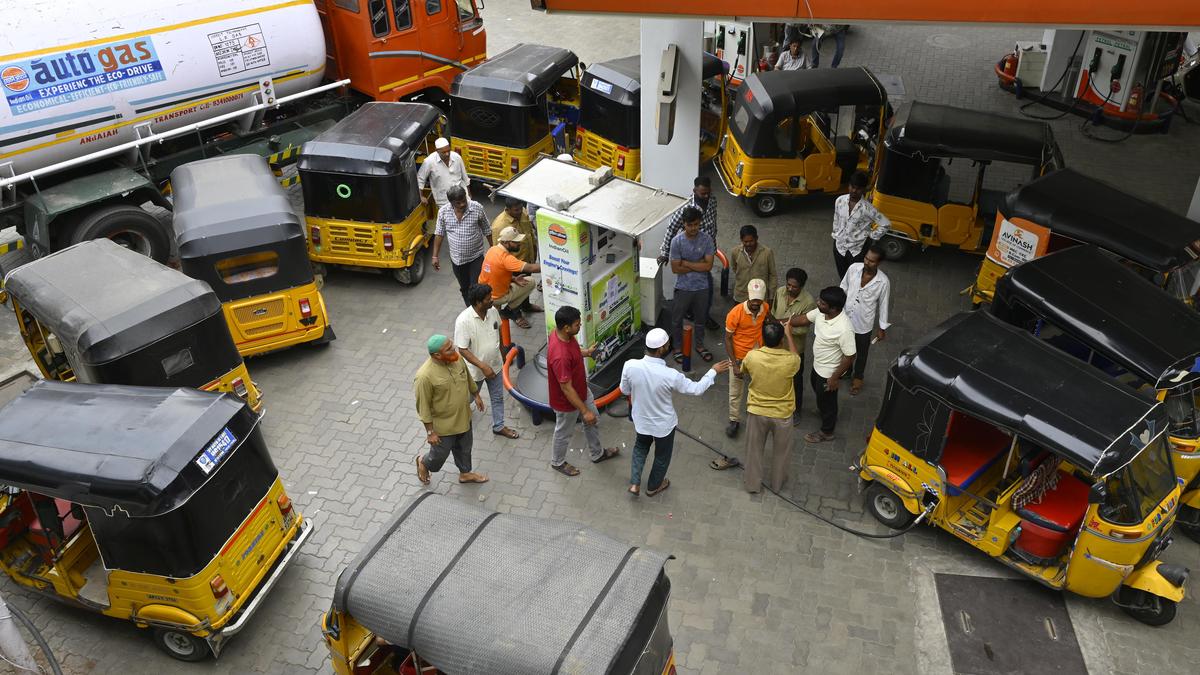
100% ethanol blending target aims to replace fossil fuels entirely with ethanol in petrol
GK and monthly revision
What is 100% ethanol blending? | Explained
The article explains 100% ethanol blending as a policy goal to reduce fossil fuel dependence and emissions. It highlights that achieving this target sustainably requires scaling up second-generation (2G) ethanol from agricultural residues, avoiding over-reliance on sugarcane-based first-generation ethanol. This is critical for India's energy security, net-zero commitments, and Sustainable Aviation Fuel (SAF) production. For exams, it links to National Biofuel Policy, Ethanol Blended Petrol Programme, and climate action under UNFCCC.
Revision structure
Monthly events and exam calendar context
Static GK and one-liner notes
Quiz and mock-test revision path
Key points
Exam-ready takeaways
First-generation ethanol from sugarcane molasses cannot sustainably meet 100% blending without stressing water and land resources
Second-generation (2G) ethanol from agricultural residues (rice straw, wheat straw, bagasse) is essential for scalable, sustainable supply
Sustainable Aviation Fuel (SAF) production requires 2G ethanol to meet aviation decarbonisation goals under CORSIA
National Biofuel Policy 2018 targets 20% ethanol blending by 2025-26 (advanced from 2030); 100% remains long-term aspirational goal
Detailed analysis
Full exam-oriented breakdown
India's pursuit of 100% ethanol blending represents one of the most ambitious energy transition initiatives in the developing world, rooted in the convergence of energy security imperatives, climate commitments, and agricultural policy. The journey began with the Ethanol Blended Petrol (EBP) Programme launched in 2003, initially targeting 5% blending, which was progressively scaled up under the National Policy on Biofuels, 2018. This policy, notified by the Ministry of Petroleum and Natural Gas, set a target of 20% ethanol blending in petrol by 2025-26 (advanced from the original 2030 deadline), with 100% blending envisioned as a long-term aspirational goal. The constitutional basis for such central intervention lies in Entry 53 of the Union List (regulation and development of oilfields and mineral oil resources) and Entry 33 of the Concurrent List (trade and commerce in, and production, supply and distribution of, products of industries where Parliament declares control expedient in public interest), enabling the Centre to legislate on fuel standards and blending mandates. The stakeholder ecosystem is complex and multi-layered. At the apex, the Prime Minister's Office and NITI Aayog provide strategic direction, while the Ministry of Petroleum and Natural Gas (MoPNG) implements the EBP programme through Oil Marketing Companies (OMCs) like Indian Oil, BPCL, and HPCL. The Ministry of Agriculture and Farmers' Welfare and the Department of Food and Public Distribution manage sugarcane pricing (Fair and Remunerative Price - FRP) and procurement, directly impacting feedstock availability. State governments play a crucial role in land use, water allocation, and agricultural extension services. The sugar industry, represented by associations like ISMA and NFCSF, is the primary supplier of first-generation (1G) ethanol from molasses. Meanwhile, technology providers, public sector undertakings like Indian Oil's R&D centre, and private firms such as Praj Industries are driving second-generation (2G) ethanol commercialisation. International stakeholders include ICAO (for CORSIA compliance), UNFCCC (for NDC reporting), and global SAF buyers. The significance for India is profound across dimensions. Economically, achieving 20% blending alone saves approximately ₹40,000-50,000 crore annually in crude oil imports (at $80-90/barrel), improving the Current Account Deficit and rupee stability. It provides farmers with an alternative revenue stream — the government claims ethanol procurement has transferred over ₹80,000 crore to farmers and distilleries since 2014. Politically, it addresses rural distress in sugarcane belts (UP, Maharashtra, Karnataka) and aligns with the 'Atmanirbhar Bharat' and 'Make in India' narratives. Socially, it promises reduced vehicular emissions (CO, HC, PM) improving urban air quality. However, the 1G pathway faces hard biophysical limits: sugarcane is water-intensive (1,500-2,500 litres/kg), and diverting more land to cane threatens food security and groundwater — already critical in Maharashtra and UP. The 2018 policy explicitly prioritises 2G ethanol from agricultural residues (rice straw, wheat straw, corn cobs, bagasse) and municipal solid waste to circumvent these constraints. The 100% blending target is inextricably linked to Sustainable Aviation Fuel (SAF) production. Aviation contributes 2-3% of global CO2 emissions, and under ICAO's Carbon Offsetting and Reduction Scheme for International Aviation (CORSIA), Indian carriers must offset emissions growth post-2020. SAF, produced via Alcohol-to-Jet (AtJ) pathway from 2G ethanol, is the only near-term decarbonisation option for long-haul flights. India's first SAF flight (IndiGo, 2023) used 2G ethanol from Praj's demo plant. Scaling this requires massive investment — the 2018 policy targets 1,000 crore litres of ethanol annually by 2025-26, needing ~₹1.5 lakh crore in distillery capacity. The Pradhan Mantri JI-VAN Yojana (2019) provides viability gap funding for 2G plants, with 12 commercial projects sanctioned as of 2024. Constitutionally, this intersects with Article 48A (environmental protection), Article 21 (right to clean air), and Article 39(b) (distribution of material resources for common good). The Energy Conservation (Amendment) Act, 2022 empowers the Centre to mandate non-fossil fuel use, providing legal teeth to blending mandates. Internationally, it strengthens India's climate leadership — at COP26, PM Modi announced net-zero by 2070 and 50% non-fossil electricity by 2030; ethanol blending is a transport-sector pillar of this pledge. Future implications hinge on three variables: 2G technology commercialisation (currently at TRL 8-9, with ~300 million litres/year capacity vs 10+ billion needed), feedstock supply chain logistics (collecting 100+ million tonnes of crop residue annually), and global SAF demand creating export markets. The 2024-25 Budget's announcement of a 'Biofuels Mission' signals policy continuity. For aspirants, this topic epitomises the governance challenge of balancing competing national objectives — energy, agriculture, environment, equity — within constitutional federalism and global commitments.
How to study
Turn news into exam marks
Revise monthly events by exam family instead of reading random updates.
Pair one-liners with mock tests so mistakes become the next revision list.
Keep state job pages, calendar pages and GK packs connected in one path.