
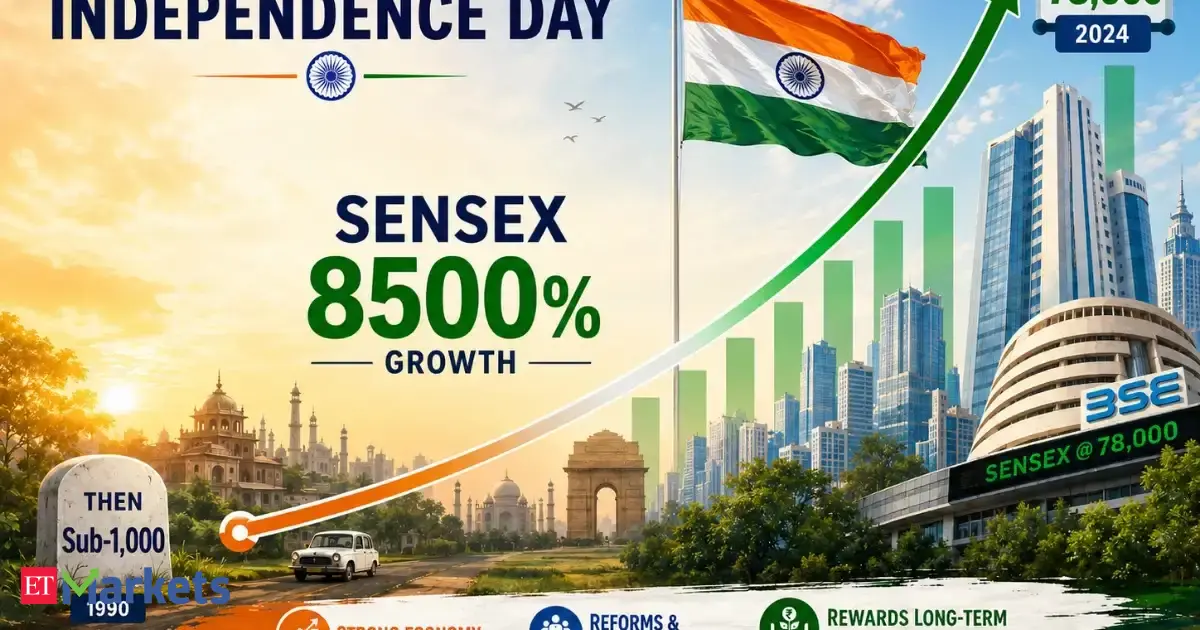
Sensex delivered ~8,500% absolute return since 1991 economic liberalisation reforms initiated under PM P.V. Narasimha Rao and Finance Minister Manmohan Singh
GK and monthly revision
Independence Day 2026: How Sensex skyrocketed 8,500% in less than 35 years since 1991 liberalisation reforms
Since the 1991 economic liberalisation reforms, India's benchmark Sensex has surged approximately 8,500%, delivering a compounded annual growth rate of around 14% over less than 35 years. This remarkable long-term wealth creation occurred despite major setbacks including the Harshad Mehta scam (1992), Ketan Parekh scam (2001), 2008 global financial crisis, COVID-19 pandemic, and geopolitical tensions. The trajectory underscores the transformative impact of structural reforms — delicensing, FDI liberalisation, tax rationalisation, and capital market modernisation — on investor confidence and corporate earnings growth. For competitive exams, this serves as a key case study linking 1991 reforms to tangible financial market outcomes and India's emergence as a resilient emerging market.
Revision structure
Monthly events and exam calendar context
Static GK and one-liner notes
Quiz and mock-test revision path
Key points
Exam-ready takeaways
Compounded Annual Growth Rate (CAGR) of approximately 14% over less than 35 years (1991–2026)
Key reforms: Industrial delicensing (except 18 sectors), FDI liberalisation, MRTP Act dilution, SEBI establishment (1992), and tax reforms
Major crises weathered: Harshad Mehta scam (1992), Ketan Parekh scam (2001), 2008 global financial crisis, COVID-19 crash (2020), and Russia-Ukraine war (2022)
Benchmark index resilience cited as evidence of structural reform success and long-term institutional strengthening of Indian capital markets
Detailed analysis
Full exam-oriented breakdown
The 8,500% surge in the BSE Sensex since the 1991 economic liberalisation reforms stands as one of the most compelling empirical validations of structural economic transformation in modern Indian history. To understand this journey, we must first revisit the precipice on which India stood in mid-1991: a balance of payments crisis so severe that the Chandra Shekhar government had to airlift 47 tonnes of gold to the Bank of England and the Union Bank of Switzerland to secure emergency loans. The IMF bailout came with stringent conditionalities, but it was the political courage of Prime Minister P.V. Narasimha Rao and the technocratic brilliance of Finance Minister Dr. Manmohan Singh that converted crisis into opportunity. On July 24, 1991, Dr. Singh presented a budget that dismantled the Licence Raj — a labyrinth of controls rooted in the Industries (Development and Regulation) Act, 1951, and the Monopolies and Restrictive Trade Practices (MRTP) Act, 1969 — which had stifled private enterprise for four decades. The reform package was multi-dimensional: industrial delicensing (retaining licensing only for 18 strategic sectors), automatic approval for Foreign Direct Investment (FDI) up to 51% in 34 high-priority industries, abolition of the MRTP threshold for asset concentration, and the establishment of the Securities and Exchange Board of India (SEBI) as a statutory regulator in 1992 under the SEBI Act, 1992. These measures were not merely administrative; they represented a philosophical shift from state-directed allocation to market-determined resource allocation, aligning with the Directive Principles of State Policy under Article 39(b) and (c) of the Constitution, which call for preventing concentration of wealth and ensuring material resources serve the common good — now pursued through competitive markets rather than bureaucratic fiat. The Sensex, which stood at around 1,000 in July 1991, crossing 80,000 by 2026, reflects not just nominal growth but deep structural strengthening. The 14% CAGR outperforms most global benchmarks and underscores the power of compounding in a reform-driven economy. Yet the path was far from linear. The Harshad Mehta scam (1992) exposed gaps in banking-stock market linkages, leading to the creation of the National Stock Exchange (NSE) in 1994 with screen-based trading and settlement guarantees. The Ketan Parekh scam (2001) prompted tighter margin rules and the introduction of derivative trading in 2000. The 2008 global financial crisis saw FII outflows, but India’s domestic institutional investors — mutual funds, insurance companies (post-IRDA Act, 1999), and later EPFO equity participation — provided stability. The COVID-19 crash of March 2020, when Sensex fell 38% in a month, was followed by the fastest recovery in history, fueled by fiscal stimulus (Atmanirbhar Bharat), monetary easing, and a surge in retail participation via demat accounts (over 120 million by 2024). This resilience is rooted in institutional deepening: the Insolvency and Bankruptcy Code (2016), GST (2017, under 101st Constitutional Amendment), corporate tax cuts (2019), and the Production Linked Incentive (PLI) schemes have enhanced ease of doing business and earnings visibility. Moreover, India’s demographic dividend — with a median age of 28 — and rising financial savings channelling into equities (from 2% of household financial assets in 1991 to over 15% in 2024) provide a structural tailwind. For India, this is not just a stock market story. It signifies the maturation of capital markets as engines of capital formation, job creation, and innovation. It validates the reform consensus across political lines — from Rao-Singh to Vajpayee-Jaitley to Modi-Sitharaman — demonstrating policy continuity. Globally, it positions India as a credible alternative in the "China+1" strategy, attracting sovereign wealth funds and pension capital. Looking ahead, the next 35 years will test whether India can sustain 14% CAGR. Challenges include climate transition financing, ageing population post-2050, geopolitical fragmentation, and the need for deeper bond markets. The next wave of reforms — land, labour (partially addressed via four labour codes), judicial efficiency, and factor market liberalisation — will determine if the Sensex story remains a historical anomaly or becomes a perpetual engine of inclusive prosperity. As Dr. Singh said in 1991: "No power on earth can stop an idea whose time has come." The idea was economic freedom; the Sensex is its scorecard.
How to study
Turn news into exam marks
Revise monthly events by exam family instead of reading random updates.
Pair one-liners with mock tests so mistakes become the next revision list.
Keep state job pages, calendar pages and GK packs connected in one path.