
Balance of Payments (BoP) deficit: $8.1 billion in Q1 FY27 (April–June 2026)
GK and monthly revision
India’s balance of payments slips into deficit in Q1FY27
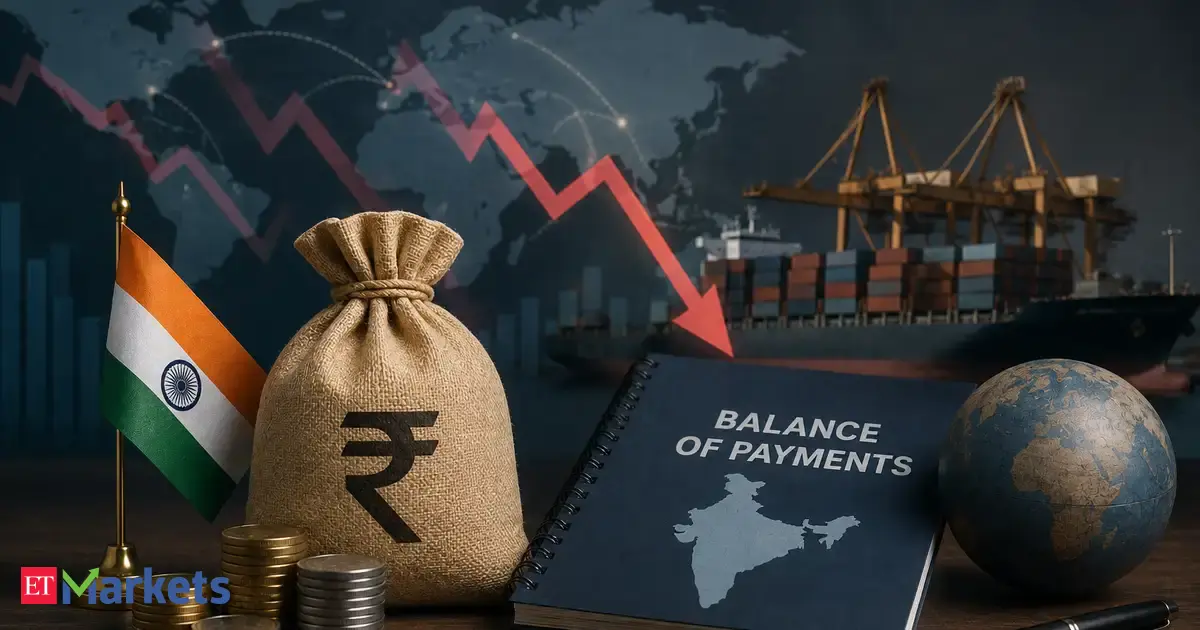
India's Balance of Payments (BoP) slipped into a deficit of $8.1 billion in Q1 FY27 (April–June 2026), driven primarily by capital account outflows. The Current Account Deficit (CAD) widened to $3.1 billion, mainly due to higher fuel import costs widening the merchandise trade deficit. Despite robust services exports and remittances, they were insufficient to offset the gap. This development is crucial for exams testing macroeconomic indicators, external sector stability, and RBI's policy response.
Revision structure
Monthly events and exam calendar context
Static GK and one-liner notes
Quiz and mock-test revision path
Key points
Exam-ready takeaways
Current Account Deficit (CAD) widened to $3.1 billion in Q1 FY27
Primary driver: Capital account dollar outflows
Merchandise trade deficit widened due to rising fuel import expenses
Services exports and remittances remained strong but insufficient to offset deficit
Detailed analysis
Full exam-oriented breakdown
India's Balance of Payments (BoP) slipping into a deficit of $8.1 billion in Q1 FY27 (April–June 2026) marks a significant shift in the country's external sector dynamics, warranting careful analysis by students of macroeconomics and public policy. Historically, India has often recorded a BoP surplus in recent years, driven by robust capital inflows — particularly Foreign Portfolio Investment (FPI) and Foreign Direct Investment (FDI) — even when the Current Account Deficit (CAD) persisted. The reversal in Q1 FY27 signals a structural vulnerability: heavy reliance on volatile capital flows to finance the current account gap. The CAD itself widened to $3.1 billion, primarily due to a surge in fuel import bills. As a net importer of crude oil (meeting over 85% of its requirement through imports), India remains acutely sensitive to global energy price fluctuations. The merchandise trade deficit widened accordingly, despite resilient services exports — led by IT, business process management, and professional services — and record remittances exceeding $110 billion annually in recent years, as per RBI data. Key stakeholders include the Reserve Bank of India (RBI), which manages the BoP under the RBI Act, 1934, and the Foreign Exchange Management Act (FEMA), 1999; the Ministry of Finance, which formulates fiscal and trade policy; and global investors whose risk appetite drives capital flows. The RBI's intervention in the forex market to curb rupee volatility — using its $600+ billion reserves — has implications for domestic liquidity and monetary policy transmission. Constitutionally, while no single Article directly governs BoP, Article 265 (taxation only by law), Article 266 (Consolidated Fund of India), and Article 293 (state borrowing limits) frame the fiscal architecture influencing external stability. Moreover, India's commitments under WTO agreements and bilateral trade pacts shape merchandise trade dynamics. The significance extends beyond numbers: a sustained BoP deficit could pressure the rupee, import inflation, and force RBI into tighter monetary policy, affecting growth. It may also constrain fiscal space if capital flight triggers sovereign rating concerns. Politically, it fuels debates on self-reliance (Atmanirbhar Bharat), energy security, and export competitiveness. Socially, a weaker rupee raises costs for students abroad, medical tourists, and households dependent on imported goods. Looking ahead, much depends on global interest rate trajectories — especially the US Federal Reserve's policy — crude oil prices, and India's ability to diversify exports and attract stable FDI. The government's focus on PLI schemes, green hydrogen, and semiconductor manufacturing aims to reduce import dependence. For aspirants, this episode underscores the interplay between domestic policy choices and global headwinds — a recurring theme in UPSC GS-III, RBI Grade B, and banking exams. Monitoring the RBI's half-yearly BoP reports and Monetary Policy Reports will be essential for tracking resolution of this imbalance.
How to study
Turn news into exam marks
Revise monthly events by exam family instead of reading random updates.
Pair one-liners with mock tests so mistakes become the next revision list.
Keep state job pages, calendar pages and GK packs connected in one path.