
Four private banks: Kotak Mahindra Bank, YES Bank, IDFC First Bank, Federal Bank
GK and monthly revision
Four Indian private banks eye dollar debt before RBI swap window deadline, bankers say
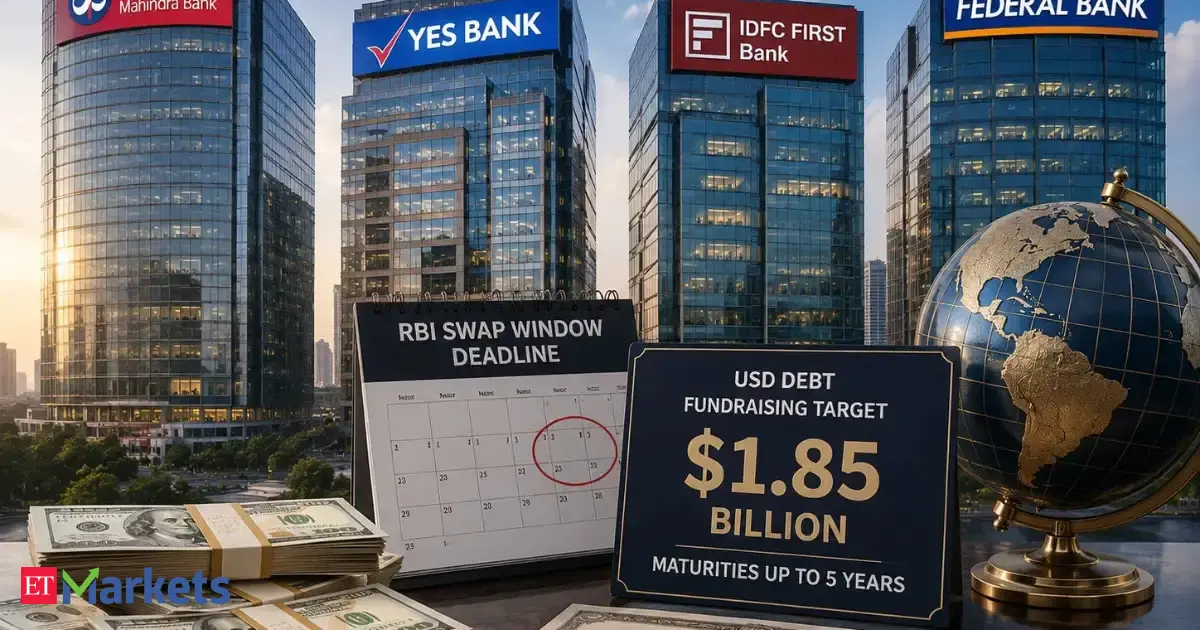
Four Indian private banks — Kotak Mahindra Bank, YES Bank, IDFC First Bank, and Federal Bank — are accelerating dollar bond issuances worth $1.85 billion before the RBI's swap window deadline of August 31. This follows successful $1 billion+ raises by ICICI Bank and Axis Bank. The move allows banks to access cheaper foreign currency funding via RBI's dollar-rupee swap facility, enhancing liquidity and reducing borrowing costs. For competitive exams, this highlights RBI's liquidity management tools, private sector banking fundraising trends, and external commercial borrowing mechanisms.
Revision structure
Monthly events and exam calendar context
Static GK and one-liner notes
Quiz and mock-test revision path
Key points
Exam-ready takeaways
Total fundraising target: $1.85 billion via dollar-denominated bonds
Deadline: August 31 for RBI's dollar-rupee swap window facility
Precedent: ICICI Bank and Axis Bank already raised over $1 billion each
Mechanism: RBI swap facility enables cheaper foreign currency funding for banks
Detailed analysis
Full exam-oriented breakdown
The recent surge in dollar-denominated bond issuances by Indian private sector banks marks a significant development in India's banking sector's integration with global capital markets. Four major private lenders — Kotak Mahindra Bank, YES Bank, IDFC First Bank, and Federal Bank — are racing to raise approximately $1.85 billion before the August 31 deadline for the Reserve Bank of India's (RBI) dollar-rupee swap window facility. This facility, introduced as part of RBI's liquidity management toolkit, allows banks to swap rupees for dollars at a predetermined rate, effectively hedging currency risk and reducing the cost of foreign currency borrowing. The move follows successful fundraising of over $1 billion each by ICICI Bank and Axis Bank earlier, demonstrating strong investor appetite for Indian bank paper in international markets. To understand the context, we must look at the evolution of External Commercial Borrowings (ECB) framework in India. Post-1991 economic reforms, India gradually liberalized ECB norms under the Foreign Exchange Management Act (FEMA), 1999, replacing the earlier FERA regime. The RBI, under Section 45 of the RBI Act, 1934, and empowered by the Banking Regulation Act, 1949, regulates the borrowing and lending activities of banks, including their access to overseas markets. The dollar-rupee swap window is a relatively recent innovation, first used extensively during the COVID-19 pandemic in 2020 to inject dollar liquidity into the banking system. It operates under RBI's broader mandate to maintain monetary stability and manage the external sector, as outlined in the Preamble to the RBI Act. The key stakeholders include the RBI as the central banking authority and regulator, the four private banks seeking to diversify funding sources beyond domestic deposits, foreign institutional investors (FIIs) and global bond funds subscribing to these issuances, and the Government of India which benefits from enhanced financial sector stability. For the banks, accessing dollar funds via the swap window reduces hedging costs — typically 4-5% annually — making foreign borrowing competitive with domestic rupee funding. This is particularly crucial as credit growth in India has been running at 15-16% year-on-year, outpacing deposit growth, creating a structural funding gap. The significance for India's economy is multi-fold. First, it reflects the maturation of Indian private banks as credible global borrowers — a far cry from the 1990s when sovereign ceilings limited corporate access. Second, it eases pressure on domestic liquidity, allowing RBI to manage systemic liquidity without resorting to open market operations (OMOs) that affect domestic yields. Third, successful issuances improve India's perception in global capital markets, potentially lowering the sovereign risk premium. However, risks remain: over-reliance on foreign currency funding exposes banks to rollover risk and sudden stops in capital flows, as witnessed during the 2013 "taper tantrum." The RBI's prudential norms on ECB, including minimum average maturity requirements and end-use restrictions, aim to mitigate these vulnerabilities. Constitutionally, while banking falls under the Union List (Entry 45, Seventh Schedule), the RBI's operational independence in monetary policy was strengthened by the 2016 amendment to the RBI Act establishing the Monetary Policy Committee (MPC). The swap window operates within this framework, balancing price stability with financial stability objectives. Internationally, these issuances align with India's gradual capital account liberalization — a topic of debate in IMF Article IV consultations. Looking ahead, if the current issuance window closes successfully, we may see more banks, including public sector ones, exploring similar routes. The RBI might extend or modify the swap facility depending on rupee-dollar dynamics and global interest rate trajectories, especially with the US Federal Reserve's rate cut cycle expectations. For aspirants, this episode encapsulates the interplay between monetary policy tools, banking regulation, external sector management, and financial market development — core themes in Indian economic governance.
How to study
Turn news into exam marks
Revise monthly events by exam family instead of reading random updates.
Pair one-liners with mock tests so mistakes become the next revision list.
Keep state job pages, calendar pages and GK packs connected in one path.