
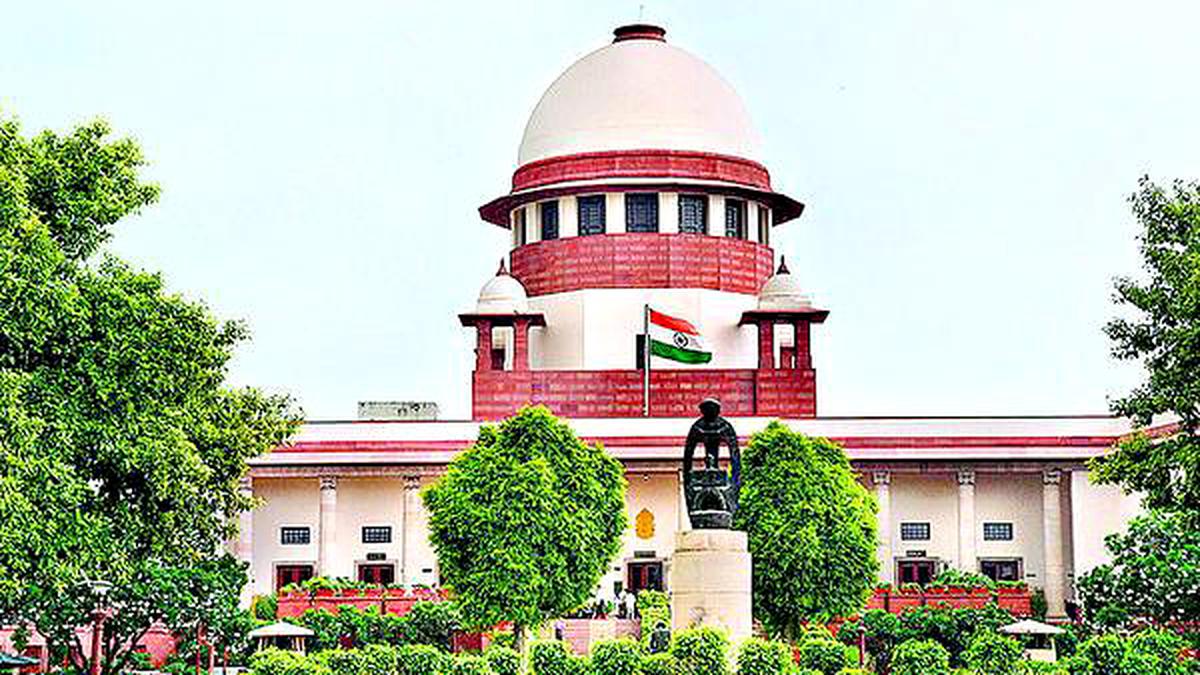
Supreme Court dismissed PIL challenging death by hanging as sole execution method in India
GK and monthly revision
Supreme Court dismisses PIL petition that challenged death by hanging | Explained
The Supreme Court dismissed a PIL challenging death by hanging as the sole method of execution, ruling it conforms to constitutional requirements of a just, fair, and reasonable procedure under Article 21. The petition sought alternative methods like lethal injection, arguing hanging is barbaric. The Court upheld the existing procedure, citing legislative competence and precedent. This ruling is significant for polity and constitutional law sections in competitive exams.
Revision structure
Monthly events and exam calendar context
Static GK and one-liner notes
Quiz and mock-test revision path
Key points
Exam-ready takeaways
Petition argued hanging violates Article 21 (right to life) and sought alternatives like lethal injection
Court ruled hanging conforms to 'procedure established by law' that is just, fair and reasonable
Decision based on legislative competence of Parliament and existing judicial precedent on capital punishment
Ruling reinforces constitutionality of Section 354(5) CrPC which prescribes hanging as mode of execution
Detailed analysis
Full exam-oriented breakdown
The Supreme Court's dismissal of the PIL challenging death by hanging as the sole method of execution in India represents a significant judicial affirmation of the existing capital punishment framework under Indian law. This case, decided in 2024, centered on a fundamental constitutional question: whether prescribing a single method of execution — hanging by the neck until death — conforms to the requirement under Article 21 of the Constitution that any procedure depriving a person of life must be 'just, fair and reasonable.' The petitioner had argued that hanging is barbaric, inhumane, and degrading, violating the dignity inherent in the right to life, and sought the introduction of alternative methods such as lethal injection, which are perceived as more humane and are used in several other jurisdictions including the United States. The historical context of this issue traces back to the colonial-era Indian Penal Code (IPC) of 1860 and the Code of Criminal Procedure (CrPC) of 1973. Section 354(5) of the CrPC explicitly mandates: 'When any person is sentenced to death, the sentence shall direct that he be hanged by the neck till he is dead.' This provision has remained unchanged since its enactment, reflecting the legislative intent of Parliament. Over the decades, the Supreme Court has repeatedly upheld the constitutionality of capital punishment itself, most notably in *Bachan Singh v. State of Punjab* (1980), where it laid down the 'rarest of rare' doctrine, restricting the death penalty to exceptional cases. However, the *method* of execution had not been squarely challenged on constitutional grounds until this PIL. The key stakeholders in this matter include the judiciary, particularly the Supreme Court as the final interpreter of the Constitution; the legislature (Parliament), which holds exclusive competence to define crimes and prescribe punishments under Entry 1 of the State List and Entry 93 of the Union List in the Seventh Schedule; the executive, responsible for carrying out executions; and civil society actors, including human rights organizations and legal aid groups, who have long advocated for abolition or reform of the death penalty. The Law Commission of India, in its 262nd Report (2015), recommended abolition of the death penalty except in terror-related cases, but did not specifically address the mode of execution. In its ruling, the Supreme Court emphasized that the choice of execution method falls squarely within the domain of legislative policy. The Court reiterated that as long as the procedure is established by a validly enacted law — here, Section 354(5) CrPC — and is not arbitrary, capricious, or disproportionate, it satisfies the 'procedure established by law' standard under Article 21 as interpreted in *Maneka Gandhi v. Union of India* (1978). The Court declined to substitute its judgment for that of Parliament, noting that hanging has been the prescribed method for over a century and has withstood the test of time and judicial scrutiny. It also observed that the petitioner failed to demonstrate that hanging, as currently administered in India with medical supervision and procedural safeguards, inherently involves unnecessary pain or suffering. The significance of this ruling extends beyond the immediate legal question. It reinforces the principle of separation of powers by affirming that penal policy, including the mode of execution, is primarily a legislative function. It also underscores the Indian judiciary's cautious approach to expanding constitutional rights in the realm of capital punishment, especially when compared to more interventionist courts in other democracies. From a governance perspective, the decision maintains continuity in the criminal justice system and avoids the administrative and ethical complexities of introducing new execution protocols, such as those associated with lethal injection — including drug sourcing, medical ethics, and botched executions. Looking ahead, this ruling is likely to settle the legal debate on the mode of execution for the foreseeable future, unless Parliament itself amends the CrPC. However, the broader discourse on the death penalty in India — its deterrent value, arbitrariness in application, socio-economic bias, and compatibility with evolving standards of human dignity — remains very much alive. Aspirants should note that while the *method* has been upheld, the *constitutionality of capital punishment itself* continues to be a live issue in constitutional law, with potential for future challenges under Articles 14, 19, and 21.
How to study
Turn news into exam marks
Revise monthly events by exam family instead of reading random updates.
Pair one-liners with mock tests so mistakes become the next revision list.
Keep state job pages, calendar pages and GK packs connected in one path.