
Commerce Minister Piyush Goyal to lead 200-member business delegation to Japan from August 24 to 27, 2024
GK and monthly revision
Commerce Minister Piyush Goyal leads 200-member business delegation to Japan, to push trade, investment
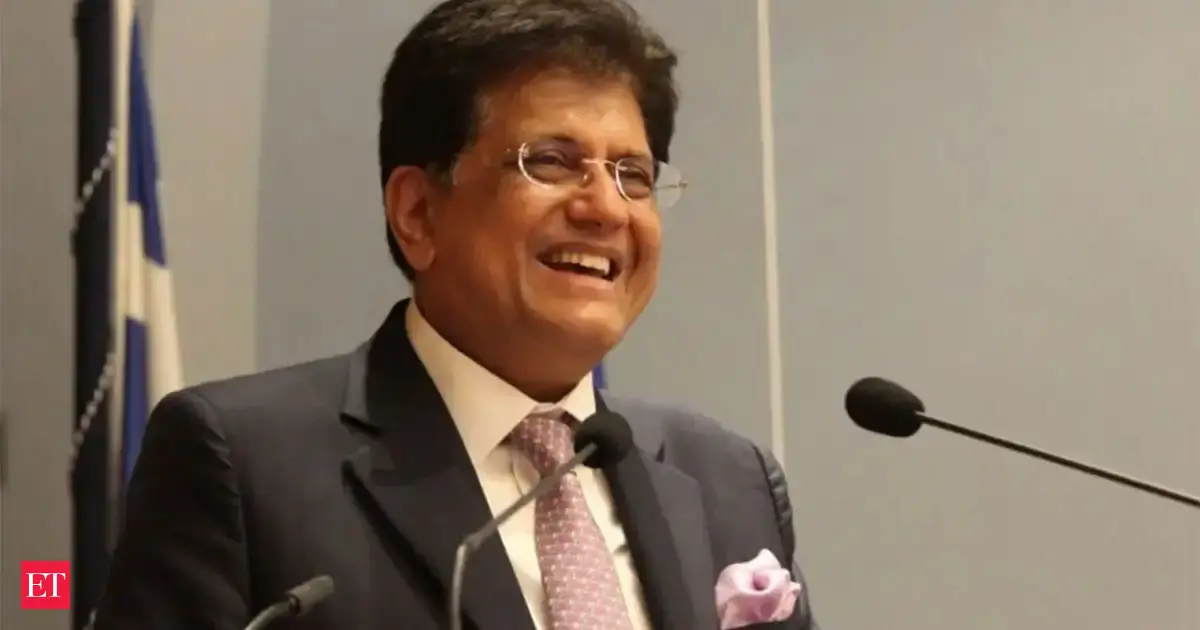
Commerce and Industry Minister Piyush Goyal will lead a 200-member business delegation to Japan from August 24-27 to enhance bilateral trade and investment. The visit focuses on high-tech manufacturing, semiconductors, artificial intelligence, clean energy, and other emerging sectors. This diplomatic and economic outreach aims to strengthen India-Japan strategic partnership and attract Japanese investment into India's technology and green energy ecosystems. The delegation includes industry leaders from key sectors, signaling India's push for deeper supply chain integration with Japan.
Revision structure
Monthly events and exam calendar context
Static GK and one-liner notes
Quiz and mock-test revision path
Key points
Exam-ready takeaways
Focus sectors: high-tech manufacturing, semiconductors, artificial intelligence (AI), clean energy, and emerging technologies
Objective: Boost bilateral trade and investment, strengthen India-Japan strategic economic partnership
Delegation comprises industry leaders from key Indian sectors to explore supply chain integration and joint ventures
Visit aligns with India's 'Make in India' and 'Atmanirbhar Bharat' initiatives in critical technology domains
Detailed analysis
Full exam-oriented breakdown
Commerce and Industry Minister Piyush Goyal's visit to Japan from August 24-27, 2024, leading a 200-member business delegation, marks a significant milestone in India-Japan economic diplomacy. This high-profile engagement is not an isolated event but the culmination of decades of evolving strategic partnership that began with the establishment of diplomatic relations in 1952 and gained momentum with the 'Global Partnership' declaration in 2000, elevated to 'Special Strategic and Global Partnership' in 2014 under Prime Minister Narendra Modi and Shinzo Abe. The historical context is crucial: Japan has been a key development partner for India since the 1950s, providing Official Development Assistance (ODA) for landmark projects like the Delhi Metro, Dedicated Freight Corridors, and the Mumbai-Ahmedabad High-Speed Rail (bullet train) project. The 2011 Comprehensive Economic Partnership Agreement (CEPA) further institutionalized trade ties, making Japan one of India's largest foreign investors with cumulative FDI equity inflows exceeding $40 billion (2000-2023). However, bilateral trade remains modest at around $20-22 billion annually, far below potential, which this visit aims to address. Key stakeholders include the Ministry of Commerce and Industry, Department for Promotion of Industry and Internal Trade (DPIIT), Japan External Trade Organization (JETRO), and industry bodies like CII, FICCI, and Keidanren (Japan Business Federation). The 200-member delegation comprises leaders from semiconductors, electronics, automotive, green hydrogen, robotics, and AI sectors — reflecting India's focus on critical and emerging technologies under the 'Make in India' and 'Atmanirbhar Bharat' initiatives. Notably, India's Production Linked Incentive (PLI) schemes for semiconductors (₹76,000 crore), electronics, and advanced chemistry cells create a policy framework attractive to Japanese firms seeking supply chain diversification under the 'China Plus One' strategy. Constitutionally, this engagement falls under Article 246 (Union List) entries on foreign trade, international agreements, and industries declared by Parliament to be expedient in public interest. The Foreign Trade (Development and Regulation) Act, 1992, and the SEZ Act, 2005, provide the legal backbone for export promotion and investment facilitation. Additionally, Article 253 empowers Parliament to implement international treaties, relevant as India-Japan agreements on civil nuclear cooperation (2016) and cybersecurity (2020) deepen regulatory alignment. The significance for India is multidimensional. Economically, Japanese investment in semiconductors and high-tech manufacturing addresses critical gaps in India's electronics value chain, where import dependence exceeds 80%. The India Semiconductor Mission (ISM), launched in 2021, targets establishing a resilient semiconductor ecosystem — Japanese firms like Renesas, Tokyo Electron, and Shin-Etsu are natural partners. In clean energy, Japan's leadership in hydrogen technology (Basic Hydrogen Strategy, 2017) complements India's National Green Hydrogen Mission (₹19,744 crore, 2023), enabling joint ventures in electrolyzer manufacturing and green ammonia production. Politically, the visit reinforces the Quad (India, Japan, US, Australia) framework's economic pillar, particularly the Quad Critical and Emerging Technology Working Group and the Supply Chain Resilience Initiative (SCRI) with Australia. It also counters China's Belt and Road Influence in the Indo-Pacific by offering transparent, high-standard infrastructure and technology partnerships. Socially, technology transfer and skill development collaborations can enhance India's demographic dividend, with Japan's Technical Intern Training Program (TITP) and Specified Skilled Worker (SSW) visa categories facilitating labor mobility. Future implications are profound. Successful outcomes could see Japanese firms anchoring semiconductor fabrication plants (fabs) in India, co-developing AI applications for agriculture and healthcare, and investing in rare earth processing — reducing import dependence on China. The proposed India-Japan Digital Partnership and Cybersecurity Dialogue will shape data governance norms. Moreover, this visit sets the stage for the Annual Summit and the 2+2 Ministerial Dialogue, potentially advancing negotiations on a broader Economic Partnership Agreement covering services, digital trade, and investment protection. For aspirants, this case study exemplifies how economic diplomacy, domestic policy (PLI, ISM), and geopolitical strategy converge in contemporary Indian foreign policy — a recurring theme in UPSC GS Paper II and III.
How to study
Turn news into exam marks
Revise monthly events by exam family instead of reading random updates.
Pair one-liners with mock tests so mistakes become the next revision list.
Keep state job pages, calendar pages and GK packs connected in one path.