
Minister: Piyush Goyal, Commerce & Industry Minister
GK and monthly revision
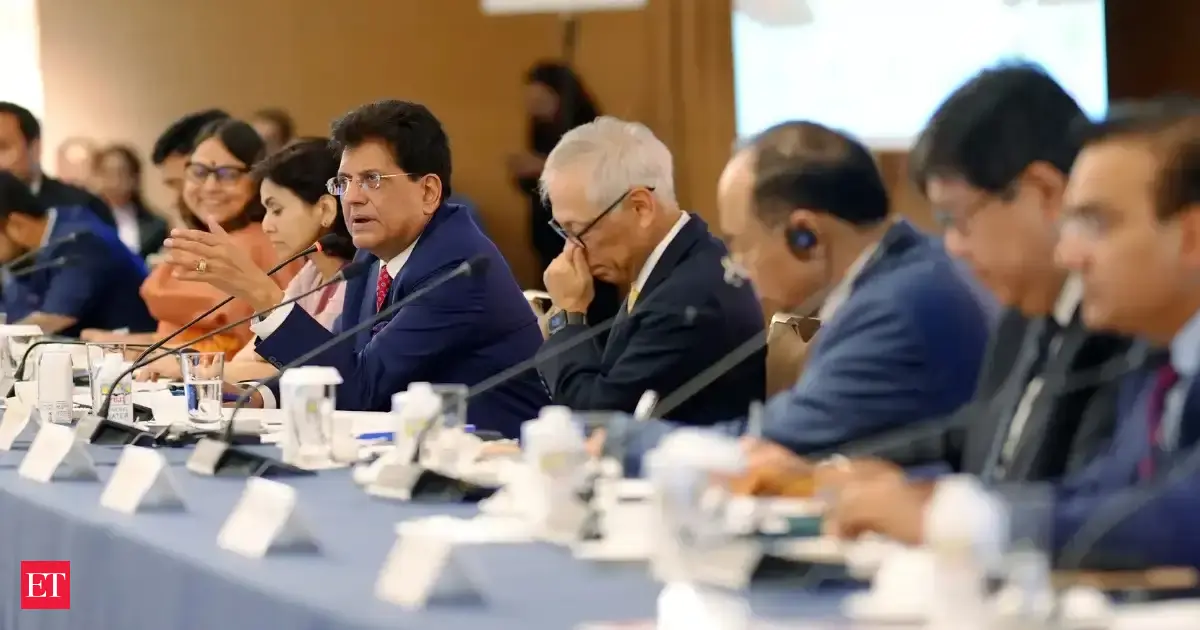
Commerce minister Piyush Goyal asks Japanese companies to deepen localisation in India
Commerce Minister Piyush Goyal urged Japanese auto and capital goods firms to deepen localisation, establish R&D centres and Global Capability Centres (GCCs), and expand manufacturing in India. He positioned India as a strategic export hub for global markets. This aligns with the government's 'Make in India' and PLI scheme objectives to boost domestic value addition and reduce import dependence. The push for GCCs highlights India's growing role in high-value services and innovation ecosystems.
Revision structure
Monthly events and exam calendar context
Static GK and one-liner notes
Quiz and mock-test revision path
Key points
Exam-ready takeaways
Target sectors: Auto and capital goods
Key asks: Increase localisation, set up R&D centres and Global Capability Centres (GCCs), build new manufacturing capacity
Strategic goal: Use India as a base for global exports
Policy context: Aligns with Make in India and Production Linked Incentive (PLI) schemes
Detailed analysis
Full exam-oriented breakdown
In a significant diplomatic and economic outreach, Commerce and Industry Minister Piyush Goyal has called upon Japanese auto and capital goods companies to deepen their localisation efforts in India, establish Research & Development (R&D) centres and Global Capability Centres (GCCs), and expand manufacturing capacity to leverage India as a global export hub. This appeal, made during high-level bilateral engagements, is not merely a routine investment pitch but a strategic manoeuvre rooted in India's evolving economic diplomacy and industrial policy framework. To understand its depth, we must trace the historical trajectory of India-Japan relations, which transformed from a cautious post-Pokhran engagement in 1998 to a 'Special Strategic and Global Partnership' today. The 2014 visit of Prime Minister Narendra Modi to Japan and the reciprocal visit by Shinzo Abe in 2015 laid the foundation for a partnership encompassing civil nuclear cooperation (2016 Agreement), bullet train technology (Mumbai-Ahmedabad High Speed Rail), and the Asia-Africa Growth Corridor. The key stakeholders here are multifaceted: the Government of India, represented by the Ministry of Commerce & Industry and NITI Aayog; Japanese conglomerates like Toyota, Suzuki, Honda, Hitachi, and Mitsubishi; state governments competing for FDI (Foreign Direct Investment) under competitive federalism; and the Indian workforce awaiting high-skilled jobs. The 'asks' — localisation, R&D, GCCs — align directly with the 'Make in India' initiative (launched September 25, 2014) and the Production Linked Incentive (PLI) schemes notified from 2020 onwards across 14 sectors, including automobiles and auto components (PLI Scheme for Automobile and Auto Components, approved September 2021, with a budgetary outlay of Rs 25,938 crore). Localisation increases domestic value addition, reduces import dependence (critical for Current Account Deficit management), and fosters a vendor ecosystem. GCCs represent a paradigm shift from India being a 'back-office' to a 'brain-office' — hosting high-end functions like AI/ML research, product design, and financial modelling. As of 2023, India hosts over 1,580 GCCs employing 1.66 million people, contributing $46 billion in export revenue. Constitutionally, this drive draws from Article 246 (Union List entries on industries, trade, and commerce), Article 298 (executive power of Union to carry on trade), and the Seventh Schedule. The Foreign Exchange Management Act (FEMA), 1999, and the Consolidated FDI Policy (updated annually by DPIIT) provide the regulatory scaffolding. The push for GCCs also resonates with the National Education Policy (NEP) 2020's emphasis on multidisciplinary research and industry-academia linkage. The significance for India is profound. Economically, it addresses the 'missing middle' in manufacturing, boosts Gross Fixed Capital Formation (GFCF), and targets the $1 trillion merchandise export goal (set for 2030). Politically, it strengthens the Quad (India, Japan, US, Australia) supply chain resilience pillar, countering over-reliance on China — a lesson reinforced by the 2020 Galwan clashes and semiconductor shortages. Socially, it promises quality employment, addressing the demographic dividend challenge where 7-8 million youth enter the workforce annually. Broader themes include 'Atmanirbhar Bharat' (self-reliant India), not as autarky but as integration into Global Value Chains (GVCs) on favourable terms. It connects to the 'China Plus One' strategy, where India competes with Vietnam, Mexico, and Indonesia. The India-Japan Comprehensive Economic Partnership Agreement (CEPA), operational since August 2011, provides tariff preferences that Japanese firms can leverage for third-country exports. Future implications are transformative. If Japanese firms deepen R&D in India, we could see co-innovation in green hydrogen, solid-state batteries, and Industry 4.0 — areas where Japan holds patents and India offers scale and software talent. The recently launched India-Japan Fund (2023), anchored by NIIF and JBIC, with a target corpus of $600 million, will catalyse this. However, challenges persist: land acquisition (despite state-level land banks), labour law harmonisation (four new Labour Codes passed 2019-2020 but not fully implemented), and logistics costs (targeted at 9% of GDP via PM Gati Shakti National Master Plan, launched October 2021). For aspirants, this episode is a living case study of economic diplomacy, industrial policy, and federal governance intersecting in real time.
How to study
Turn news into exam marks
Revise monthly events by exam family instead of reading random updates.
Pair one-liners with mock tests so mistakes become the next revision list.
Keep state job pages, calendar pages and GK packs connected in one path.