
Extra-polar ocean average temperature reached 21.1°C, a new global record
GK and monthly revision
Global ocean records hottest day ever
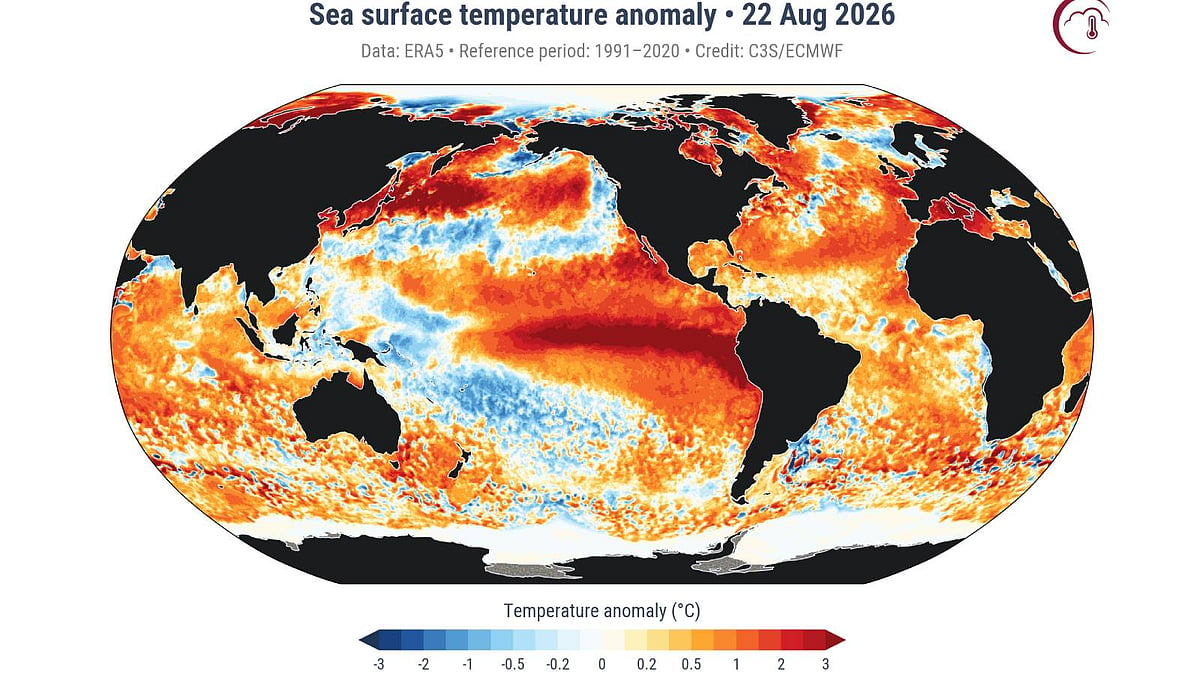
The Copernicus Climate Change Service reported that extra-polar ocean regions recorded an average temperature of 21.1°C, surpassing the previous record set in March 2024. This marks the hottest day ever observed for global oceans outside polar zones, indicating accelerating marine heatwaves driven by climate change. Rising ocean temperatures threaten marine ecosystems, intensify extreme weather events, and contribute to sea-level rise through thermal expansion. For competitive exams, this data is critical for environment, geography, and climate change sections, especially questions on Copernicus reports, ocean warming trends, and IPCC-linked findings.
Revision structure
Monthly events and exam calendar context
Static GK and one-liner notes
Quiz and mock-test revision path
Key points
Exam-ready takeaways
Previous record was set in March 2024, now surpassed as per Copernicus Climate Change Service
Copernicus is the European Union's Earth observation programme monitoring climate indicators
Rising ocean temperatures drive marine heatwaves, coral bleaching, and intensified cyclones
Ocean warming contributes to sea-level rise via thermal expansion and disrupts global weather patterns
Detailed analysis
Full exam-oriented breakdown
The Copernicus Climate Change Service (C3S), the European Union's flagship Earth observation programme, has confirmed that extra-polar ocean regions recorded an average sea surface temperature of 21.1°C, establishing a new global daily record. This milestone, surpassing the previous high set just months earlier in March 2024, is not an isolated anomaly but a stark confirmation of a long-term, accelerating trend driven by anthropogenic climate change. For an aspirant, understanding the 'why' and 'how' behind this headline is crucial. The background context lies in the Earth's energy imbalance: over 90% of the excess heat trapped by greenhouse gases is absorbed by the oceans. Since the pre-industrial era, the ocean has warmed unabated, with the rate of warming more than doubling since the 1990s. The recent record is amplified by the transition from a La Niña phase to El Niño conditions in 2023-24, which releases vast stores of oceanic heat into the atmosphere, but the underlying driver remains the relentless accumulation of CO2, now exceeding 420 ppm. Key stakeholders in this narrative extend beyond the scientific community. The Intergovernmental Panel on Climate Change (IPCC) Sixth Assessment Report (AR6) explicitly links ocean warming to human influence with 'high confidence'. Nationally, the India Meteorological Department (IMD) and the Indian National Centre for Ocean Information Services (INCOIS) are the primary agencies monitoring these shifts, feeding data into disaster management frameworks. Internationally, this data fuels negotiations at the UNFCCC COP meetings, particularly regarding the 'Loss and Damage' fund operationalized at COP28 in Dubai, where ocean warming impacts on Small Island Developing States (SIDS) and coastal nations are central to climate finance debates. The significance for India is profound and multi-dimensional. With a 7,516 km coastline and 14% of the population living in coastal districts, India is exceptionally vulnerable. Economically, the 'Blue Economy' — contributing roughly 4% to GDP and supporting millions in fisheries and tourism — faces existential threats. Marine heatwaves, which have doubled in frequency since 1982 according to the IPCC, trigger mass coral bleaching in the Lakshadweep, Andaman, and Gulf of Mannar reefs, devastating biodiversity and livelihoods. Warmer oceans fuel rapid intensification of cyclones; the Arabian Sea has seen a 52% increase in cyclone frequency and 150% increase in very severe cyclones since 1982, directly threatening Gujarat and Maharashtra. Furthermore, thermal expansion contributes to nearly 40% of global sea-level rise, endangering megacities like Mumbai, Kolkata, and Chennai. Socially, saltwater intrusion contaminates freshwater aquifers and agricultural land in the Sundarbans and Gujarat, driving climate migration. Constitutionally, the mandate to address this crisis is embedded in the Directive Principles of State Policy. Article 48A mandates the State to 'protect and improve the environment and to safeguard the forests and wildlife of the country'. Article 51A(g) imposes a Fundamental Duty on every citizen to protect the natural environment. The Supreme Court, in landmark judgments like M.C. Mehta vs. Union of India (1987) and recently in M.K. Ranjitsinh vs. Union of India (2024), has expanded Article 21 (Right to Life) to include the right to a clean, stable climate, effectively making climate inaction a constitutional violation. Legislatively, the Environment (Protection) Act, 1986, the Coastal Regulation Zone (CRZ) Notification, 2019, and the National Action Plan on Climate Change (NAPCC) — specifically the National Mission for Sustaining the Himalayan Ecosystem and the National Coastal Mission — provide the regulatory architecture. Connecting to broader themes, ocean warming is a 'threat multiplier' for governance and international relations. It exacerbates geopolitical tensions over shifting fish stocks and maritime boundaries in the Indian Ocean Region (IOR). It challenges the 'SAGAR' (Security and Growth for All in the Region) doctrine by increasing Humanitarian Assistance and Disaster Relief (HADR) burdens on the Indian Navy. Economically, it necessitates a recalibration of the Pradhan Mantri Matsya Sampada Yojana (PMMSY) towards climate-resilient aquaculture. Future implications point towards irreversible tipping points. The potential collapse of the Atlantic Meridional Overturning Circulation (AMOC), deoxygenation of oceans, and the release of methane from melting subsea permafrost represent high-impact, low-probability risks that become more likely with every 0.1°C rise. For India, the imperative is clear: accelerate the Net Zero by 2070 pathway, enhance coastal resilience through the National Disaster Management Plan (NDMP), and champion the Global South's demand for climate justice and technology transfer at forums like the G20 and COP30 in Belém.
How to study
Turn news into exam marks
Revise monthly events by exam family instead of reading random updates.
Pair one-liners with mock tests so mistakes become the next revision list.
Keep state job pages, calendar pages and GK packs connected in one path.