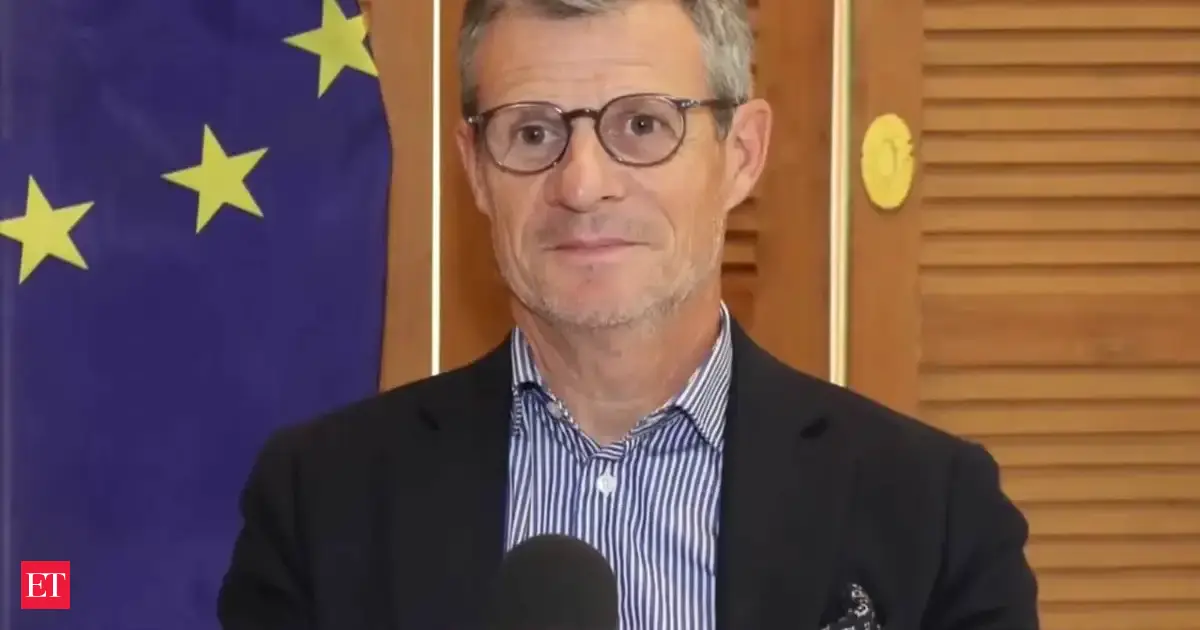
India-EU Free Trade Agreement negotiations progressed with realism and pragmatism from both sides
GK and monthly revision
India-EU ties stronger than ever, FTA breakthrough driven by realism, pragmatism: EU Ambassador
India-EU relations have strengthened significantly with FTA negotiations advancing through realism and pragmatism. The Carbon Border Adjustment Mechanism (CBAM) aims to prevent carbon leakage and incentivize lower emissions. Both sides seek to de-risk supply chains and enhance resilience, with cooperation deepening via the India-EU Trade and Technology Council. This reflects growing strategic alignment between India and the EU on trade, technology, and climate policy.
Revision structure
Monthly events and exam calendar context
Static GK and one-liner notes
Quiz and mock-test revision path
Key points
Exam-ready takeaways
Carbon Border Adjustment Mechanism (CBAM) aims to prevent carbon leakage and incentivize lower emissions
Both India and EU seek to de-risk supply chains and build greater resilience
Cooperation to be strengthened through agreements and the India-EU Trade and Technology Council (TTC)
EU Ambassador stated India-EU relations are stronger than ever due to increased strategic understanding
Detailed analysis
Full exam-oriented breakdown
The recent statement by the EU Ambassador highlighting that India-EU relations are "stronger than ever" marks a significant milestone in one of the world's most important strategic partnerships. This development didn't happen overnight — it's the culmination of decades of diplomatic engagement, punctuated by periods of stagnation and breakthrough. The India-EU relationship formally began with the 1994 Cooperation Agreement, upgraded to a Strategic Partnership in 2004, but the Free Trade Agreement (FTA) negotiations launched in 2007 stalled by 2013 due to disagreements on intellectual property rights, data security, automobile tariffs, and agricultural market access. The revival of talks in 2021, followed by the launch of the India-EU Trade and Technology Council (TTC) in 2022 — only the second such council for the EU after the US — signals a new phase driven by geopolitical realism and economic pragmatism. Key stakeholders include the European Commission (led by Executive Vice-President Valdis Dombrovskis), India's Ministry of Commerce and Industry (under Minister Piyush Goyal), and the India-EU TTC's three working groups: Strategic Technologies, Digital Governance, and Green Technologies. The EU is India's third-largest trading partner (€88 billion in goods trade in 2022), while India is the EU's 10th largest. Both sides face common challenges: over-dependence on China for critical minerals, semiconductors, and pharmaceutical ingredients; the need for trusted technology partners in 5G, AI, and quantum computing; and the imperative of climate action under the Paris Agreement. The Carbon Border Adjustment Mechanism (CBAM), effective from October 2023 (transitional phase) with full implementation from 2026, is a game-changer. It imposes a carbon price on imports of cement, iron and steel, aluminium, fertilizers, electricity, and hydrogen — sectors where India has significant export exposure. For India, CBAM poses short-term competitiveness challenges but long-term incentives for green industrialization. India's response — exploring a domestic carbon trading scheme under the Energy Conservation (Amendment) Act, 2022 — shows adaptive policymaking. Constitutionally, Article 253 empowers Parliament to implement international treaties, while Article 246 read with the Seventh Schedule places trade and commerce in the Union List, giving the Centre exclusive authority over FTA negotiations. The "de-risking" (not decoupling) strategy aligns with India's Atmanirbhar Bharat and Production Linked Incentive (PLI) schemes. The TTC's focus on trusted supply chains for semiconductors (where India's $10 billion Semicon India programme seeks EU collaboration), critical raw materials (via the EU's Critical Raw Materials Act), and digital public infrastructure (India's UPI, Aadhaar, and DigiLocker models) creates win-win opportunities. Geopolitically, the partnership reinforces a rules-based order in the Indo-Pacific, evidenced by the EU's 2021 Indo-Pacific Strategy and joint naval exercises. Future implications are profound: a balanced FTA could boost bilateral trade to €150 billion by 2030; CBAM compliance will accelerate India's green steel and hydrogen missions; TTC collaboration could make India a global hub for trusted electronics manufacturing; and the partnership may expand to security domains, including counter-terrorism and maritime domain awareness. For aspirants, this isn't just a trade story — it's a case study in 21st-century diplomacy where economics, technology, climate, and geopolitics converge.
How to study
Turn news into exam marks
Revise monthly events by exam family instead of reading random updates.
Pair one-liners with mock tests so mistakes become the next revision list.
Keep state job pages, calendar pages and GK packs connected in one path.