

Prime Minister Modi undertook a strategic tour in December.
GK and monthly revision
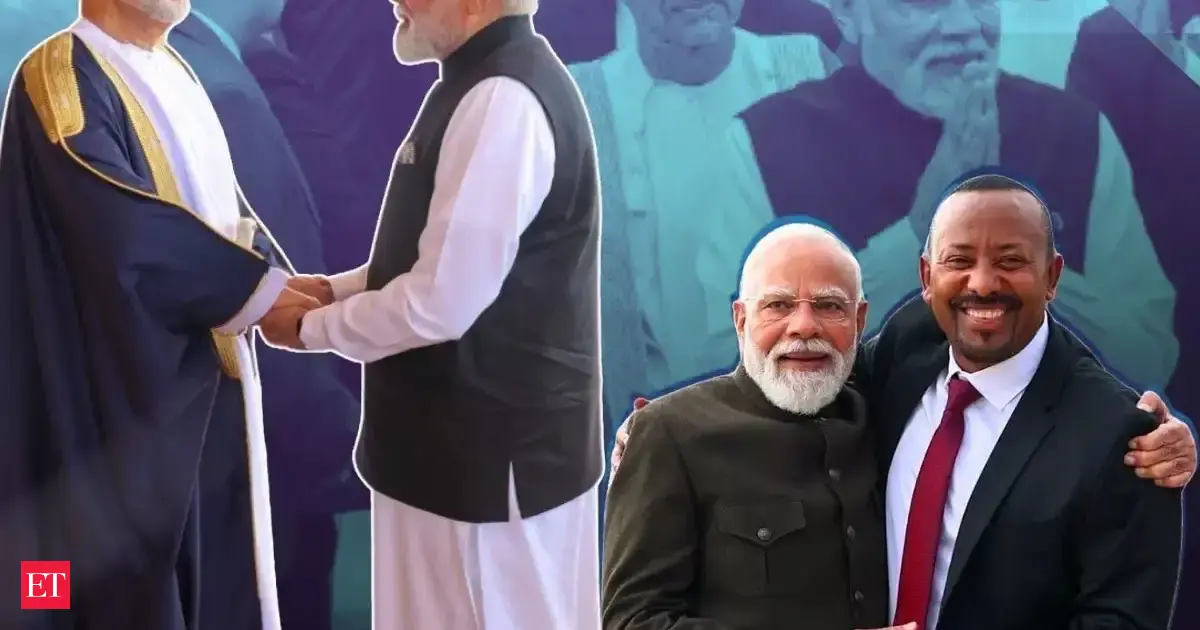
Jordan, Ethiopia, Oman: How India stitched a new triangle of influence
Prime Minister Modi's December tour to Oman, Jordan, and Ethiopia established a new "triangle of influence" linking the Gulf, West Asia, and Africa. This strategic initiative aimed to solidify trade pacts, enhance political stability, and foster long-term influence through economic, political, and people-to-people ties. It signifies India's proactive foreign policy and growing global partnerships, crucial for understanding India's international relations in competitive exams.
Revision structure
Monthly events and exam calendar context
Static GK and one-liner notes
Quiz and mock-test revision path
Key points
Exam-ready takeaways
The tour involved visits to three key nations: Oman, Jordan, and Ethiopia.
This initiative is described as stitching a "new triangle of influence."
The tour aimed to strategically link three regions: the Gulf, West Asia, and Africa.
Key objectives included solidifying trade pacts and enhancing political stability.
Detailed analysis
Full exam-oriented breakdown
India's foreign policy has undergone a significant transformation from the non-alignment era to a more proactive and multi-aligned approach, driven by its growing economic prowess and strategic ambitions. Prime Minister Modi's December tour to Oman, Jordan, and Ethiopia exemplifies this shift, aiming to stitch a 'new triangle of influence' that strategically links the Gulf, West Asia, and Africa. This initiative is not merely a series of bilateral visits but a calculated move to deepen India's engagement across crucial geopolitical and economic corridors. **Background Context and Historical Ties:** India's engagement with these regions is rooted in centuries of historical, cultural, and trade ties. The ancient maritime silk route connected India with the Arabian Peninsula and East Africa, fostering robust people-to-people exchanges. Post-independence, India maintained strong relations through the Non-Aligned Movement (NAM), advocating for decolonization and South-South cooperation. However, in recent decades, India's foreign policy has evolved to prioritize economic partnerships, energy security, and strategic influence. The Gulf region, particularly Oman, has been a cornerstone of India's energy security and a significant destination for its diaspora, contributing billions in remittances. West Asia, with Jordan as a key moderate player, is vital for regional stability and counter-terrorism efforts. Africa, especially fast-growing economies like Ethiopia, represents a vast untapped market, a source of raw materials, and a partner in multilateral forums. China's aggressive inroads into these regions, through initiatives like the Belt and Road Initiative (BRI), have also spurred India to intensify its diplomatic and economic outreach. **The Strategic Tour and its Objectives:** Prime Minister Modi's tour sought to solidify India's presence and influence across this critical 'triangle.' The objectives were multi-faceted: to solidify trade pacts, enhance political stability, and foster long-term influence through economic, political, and people-to-people ties. In Oman, discussions likely focused on energy cooperation, maritime security (given Oman's strategic location at the Strait of Hormuz), and investment. With Jordan, a stable partner in a volatile region, the emphasis would have been on counter-terrorism, defense cooperation, and regional peace initiatives. Ethiopia, a major economy in East Africa and host to the African Union headquarters, presented opportunities for expanding trade, investment in manufacturing and infrastructure, and strengthening India's broader Africa policy, often articulated through the India-Africa Forum Summit (IAFS) framework. **Key Stakeholders and their Interests:** * **India:** Seeks assured energy supplies, diverse export markets, strategic depth in the Indian Ocean Region, welfare of its vast diaspora (especially in the Gulf), counter-terrorism cooperation, and enhancing its global stature. The tour aligns with India's 'Act West' and 'SAGAR' (Security and Growth for All in the Region) doctrines. * **Oman:** A crucial partner for India's maritime security and energy needs. Oman values India's non-interfering foreign policy and its growing economic power. It seeks investments and diversification of its economy away from oil. * **Jordan:** A moderate voice in the Arab world, Jordan seeks economic development, security assistance, and partnerships that can contribute to regional stability amidst conflicts in neighboring countries. India's developmental expertise and counter-terrorism experience are valuable. * **Ethiopia:** As a rapidly developing African nation, Ethiopia is keen on foreign investment, technology transfer, and infrastructure development. India's 'development partnership' model, focusing on capacity building and concessional credit lines, is attractive. Ethiopia's strategic location in the Horn of Africa makes it a gateway to the broader African continent. **Significance for India:** This 'triangle of influence' is profoundly significant for India. Economically, it ensures energy security, opens new markets for Indian goods and services, and provides investment opportunities. Politically, it enhances India's diplomatic leverage, strengthens its voice in international forums, and fosters crucial partnerships for regional stability and counter-terrorism. Strategically, it helps India project power and influence across vital maritime routes and land corridors, countering the growing influence of other global players. The focus on people-to-people ties is crucial for diaspora welfare and cultural diplomacy. **Constitutional and Policy Framework:** India's foreign policy is guided by **Article 51 of the Constitution**, which directs the state to 'endeavour to promote international peace and security, maintain just and honourable relations between nations, foster respect for international law and treaty obligations, and encourage settlement of international disputes by arbitration.' This constitutional directive underpins all diplomatic efforts. Specific policies like the **'Act East Policy'** (though primarily focused on Southeast Asia, its principles of economic engagement and strategic partnerships are universalized), the **'SAGAR' (Security and Growth for All in the Region) doctrine** for maritime cooperation, and the **'India-Africa Forum Summits'** (IAFS) for comprehensive engagement with Africa, provide the broader framework for these bilateral interactions. India's emphasis on 'development partnership' and 'South-South cooperation' also shapes its approach. **Future Implications:** This strategic outreach is expected to lead to increased trade volumes, greater Indian investment in these regions, and enhanced security cooperation, particularly in maritime domain awareness and counter-terrorism. It will solidify India's position as a reliable and trusted partner, distinct from other global powers. The success of this 'triangle' could inspire similar multi-regional engagements, further diversifying India's foreign policy footprint. Challenges include navigating regional geopolitical complexities, managing competition from other major powers, and ensuring the sustained implementation of agreed-upon initiatives.
How to study
Turn news into exam marks
Revise monthly events by exam family instead of reading random updates.
Pair one-liners with mock tests so mistakes become the next revision list.
Keep state job pages, calendar pages and GK packs connected in one path.