

West Bengal government renamed its state job guarantee scheme as 'Mahatma-Shree'.
GK and monthly revision
West Bengal Government renames State’s job guarantee scheme as ‘Mahatma-Shree’ to honour Mahatma Gandhi
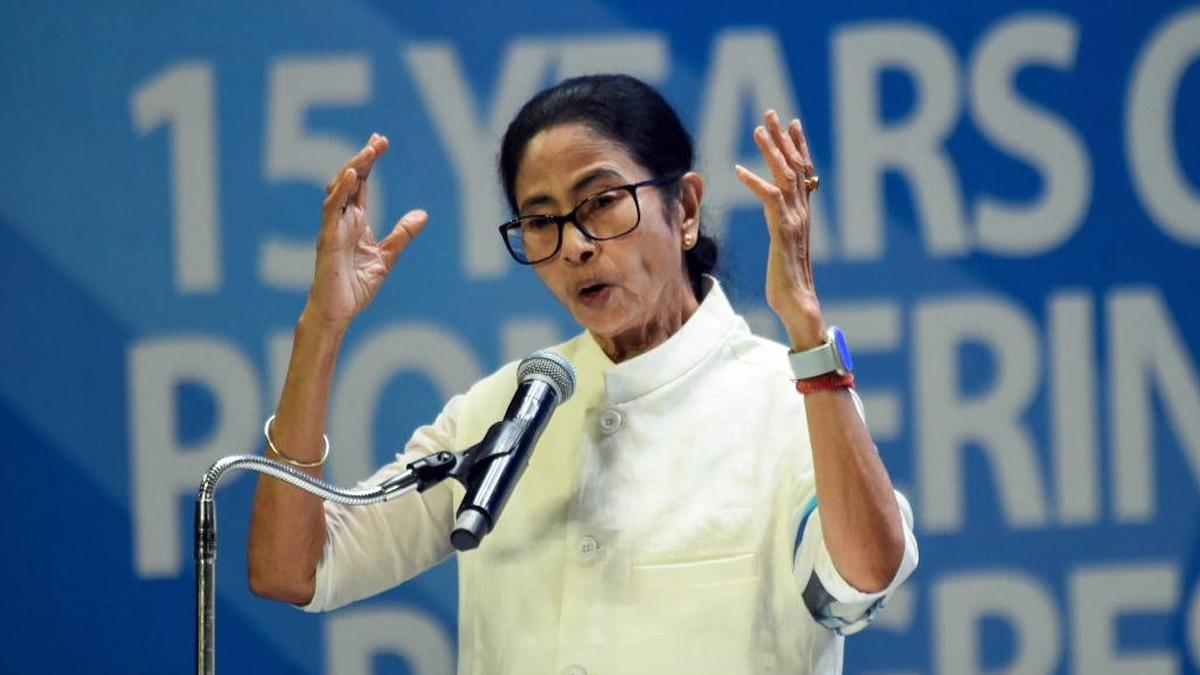
West Bengal Chief Minister Mamata Banerjee announced the renaming of the state's job guarantee scheme to 'Mahatma-Shree'. This decision comes as a direct response to the Union Government's renaming of the Mahatma Gandhi National Rural Employment Guarantee Act (MGNREGA). This highlights the ongoing state-center dynamics regarding scheme implementation and nomenclature, making it significant for competitive exams focusing on governance and social welfare programs.
Revision structure
Monthly events and exam calendar context
Static GK and one-liner notes
Quiz and mock-test revision path
Key points
Exam-ready takeaways
The renaming was announced by West Bengal Chief Minister Mamata Banerjee.
The move is a direct response to the Union Government's renaming of the Mahatma Gandhi National Rural Employment Guarantee Act (MGNREGA).
The 'Mahatma-Shree' scheme is West Bengal's state-level job guarantee program.
The new name 'Mahatma-Shree' is intended to honour Mahatma Gandhi.
Detailed analysis
Full exam-oriented breakdown
The recent decision by the West Bengal government to rename its state-level job guarantee scheme as 'Mahatma-Shree' in response to the Union Government's renaming of the Mahatma Gandhi National Rural Employment Guarantee Act (MGNREGA) brings to the forefront critical aspects of India's federal structure, political symbolism, and the implementation of social welfare programs. This move is not merely an administrative change but a deeply political one, highlighting the ongoing tensions and power dynamics between the Union and state governments. To understand this development, it's essential to first grasp the background of MGNREGA. Enacted on August 25, 2005, through the Mahatma Gandhi National Rural Employment Guarantee Act, the scheme aims to guarantee 100 days of wage employment in a financial year to every rural household whose adult members volunteer to do unskilled manual work. It is a demand-driven scheme, a legal right, and an important tool for poverty alleviation, rural development, and strengthening local self-governance through Panchayati Raj Institutions. The Act was a landmark piece of legislation, symbolizing a commitment to social security and the right to work, drawing philosophical inspiration from the Directive Principles of State Policy, particularly Article 41 which speaks of the state making effective provision for securing the right to work, to education, and to public assistance in cases of unemployment. The Union Government recently initiated a process to rename various components or aspects associated with MGNREGA, often leading to a perception that the scheme itself is being rebranded. While the core Act remains, changes in nomenclature or emphasis can be seen as attempts to align schemes with the current government's vision or to reduce the prominence of previous administrations' branding. This perceived 'renaming' by the Union government served as the direct trigger for West Bengal's action. Chief Minister Mamata Banerjee announced 'Mahatma-Shree' to explicitly honour Mahatma Gandhi, asserting the state's continued commitment to the principles associated with the original scheme and its namesake. Key stakeholders in this episode include the Union Government, primarily represented by the Ministry of Rural Development, which is responsible for the overall administration and funding of MGNREGA. Their motivation often lies in policy alignment, administrative efficiency, and sometimes, political branding. The West Bengal Government, led by Chief Minister Mamata Banerjee, is another crucial stakeholder. Their motivation stems from asserting state autonomy, maintaining political identity, and ensuring the delivery of welfare services to their constituents, often amidst resource constraints and political friction with the Centre. The ultimate beneficiaries – the rural poor seeking employment – are indirectly involved, as the dispute over names and funding can potentially impact the smooth delivery of services. Political parties also play a significant role, leveraging such issues for electoral narratives and ideological positioning. This incident matters significantly for India's federal structure. India operates as a 'union of states,' with powers distributed between the Centre and states as outlined in the Seventh Schedule of the Constitution. While 'rural development' and 'social welfare' often fall under the Concurrent List or State List, centrally sponsored schemes like MGNREGA are a blend, with the Centre providing significant funding and policy frameworks, and states handling implementation. This creates a fertile ground for disputes over funding, administrative control, and, as seen here, even nomenclature. The renaming reflects a move towards 'competitive federalism' where states might try to assert their distinct identity or claim ownership over welfare programs, rather than purely 'cooperative federalism' where Centre and states work seamlessly together. It also highlights the broader theme of 'fiscal federalism,' where states often depend on central grants and schemes, giving the Centre considerable leverage. Historically, disputes over centrally sponsored schemes are not new. States have often expressed concerns about the rigidity of central guidelines, delayed fund releases, and the imposition of central branding. The current renaming by West Bengal can be seen as a form of political counter-branding, a way for a state government to reaffirm its political space and messaging. This move could set a precedent, potentially encouraging other states, especially those governed by opposition parties, to similarly rebrand centrally sponsored schemes or launch parallel state-specific initiatives to maintain their political distinctiveness. In terms of future implications, this dynamic could lead to increased fragmentation in welfare scheme implementation, making it harder to track national progress or ensure uniform standards. It might also intensify political battles over credit for welfare delivery, potentially impacting the efficiency and focus on beneficiaries. From a governance perspective, such actions can strain Centre-state relations, making consensus-building on critical national development agendas more challenging. For the common citizen, it could lead to confusion regarding scheme names and eligibility, though the core benefit of job guarantee remains the primary concern. In conclusion, West Bengal's 'Mahatma-Shree' move is a potent symbol of ongoing Centre-state friction, federal dynamics, and the politicisation of welfare schemes in India. It underscores the intricate balance between national policy objectives and state autonomy, a balance that is constantly being negotiated and redefined in India's vibrant democracy. The incident serves as a crucial case study for understanding the practical challenges and political realities of India's federal system.
How to study
Turn news into exam marks
Revise monthly events by exam family instead of reading random updates.
Pair one-liners with mock tests so mistakes become the next revision list.
Keep state job pages, calendar pages and GK packs connected in one path.