

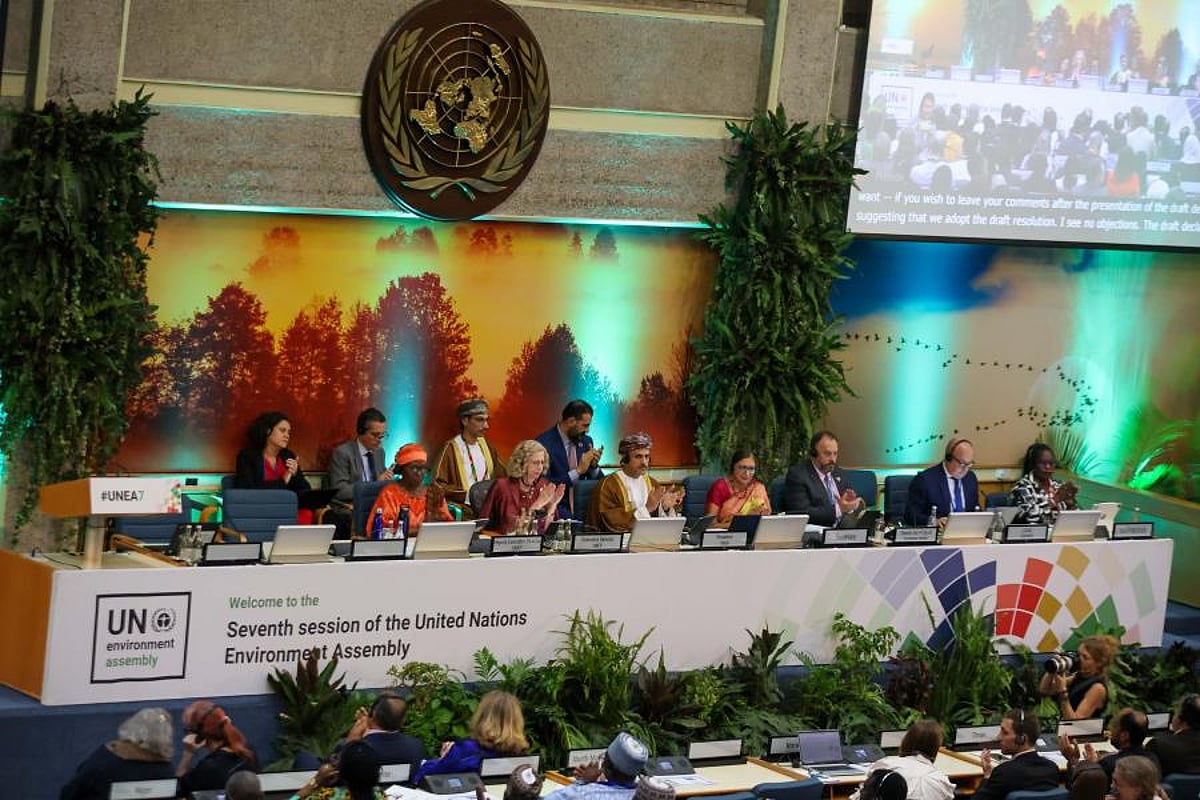
The UN Environmental Assembly (UNEA) dropped a resolution concerning the strengthening of the United Nations Environment Programme (UNEP) headquarters.
GK and monthly revision
UN Environmental Assembly drops resolution on strengthening UNEP Nairobi headquarters
The UN Environmental Assembly (UNEA) recently decided to drop a resolution aimed at strengthening the Nairobi headquarters of the United Nations Environment Programme (UNEP). This move has drawn criticism from delegates and civil society groups, who argue that it significantly weakens global environmental governance. For competitive exams, this highlights the operational challenges and political dynamics within key international environmental organizations like UNEP and UNEA.
Revision structure
Monthly events and exam calendar context
Static GK and one-liner notes
Quiz and mock-test revision path
Key points
Exam-ready takeaways
The permanent headquarters of the United Nations Environment Programme (UNEP) is located in Nairobi, Kenya.
The dropped resolution specifically aimed to enhance the institutional capacity and resource allocation for the UNEP Nairobi headquarters.
Delegates and civil society organizations have expressed concerns that this decision could weaken the framework of global environmental governance.
The UN Environmental Assembly (UNEA) serves as the world's highest-level decision-making body on environmental matters.
Detailed analysis
Full exam-oriented breakdown
The recent decision by the UN Environmental Assembly (UNEA) to drop a resolution aimed at strengthening the Nairobi headquarters of the United Nations Environment Programme (UNEP) has sparked significant debate, highlighting the complex political dynamics and operational challenges within global environmental governance. This move, criticized by various delegates and civil society groups, underscores a potential weakening of the institutional framework crucial for addressing pressing environmental crises. **Background Context and Historical Significance:** To understand the gravity of this decision, one must first appreciate the role and history of UNEP. Established in 1972 following the landmark UN Conference on the Human Environment in Stockholm, UNEP was conceived as the leading global environmental authority. Its mandate is to set the global environmental agenda, promote the coherent implementation of the environmental dimension of sustainable development within the United Nations system, and serve as an authoritative advocate for the global environment. A distinctive feature of UNEP is its permanent headquarters in Nairobi, Kenya. This choice was deliberate, symbolizing a commitment to place environmental issues, and the institutions addressing them, firmly within the developing world, away from the traditional power centers of New York or Geneva. This location was meant to ensure that the perspectives and needs of developing countries, often disproportionately affected by environmental degradation, were central to global environmental policy-making. The dropped resolution likely sought to enhance UNEP's institutional capacity, resource allocation, and overall effectiveness, thereby bolstering its ability to fulfill this crucial mandate from its Nairobi base. **What Happened and Key Stakeholders:** The UN Environmental Assembly (UNEA) is the world's highest-level decision-making body on environmental matters, bringing together representatives from all 193 UN Member States. It provides a platform for setting global environmental policy. The resolution in question aimed at strengthening the UNEP Nairobi headquarters, implying a need for greater funding, technical capacity, and perhaps even a more prominent political role for the institution. The decision to drop this resolution suggests a failure to achieve consensus among member states. Key stakeholders involved include: * **UNEP and UNEA Secretariat:** Whose operational capacity and influence are directly affected. * **Developing Nations (often represented by the G77 + China, and the African Group):** These nations frequently advocate for a stronger UNEP, seeing its Nairobi location as a symbol of their collective voice and a vital mechanism for addressing their environmental concerns with adequate resources. * **Developed Nations:** While generally supportive of environmental goals, some developed nations might have reservations about increased funding commitments or institutional reforms that could shift power dynamics or resource allocation away from other established bodies. * **Civil Society Organizations and Environmental Activists:** These groups consistently push for robust global environmental governance and view a strong UNEP as essential for effective action. * **Delegates from Member States:** Representing their national interests, their inability to reach a consensus led to the resolution being dropped. **Significance for India:** For India, a major developing country with significant environmental challenges and a growing role in international affairs, this development carries considerable weight. India has historically championed the cause of developing nations in international forums and has been a strong advocate for a more equitable global governance structure. A weakened UNEP, or one perceived as lacking adequate institutional support, could diminish the collective voice of the Global South on environmental issues. India's own ambitious climate targets and environmental protection efforts, including its Nationally Determined Contributions (NDCs) under the Paris Agreement, are intrinsically linked to a robust and supportive international framework. India's Constitution, through **Article 48A**, mandates the State to 'endeavour to protect and improve the environment and to safeguard the forests and wild life of the country.' Furthermore, **Article 51A(g)** imposes a fundamental duty on every citizen 'to protect and improve the natural environment including forests, lakes, rivers and wild life, and to have compassion for living creatures.' India's domestic environmental laws, such as the Environment (Protection) Act, 1986, often draw inspiration from and are aligned with international commitments. A strong UNEP is vital for fostering international cooperation, facilitating technology transfer, and mobilizing financial resources for environmental protection, all of which are crucial for India's sustainable development trajectory. The decision to drop the resolution could be seen as a setback for multilateralism and the principle of common but differentiated responsibilities, which India strongly upholds. **Future Implications:** The dropping of this resolution could have several future implications. It might signal a lack of unified political will to significantly empower UNEP, potentially leading to a more fragmented approach to global environmental governance. This could necessitate greater reliance on other international bodies or bilateral agreements, possibly diluting the comprehensive and coordinated action needed for planetary challenges. It could also exacerbate the North-South divide in environmental negotiations, as developing nations might perceive this as a reluctance by developed countries to adequately support institutions based in the Global South. The effectiveness of future global environmental agreements, such as those related to biodiversity or climate change adaptation, might be hampered if the central coordinating body is not sufficiently robust. Ultimately, it poses a challenge to the vision of a truly global and equitable environmental governance architecture, demanding renewed efforts to build consensus and commitment towards strengthening crucial institutions like UNEP.
How to study
Turn news into exam marks
Revise monthly events by exam family instead of reading random updates.
Pair one-liners with mock tests so mistakes become the next revision list.
Keep state job pages, calendar pages and GK packs connected in one path.