

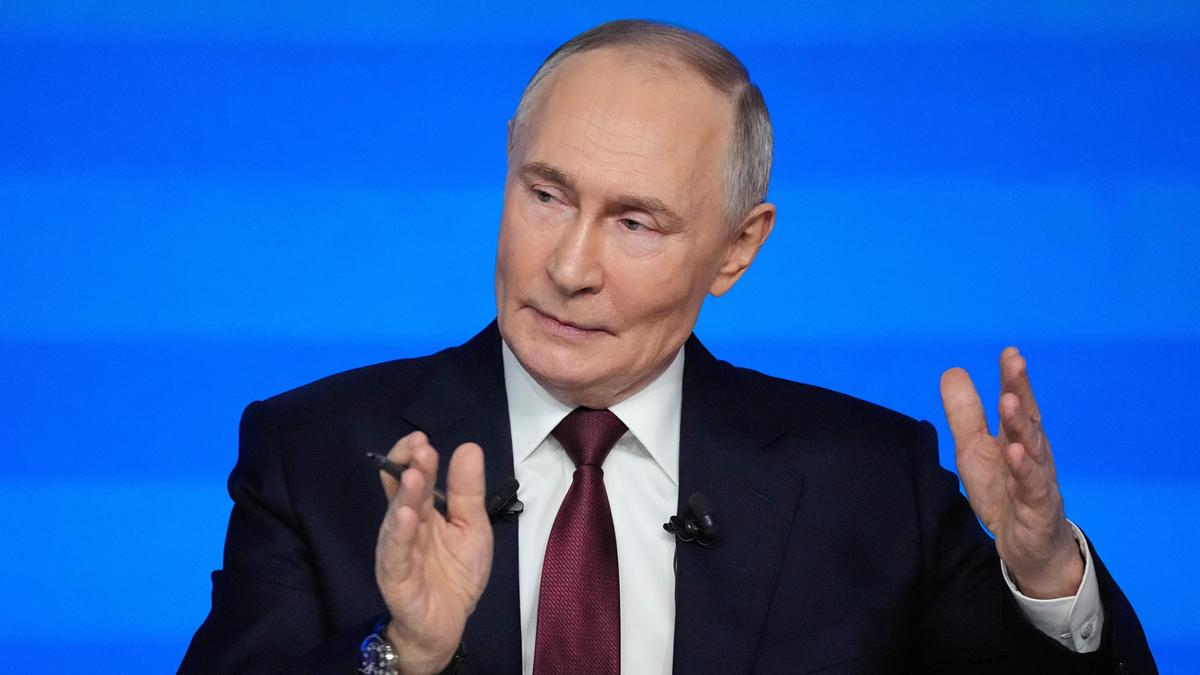
Russian President Vladimir Putin made the statement during his annual news conference.
GK and monthly revision
Putin tells his annual news conference that the Kremlin's military goals will be achieved in Ukraine
Russian President Vladimir Putin, during his annual news conference, asserted that Russian forces have "fully seized strategic initiative" in Ukraine and anticipate further gains by the year's end. This statement underscores Russia's continued military objectives and confidence in the ongoing conflict. For competitive exams, it highlights the geopolitical landscape, the role of key international leaders, and the status of significant global conflicts, crucial for international relations and current affairs sections.
Revision structure
Monthly events and exam calendar context
Static GK and one-liner notes
Quiz and mock-test revision path
Key points
Exam-ready takeaways
Putin claimed that Russian forces have "fully seized strategic initiative" in Ukraine.
He predicted that Russian forces would make more military gains in Ukraine by the year's end.
The statement reflects the Kremlin's declared military goals regarding the conflict in Ukraine.
The ongoing conflict involves Russia's military operations in Ukraine.
Detailed analysis
Full exam-oriented breakdown
Russian President Vladimir Putin's declaration during his annual news conference that Russian forces have "fully seized strategic initiative" in Ukraine and anticipate further gains by year's end is a significant statement reflecting the ongoing geopolitical struggle and Russia's unwavering commitment to its military objectives. This pronouncement, made in a highly publicized forum, serves as a message to both domestic and international audiences regarding the Kremlin's confidence and strategic outlook in the protracted conflict. The background to this conflict is deeply rooted in post-Soviet geopolitical shifts. Following the dissolution of the Soviet Union in 1991, Ukraine, a former Soviet republic, asserted its independence and began to orient itself towards the West, seeking closer ties with the European Union and eventually expressing aspirations for NATO membership. Russia viewed NATO's eastward expansion as a direct threat to its security interests, a perspective that intensified after the 'Orange Revolution' in Ukraine in 2004 and the 'Euromaidan Revolution' in 2014, which saw pro-Russian President Viktor Yanukovych overthrown. In response to the 2014 events, Russia swiftly annexed Crimea and supported separatist movements in the Donbas region (eastern Ukraine), leading to a simmering conflict that preceded the full-scale invasion. The current phase of the conflict escalated dramatically on February 24, 2022, when Russia launched a large-scale invasion of Ukraine, citing reasons such as protecting Russian speakers, 'de-Nazification' of Ukraine, and preventing Ukraine from joining NATO. Putin's recent statement about seizing 'strategic initiative' indicates Russia's belief that it holds the upper hand militarily, controlling the tempo and direction of operations, despite significant Ukrainian resistance and Western military aid. This signals a long-term commitment to its objectives, rather than a search for an immediate diplomatic resolution on terms unfavorable to Russia. Key stakeholders in this conflict are numerous and diverse. **Russia**, led by President Putin, aims to secure its perceived security interests, expand its sphere of influence, and challenge the unipolar world order dominated by the United States. Its military actions are central to achieving these aims. **Ukraine**, under President Volodymyr Zelenskyy, is fighting for its sovereignty, territorial integrity, and the right to self-determination, backed by substantial military and financial aid from Western allies. The **United States and NATO** members are crucial stakeholders, providing extensive military, financial, and humanitarian assistance to Ukraine, while imposing stringent sanctions on Russia. Their objective is to weaken Russia's military capabilities, uphold international law, and prevent the erosion of the rules-based international order. International bodies like the **United Nations** are also involved, primarily in humanitarian efforts, attempting to mediate and pass resolutions condemning the invasion, though often hampered by Russia's veto power in the Security Council. For India, this conflict carries significant implications across various domains. Geopolitically, India faces a delicate balancing act. Historically, India has maintained a strong strategic partnership with Russia, particularly in defence procurement (e.g., S-400 missile system) and energy. Simultaneously, India has been strengthening ties with Western powers, notably through forums like the Quad (Quadrilateral Security Dialogue) with the US, Japan, and Australia, aimed at ensuring a free and open Indo-Pacific. India's foreign policy, guided by the principle of strategic autonomy and non-alignment, has seen it abstain from several UN resolutions condemning Russia, while simultaneously calling for respect for sovereignty and territorial integrity and advocating for dialogue and diplomacy. This stance reflects India's national interests, which include maintaining stable relations with both sides. Economically, the conflict has had a substantial impact on India. Global crude oil prices surged initially, affecting India's import bill and contributing to inflation. India has leveraged discounted Russian oil, which has helped mitigate some economic pressures but also drawn scrutiny from Western nations. Disruptions to global supply chains, particularly for fertilizers and food grains (Ukraine and Russia are major exporters), have also posed challenges. India's commitment to promoting international peace and security, as enshrined in **Article 51 of the Indian Constitution** (Directive Principles of State Policy), guides its diplomatic efforts to de-escalate tensions and promote peaceful resolution, while also safeguarding its economic and strategic interests. Historically, the conflict can be viewed through the lens of great power competition and the struggle for regional hegemony, a recurring theme in international relations. The current geopolitical landscape is reminiscent of Cold War-era tensions, albeit with different actors and dynamics. The expansion of military alliances like NATO and Russia's perception of encirclement are key historical drivers. Looking ahead, the future implications are profound. Putin's statement suggests a prolonged conflict, possibly leading to further territorial changes and a continued humanitarian crisis. The conflict is reshaping the global energy landscape, accelerating Europe's pivot away from Russian energy, and potentially leading to new alliances and trade routes. For India, the challenge of balancing its strategic partnerships will continue. It will need to navigate evolving global power dynamics, ensure its energy and food security, and potentially diversify its defence procurement sources. The conflict underscores the fragility of the international order and the importance of multilateral institutions, even as their effectiveness is tested. India's role on the global stage, particularly as it seeks a permanent seat on the UN Security Council, will be increasingly defined by its ability to navigate such complex international crises while upholding its constitutional commitment to international peace and justice.
How to study
Turn news into exam marks
Revise monthly events by exam family instead of reading random updates.
Pair one-liners with mock tests so mistakes become the next revision list.
Keep state job pages, calendar pages and GK packs connected in one path.