

A Russian strike targeted Ukraine's Odesa port, a key strategic location.
GK and monthly revision
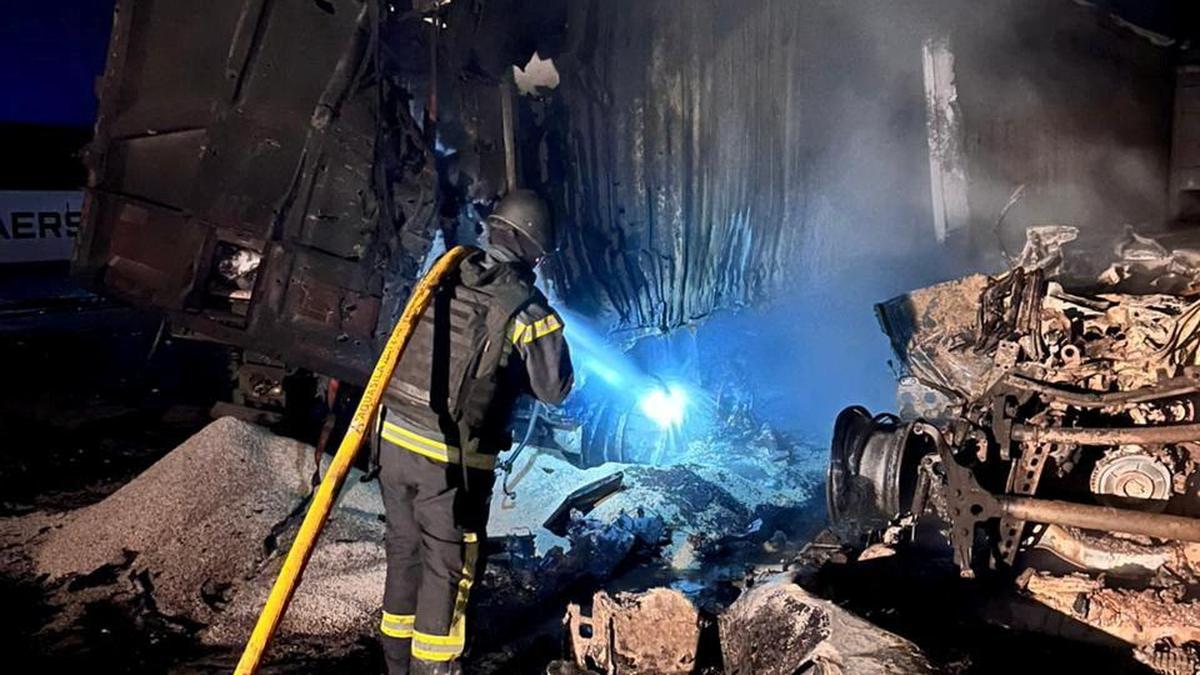
At least eight dead and dozens wounded in Russian strike on Ukraine’s Odesa port
A recent Russian strike on Ukraine's Odesa port resulted in at least eight fatalities and dozens injured, highlighting the severe human cost of the ongoing conflict. This event is crucial for competitive exams as it underscores the strategic importance of port cities in the Russia-Ukraine war and its broader geopolitical implications. Ukraine retaliated by using drones to hit a Russian warship, indicating continued military escalation in the region.
Revision structure
Monthly events and exam calendar context
Static GK and one-liner notes
Quiz and mock-test revision path
Key points
Exam-ready takeaways
The attack on Odesa resulted in at least eight fatalities.
Dozens of individuals were reported wounded in the Russian strike.
Ukrainian forces launched a counter-attack utilizing drones.
The Ukrainian drone attack successfully hit a Russian warship and other facilities.
Detailed analysis
Full exam-oriented breakdown
The recent Russian strike on Ukraine's Odesa port, resulting in at least eight fatalities and dozens wounded, and Ukraine's subsequent retaliation against a Russian warship, underscores the persistent and brutal nature of the ongoing conflict. This incident is not merely a localized military engagement; it has profound implications for global geopolitics, economic stability, and international law, making it a critical topic for competitive exam aspirants. **Background Context and Historical Roots:** The current conflict escalated dramatically with Russia's full-scale invasion of Ukraine on February 24, 2022, but its roots trace back much further. The dissolution of the Soviet Union in 1991 led to Ukraine's independence, a move viewed by Russia as a strategic loss. Tensions mounted significantly in 2014 when Russia annexed Crimea following a pro-Russian uprising and supported separatists in the Donbas region (eastern Ukraine), leading to a protracted conflict. Russia's stated goals for the 2022 invasion included 'demilitarization' and 'denazification' of Ukraine, aiming to prevent Ukraine's closer alignment with Western alliances like NATO and to secure its own perceived security interests. Ukraine, on the other hand, is fighting for its sovereignty, territorial integrity, and the right to self-determination. **The Strategic Significance of Odesa:** Odesa is Ukraine's largest port city and a vital economic lifeline, particularly for its agricultural exports. Located on the Black Sea, it serves as a critical conduit for grain, steel, and other goods, connecting Ukraine to global markets. Control over Odesa would effectively landlock Ukraine, severely crippling its economy and granting Russia significant strategic advantage in the Black Sea region. The port's importance was highlighted by the UN-brokered Black Sea Grain Initiative (July 2022 to July 2023), which allowed for the safe passage of Ukrainian grain exports amidst the conflict, aiming to alleviate global food shortages. Russia's continued targeting of Odesa, even after the collapse of the grain deal, signals its intent to cripple Ukraine's economic capacity and exert pressure. **Key Stakeholders Involved:** The primary stakeholders are, of course, **Russia** and **Ukraine**. Russia seeks to achieve its geopolitical objectives, including control over key Ukrainian territories and preventing its Western integration. Ukraine, supported by numerous international partners, is fighting for its existence as a sovereign nation. Other significant stakeholders include **NATO** and the **European Union (EU)**, which have provided substantial military, financial, and humanitarian aid to Ukraine, viewing the conflict as a threat to European security and democratic values. The **United Nations (UN)** and its various agencies are involved in humanitarian efforts, attempting to mediate peace, and upholding international law. Global powers like the **United States** and **China** also play crucial roles, with the former leading Western support for Ukraine and the latter maintaining a more ambiguous stance, often seen as tacitly supporting Russia. **Why This Matters for India:** The Russia-Ukraine conflict has far-reaching implications for India across economic, geopolitical, and strategic dimensions. Economically, India is vulnerable to global supply chain disruptions. Ukraine is a significant global exporter of wheat and sunflower oil, and the conflict has contributed to **global food inflation**, impacting India's import costs and domestic prices. Furthermore, India, a major oil importer, has faced **energy price volatility** due to the conflict, although it has leveraged discounted Russian oil. Geopolitically, India maintains a delicate balancing act. While advocating for a peaceful resolution and respecting territorial integrity, India has refrained from explicitly condemning Russia, its long-standing defence partner and a crucial source of military hardware. This stance is rooted in India's policy of **strategic autonomy**, aiming to maintain good relations with all major powers and avoid aligning with any particular bloc. The conflict also prompts India to diversify its defence procurement and reassess its foreign policy in a rapidly changing world order. India's consistent call for dialogue and diplomacy aligns with its historical foreign policy principles. **Constitutional and Policy Linkages (for India):** India's foreign policy, deeply impacted by such global events, is guided by the **Directive Principles of State Policy**, specifically **Article 51 of the Indian Constitution**. This article mandates the state to: (a) promote international peace and security; (b) maintain just and honourable relations between nations; (c) foster respect for international law and treaty obligations; and (d) encourage settlement of international disputes by arbitration. India's nuanced position on the Russia-Ukraine conflict, while maintaining strategic autonomy, reflects these constitutional principles by advocating for peace, dialogue, and adherence to international law without directly taking sides in a manner that could compromise its national interests or long-standing partnerships. The emphasis on a rules-based international order is also a cornerstone of India's external affairs policy. **Future Implications:** The Odesa strike signals a continuation of Russia's strategy to exert pressure on Ukraine's economy and military infrastructure. The conflict is likely to remain protracted, with potential for further escalation, especially if either side perceives a significant shift in military advantage. The global economy will continue to grapple with instability in food and energy markets. For India, the conflict reinforces the need for greater self-reliance (Atmanirbhar Bharat) in defence and critical sectors, diversification of trade partners, and a robust diplomatic approach to navigate complex global challenges. The long-term implications include a reshaping of the international order, renewed debates about collective security mechanisms, and the enduring challenge of upholding international law against acts of aggression. The future of Ukraine and the security architecture of Europe remain profoundly uncertain.
How to study
Turn news into exam marks
Revise monthly events by exam family instead of reading random updates.
Pair one-liners with mock tests so mistakes become the next revision list.
Keep state job pages, calendar pages and GK packs connected in one path.