

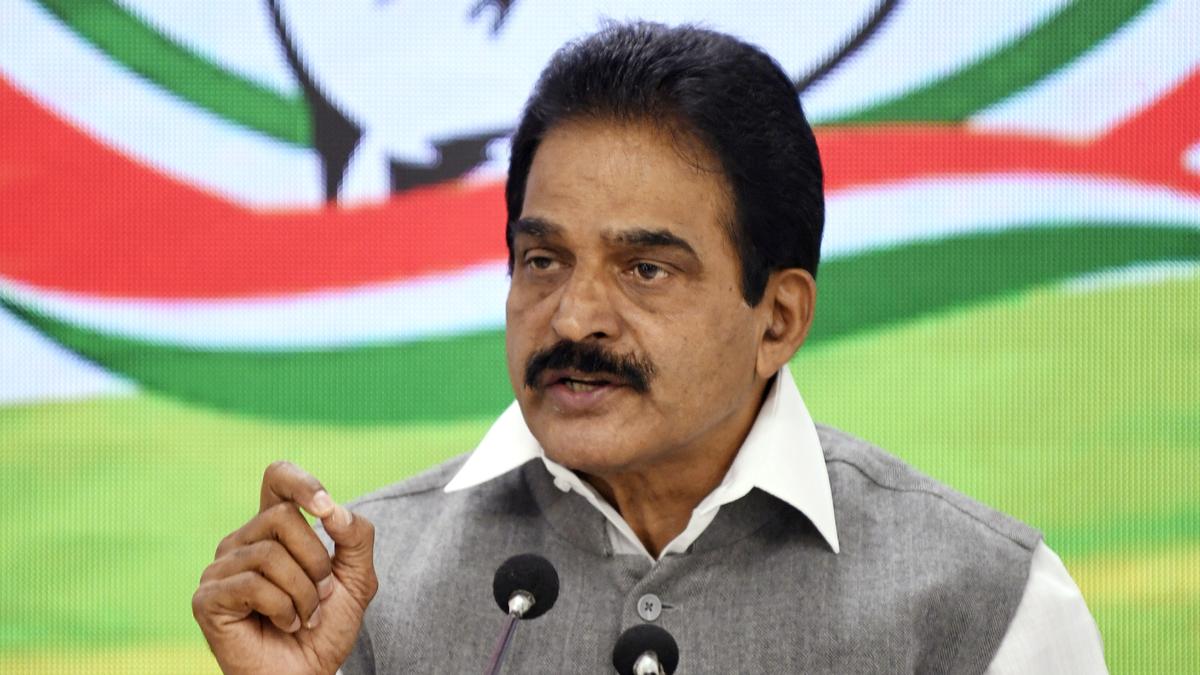
Congress leader K.C. Venugopal accused the Modi government of 'dismantling' the MGNREGA scheme.
GK and monthly revision
Congress slams government for ‘dismantling’ MGNREGA after passage of VB-G Ram G Bill
The Congress party, through leader K.C. Venugopal, has criticized the Modi government for allegedly 'dismantling' the MGNREGA scheme. This criticism stems from the passage of a bill, referred to as the 'VB-G Ram G Bill', which the Congress claims converts MGNREGA from a legal right to a discretionary favour. This development is significant for competitive exams as it highlights political discourse surrounding major social welfare programs and potential legislative impacts on their implementation, relevant for polity and social justice topics.
Revision structure
Monthly events and exam calendar context
Static GK and one-liner notes
Quiz and mock-test revision path
Key points
Exam-ready takeaways
The alleged 'dismantling' is linked to the passage of the 'VB-G Ram G Bill' as stated by the Congress.
Congress claims this bill converts MGNREGA from a legal 'right' to a 'favour'.
MGNREGA, or Mahatma Gandhi National Rural Employment Guarantee Act, was enacted in 2005.
The scheme guarantees 100 days of wage employment in a financial year to adult members of rural households.
Detailed analysis
Full exam-oriented breakdown
The Mahatma Gandhi National Rural Employment Guarantee Act (MGNREGA), enacted in 2005, stands as a landmark piece of legislation in India's social welfare framework. Born out of a deep understanding of rural distress and the need for a social safety net, MGNREGA guarantees 100 days of wage employment in a financial year to adult members of rural households who volunteer to do unskilled manual work. Its core principle is a 'right-based' approach, meaning employment is not a favour but a legal entitlement, backed by the statute. This act has been instrumental in providing livelihood security, reducing distress migration, empowering women, and creating durable assets in rural areas over the past two decades. The recent controversy stems from the Congress party's accusation, articulated by leader K.C. Venugopal, that the Modi government is 'dismantling' MGNREGA. The specific allegation is that a new legislative instrument, referred to as the 'VB-G Ram G Bill' by the Congress, is converting MGNREGA from a legal 'right' to a 'favour'. While the details of this specific bill or legislative change are not widely publicized, the essence of the criticism is a perceived dilution of the Act's foundational 'right to work' principle. The opposition suggests that through budgetary cuts, delayed wage payments, or administrative changes, the government is making access to MGNREGA employment discretionary rather than an assured right, thereby undermining its original intent. Key stakeholders in this debate include the Government of India, primarily the Ministry of Rural Development, which is responsible for implementing MGNREGA. The government's perspective often focuses on improving efficiency, ensuring proper targeting of beneficiaries, and addressing fiscal constraints, though these are not explicitly cited as reasons for the alleged 'dismantling' in the current context. The Indian National Congress, as the principal opposition party, positions itself as the protector of social welfare programs, leveraging this issue to highlight perceived governmental neglect of the rural poor. The most crucial stakeholders are the millions of rural workers and their families who rely on MGNREGA for their livelihood. Any shift from a 'right' to a 'favour' could significantly impact their economic security and bargaining power. Additionally, state governments, responsible for on-ground implementation, and various civil society organizations and activists who advocate for the rights of rural workers, are also deeply invested in the scheme's integrity. This issue holds immense significance for India across several dimensions. Socially, MGNREGA has been a critical tool for poverty alleviation, particularly in times of economic hardship or agricultural distress. Diluting its 'right' aspect could exacerbate rural poverty, increase food insecurity, and potentially lead to a rise in distress migration. Economically, the scheme injects crucial purchasing power into rural economies, stimulating local demand and contributing to asset creation like rural roads, water conservation structures, and irrigation canals. Politically, the debate underscores differing ideologies on welfare delivery – a rights-based approach versus a more discretionary, targeted assistance model. This political discourse is vital in a democracy, reflecting the government's priorities and the opposition's role in holding it accountable. Historically, MGNREGA is a continuation of India's journey towards realizing the Directive Principles of State Policy (DPSP) enshrined in Part IV of the Constitution. Specifically, Article 38 mandates the state to secure a social order for the promotion of welfare of the people, and Article 41 directs the state to make effective provision for securing the right to work, to education, and to public assistance in cases of unemployment. MGNREGA operationalizes these principles, much like the Right to Education Act (2009) or the National Food Security Act (2013). The Supreme Court has also broadly interpreted Article 21 (Right to Life and Personal Liberty) to include the right to live with dignity, which often necessitates a right to livelihood. Any move to convert MGNREGA from a right to a favour could be seen as a step back from these constitutional ideals and the progressive realization of socio-economic rights. Looking ahead, the future implications are significant. A weakened MGNREGA, if the allegations hold true, could lead to increased rural unemployment and underemployment, particularly for women who constitute a significant portion of its workforce. It could also diminish the bargaining power of rural laborers, potentially driving down wages in the informal sector. The political ramifications will likely continue, with the opposition using this issue to rally support and question the government's commitment to social welfare. It also raises questions about India's broader commitment to inclusive growth and achieving Sustainable Development Goals related to poverty eradication and decent work. For competitive exam aspirants, understanding this debate is crucial not just for factual recall but for analyzing policy shifts, their underlying motivations, and their multi-faceted impact on Indian society and polity.
How to study
Turn news into exam marks
Revise monthly events by exam family instead of reading random updates.
Pair one-liners with mock tests so mistakes become the next revision list.
Keep state job pages, calendar pages and GK packs connected in one path.