

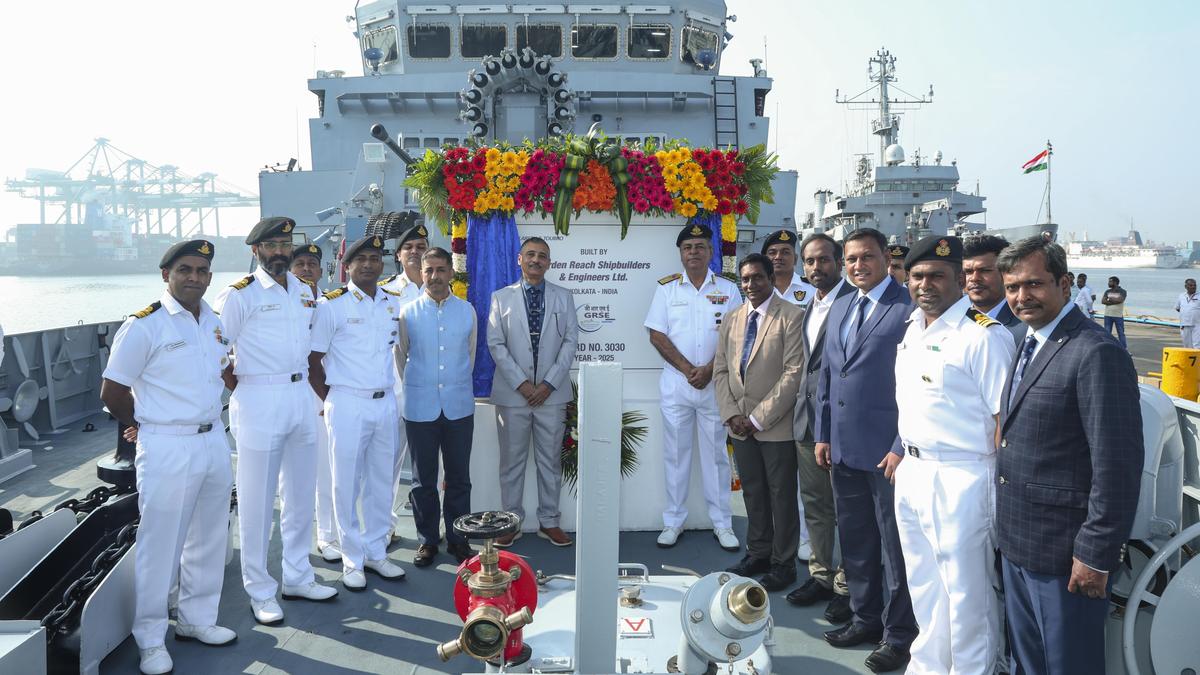
The Indian Navy received the third indigenous Anti-Submarine Warfare (ASW) Shallow Water Craft (SWC) named 'Anjadip'.
GK and monthly revision
Indian Navy receives third indigenous ASW Shallow Water Craft ‘Anjadip’ from GRSE
The Indian Navy has received 'Anjadip', its third indigenous Anti-Submarine Warfare (ASW) Shallow Water Craft (SWC), from Garden Reach Shipbuilders & Engineers (GRSE). This delivery significantly bolsters India's naval capabilities by enhancing its capacity for detecting and engaging underwater threats in shallow waters. It underscores the nation's commitment to 'Make in India' in defence and is crucial for national security and self-reliance.
Revision structure
Monthly events and exam calendar context
Static GK and one-liner notes
Quiz and mock-test revision path
Key points
Exam-ready takeaways
The vessel 'Anjadip' was delivered by Garden Reach Shipbuilders & Engineers (GRSE).
It is equipped with state-of-the-art lightweight torpedoes and indigenously developed anti-submarine rockets.
The craft also features shallow-water sonar for effective detection of underwater threats.
The primary role of 'Anjadip' is to enhance the Indian Navy's capability to detect and engage underwater threats in shallow waters.
Detailed analysis
Full exam-oriented breakdown
The induction of 'Anjadip', the third indigenous Anti-Submarine Warfare (ASW) Shallow Water Craft (SWC), into the Indian Navy from Garden Reach Shipbuilders & Engineers (GRSE) marks a significant milestone in India's journey towards defence self-reliance and bolstering its maritime security. This event is not merely about adding another vessel to the fleet; it embodies a strategic shift, technological prowess, and a commitment to national security. Historically, India has been one of the largest importers of defence equipment globally. This reliance on foreign suppliers often led to geopolitical vulnerabilities, high costs, and delays in critical procurements. Recognizing this challenge, successive governments have emphasized indigenization. The 'Make in India' initiative, launched in 2014, and specifically its defence component, 'Aatmanirbhar Bharat Abhiyan' (Self-Reliant India Campaign) in 2020, have provided a robust policy framework to promote domestic manufacturing. These policies aim to transform India from a net importer to a net exporter of defence hardware, fostering a vibrant domestic defence industrial ecosystem. The Defence Acquisition Procedure (DAP) 2020, for instance, prioritizes 'Buy Indian – IDDM (Indigenously Designed, Developed and Manufactured)' categories, reflecting this strategic imperative. 'Anjadip' is part of an ambitious project to build eight ASW SWCs, with the first two being 'Arnala' and 'Androth'. These vessels are crucial for safeguarding India's vast coastline, island territories, and offshore assets. Shallow waters, characterized by complex seabed topography, varying salinity, and high noise levels, pose unique challenges for anti-submarine operations. Conventional deep-water ASW platforms are often less effective in these environments. The ASW SWCs are specifically designed to operate in these littoral zones, detecting and engaging hostile submarines. Their state-of-the-art equipment, including lightweight torpedoes, indigenously developed anti-submarine rockets, and advanced shallow-water sonar, provides a formidable capability against stealthy underwater threats. Key stakeholders in this achievement include the Indian Navy, which defines the operational requirements and deploys these assets; the Ministry of Defence, responsible for policy formulation, funding, and oversight; and GRSE, a public sector undertaking (PSU) shipyard, which is the primary builder. Furthermore, organizations like the Defence Research and Development Organisation (DRDO) play a pivotal role in developing the indigenous technologies and systems integrated into these crafts, such as the sonar and rocket systems. The broader Indian private defence industry also benefits indirectly by contributing to the supply chain for various components. For India, the significance of 'Anjadip' extends far beyond its operational capabilities. Firstly, it enhances national security by strengthening the Navy's ability to counter underwater threats, particularly from increasingly sophisticated submarines operated by potential adversaries in the Indian Ocean Region (IOR). This is vital for protecting strategic sea lanes of communication and coastal infrastructure. Secondly, it is a tangible success story for the 'Make in India' initiative, demonstrating the country's growing capability in designing, developing, and manufacturing complex defence platforms. This boosts confidence, encourages further investment in defence R&D, and creates skilled jobs, contributing to economic growth. Thirdly, it reinforces India's strategic autonomy, reducing its dependence on foreign suppliers and ensuring that critical defence assets are available without external conditionalities. This aligns with India's foreign policy objective of being a 'net security provider' in the IOR. Constitutionally, the responsibility for national defence falls exclusively under the Union Government, as outlined in Article 246 read with Entry 2 of the Union List (Seventh Schedule), which covers 'Naval, military and air forces; any other armed forces of the Union.' This constitutional mandate empowers the Union to develop and maintain its armed forces to protect the nation's sovereignty and territorial integrity. The development of indigenous platforms like 'Anjadip' is a direct fulfillment of this duty. Looking ahead, the successful delivery of 'Anjadip' and its sister ships will have several implications. It will further accelerate the indigenization drive across all defence sectors, encouraging more private sector participation and innovation. It also positions India as a potential exporter of defence technology and platforms, opening new avenues for economic and strategic partnerships. The continuous modernization of the Indian Navy with such advanced indigenous platforms is critical for maintaining a credible deterrent in a complex geopolitical environment and asserting India's role as a major maritime power in the Indo-Pacific region. This move underscores India's unwavering resolve to secure its maritime interests and project its growing self-reliance on the global stage.
How to study
Turn news into exam marks
Revise monthly events by exam family instead of reading random updates.
Pair one-liners with mock tests so mistakes become the next revision list.
Keep state job pages, calendar pages and GK packs connected in one path.