

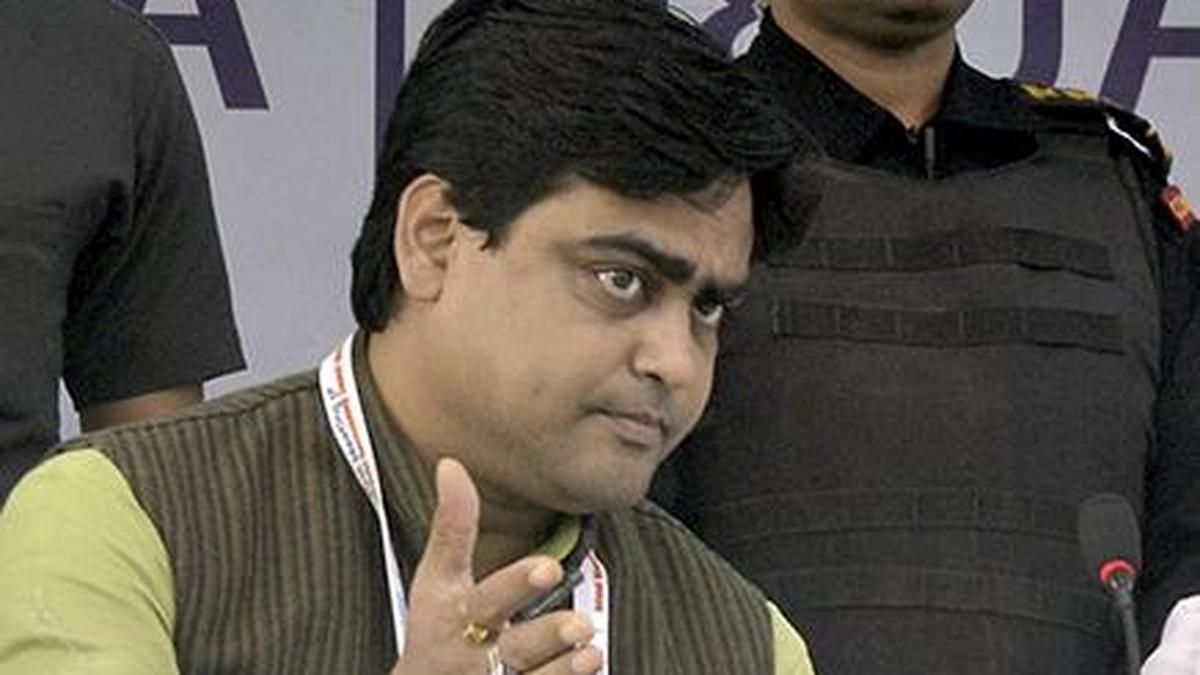
A political row erupted over comments made by BJP Matua leader Shantanu Thakur.
GK and monthly revision
Political row erupts over BJP Matua leader Shantanu Thakur’s comment on deletion of Matua voters in SIR
A political controversy has erupted concerning BJP Matua leader Shantanu Thakur's comments on the deletion of Matua voters in 'SIR'. The BJP had previously urged the Matua community to apply for citizenship under the Citizenship Amendment Act (CAA), assuring them of inclusion in the electoral roll. This issue highlights the intersection of citizenship laws, electoral processes, and community-specific concerns, making it significant for understanding contemporary Indian politics and constitutional provisions in competitive exams.
Revision structure
Monthly events and exam calendar context
Static GK and one-liner notes
Quiz and mock-test revision path
Key points
Exam-ready takeaways
The comments specifically concerned the deletion of Matua voters in a register referred to as 'SIR'.
The BJP had urged the Matua community to apply for citizenship under the Citizenship Amendment Act (CAA).
The BJP had assured the Matua community that their names would appear on the electoral roll after applying for CAA citizenship.
The controversy stems from the political implications of linking CAA application with electoral roll inclusion for the Matua community.
Detailed analysis
Full exam-oriented breakdown
The recent political controversy surrounding BJP Matua leader Shantanu Thakur's comments on the deletion of Matua voters in a register, coupled with the BJP's prior assurances regarding the Citizenship Amendment Act (CAA), brings to the forefront critical aspects of Indian polity, citizenship laws, and electoral dynamics. This issue is deeply rooted in the historical context of Partition and refugee influx, making it a significant point of study for competitive exam aspirants. **Background Context and Historical Roots:** The Matua community comprises a large number of Scheduled Caste refugees who migrated to West Bengal from East Pakistan (now Bangladesh) primarily during and after the Partition of India in 1947, and again after the 1971 Bangladesh Liberation War. Many of them have lived in India for decades without formal citizenship, leading to persistent demands for legal recognition. The community, primarily followers of the Matua Mahasangha, holds significant electoral sway in several districts of West Bengal, particularly North and South 24 Parganas, Nadia, and Howrah. Their votes are crucial for any party aspiring to power in the state. The demand for citizenship for these long-term residents has been a contentious political issue for decades. Successive governments have grappled with the complexities of granting citizenship to this population without encouraging further illegal immigration. The Bharatiya Janata Party (BJP) has actively courted the Matua community, particularly in West Bengal, promising them citizenship through the Citizenship Amendment Act (CAA), 2019. This promise was a key plank of their electoral strategy in the state, aiming to consolidate the refugee vote bank. **What Happened and Key Stakeholders:** The controversy erupted when BJP Matua leader Shantanu Thakur, a Union Minister and a prominent face of the Matua community, reportedly commented on the deletion of Matua voters from a register, referred to as 'SIR' (potentially an electoral roll or a specific register for citizenship claims). This statement created a stir because the BJP had previously assured the Matua community that once they applied for citizenship under the CAA, their names would be included in the electoral rolls. Thakur's comments seemingly contradicted this assurance, causing confusion and concern within the community and providing ammunition for opposition parties. Key stakeholders involved include: 1. **The Matua Community:** The primary beneficiaries and subjects of the CAA, their aspirations for citizenship and inclusion are central to the issue. They feel caught between political promises and the ground reality of administrative processes. 2. **Bharatiya Janata Party (BJP):** The ruling party at the Centre, which enacted the CAA and has used it as a significant political tool, especially in West Bengal, to gain the support of refugee communities. The party faces the challenge of reconciling its assurances with the practicalities of implementation. 3. **Shantanu Thakur:** As a prominent Matua leader within the BJP, his statements carry weight within the community. His comments highlight internal party dynamics and potential discrepancies in communication or policy implementation. 4. **Election Commission of India (ECI):** Responsible for maintaining accurate electoral rolls. Any deletion or inclusion of voters must adhere to ECI guidelines and legal provisions under the Representation of the People Acts, 1950 and 1951. The ECI's role becomes crucial in clarifying voter eligibility based on citizenship status. 5. **Opposition Parties (e.g., Trinamool Congress):** They often criticize the CAA as discriminatory and use such controversies to question the BJP's sincerity and commitment to the Matua community, aiming to regain or consolidate their support. **Significance for India and Constitutional Context:** This issue holds immense significance for India's political, social, and constitutional landscape: * **Political Impact:** It underscores the role of identity politics and refugee votes in West Bengal elections. The BJP's strategy to leverage the CAA for electoral gains is under scrutiny. Any perceived failure to deliver on promises can significantly impact its political fortunes in the state. For instance, in the 2021 West Bengal Assembly elections, the CAA promise played a role, and its non-implementation continues to be a point of contention. * **Social Impact:** It concerns the fundamental rights and dignity of a large refugee population. Delays or ambiguities in granting citizenship can lead to social anxiety, uncertainty, and feelings of marginalization among these communities. It also highlights the broader debate on secularism and non-discriminatory citizenship, given the CAA's provisions based on religion. * **Legal and Constitutional Implications:** The **Citizenship Amendment Act (CAA), 2019**, amends the **Citizenship Act, 1955**, to provide a path to Indian citizenship for Hindu, Sikh, Buddhist, Jain, Parsi, and Christian migrants who entered India from Pakistan, Bangladesh, and Afghanistan on or before December 31, 2014. The controversy brings into focus the implementation rules of the CAA, which were notified only in March 2024. The fundamental articles of the Indian Constitution related to citizenship are **Articles 5 to 11**. Specifically, **Article 14** (equality before law) and **Article 21** (right to life and personal liberty) are often debated in the context of CAA. The process of voter registration is governed by the **Representation of the People Act, 1950** (for preparation of electoral rolls) and **1951** (for conduct of elections), under the superintendence, direction, and control of the **Election Commission of India (Article 324)**. **Future Implications:** The controversy could have several future implications. It might lead to renewed pressure on the government to expedite the CAA implementation process and clarify the status of existing voters who apply under CAA. It could also intensify the political debate over the CAA itself, potentially leading to further legal challenges. The Election Commission might need to issue clearer guidelines regarding the deletion and inclusion of voters based on their citizenship status and CAA applications. For the Matua community, the continued uncertainty could lead to disillusionment with political parties, potentially shifting their electoral allegiances. The larger theme of integrating refugees and ensuring their rights remains a critical governance challenge for India. This incident underscores the complex interplay between law, policy, and identity politics in India, especially concerning citizenship and electoral rights. For competitive exams, understanding the nuances of the CAA, its constitutional challenges, and its socio-political ramifications is crucial.
How to study
Turn news into exam marks
Revise monthly events by exam family instead of reading random updates.
Pair one-liners with mock tests so mistakes become the next revision list.
Keep state job pages, calendar pages and GK packs connected in one path.