

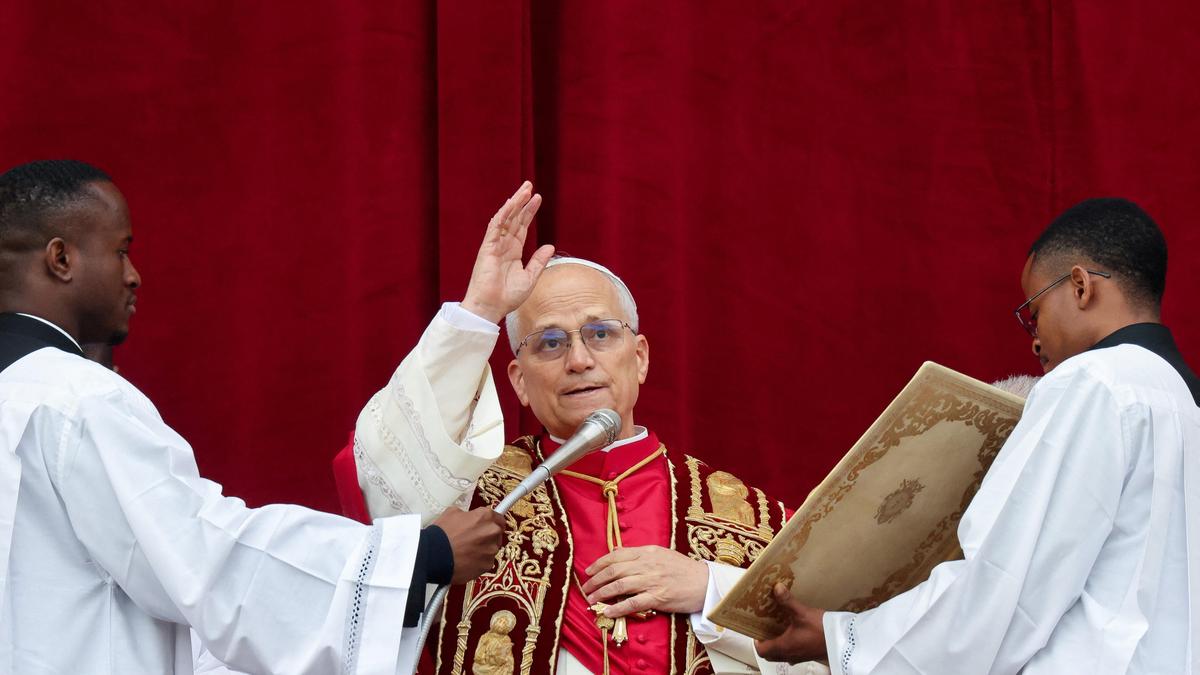
Pope Leo delivered his first Christmas sermon, addressing global issues.
GK and monthly revision
In first Christmas sermon, Pope Leo decries conditions for Palestinians in Gaza
Pope Leo, in his first Christmas sermon, critically highlighted the dire conditions faced by Palestinians in Gaza. He reiterated his long-standing view that a lasting resolution to the decades-long conflict between Israel and the Palestinian people necessitates the establishment of a Palestinian state. This stance by a major global religious leader underscores the international focus on the humanitarian crisis and the push for a two-state solution, making it relevant for international relations and current affairs in competitive exams.
Revision structure
Monthly events and exam calendar context
Static GK and one-liner notes
Quiz and mock-test revision path
Key points
Exam-ready takeaways
He specifically lamented the 'conditions for Palestinians in Gaza'.
Pope Leo stated that the only solution to the 'decades-long conflict' must include a 'Palestinian state'.
He had previously told journalists 'last month' that this solution was necessary.
The statement reflects the Vatican's diplomatic position on the Israel-Palestine conflict.
Detailed analysis
Full exam-oriented breakdown
Pope Leo's poignant Christmas sermon, where he decried the dire conditions for Palestinians in Gaza and advocated for a Palestinian state as the only viable solution to the decades-long conflict, brings into sharp focus one of the most enduring and complex geopolitical issues of our time. This statement by a global spiritual leader carries significant moral and diplomatic weight, compelling the international community to re-evaluate its approach to the Israel-Palestine conflict. **Background Context and Historical Roots:** The conflict's roots run deep, stemming from the late 19th and early 20th centuries with the rise of Zionism and Arab nationalism. Key milestones include the 1917 Balfour Declaration, which expressed British support for a 'national home for the Jewish people' in Palestine, then under Ottoman rule. After World War I, the League of Nations granted Britain a mandate over Palestine. Tensions escalated with increased Jewish immigration, particularly during and after the Holocaust. In 1947, the United Nations proposed a partition plan for Palestine into separate Arab and Jewish states, with Jerusalem as an international city. This plan was accepted by Jewish leaders but rejected by Arab leaders. The subsequent 1948 Arab-Israeli War led to the establishment of the State of Israel and the displacement of hundreds of thousands of Palestinians, an event known as the 'Nakba' (catastrophe). Israel gained control over significantly more territory than allocated by the UN plan, while Gaza came under Egyptian administration and the West Bank under Jordanian control. The 1967 Six-Day War was another pivotal moment, resulting in Israel's occupation of the West Bank, Gaza Strip, East Jerusalem, and the Golan Heights. Since then, Israeli settlements have expanded in these territories, further complicating the prospect of a contiguous Palestinian state. The Gaza Strip, in particular, has faced immense challenges. Following Israel's disengagement in 2005 and Hamas's takeover in 2007, Gaza has been under a strict blockade, leading to a severe humanitarian crisis, characterized by high unemployment, poverty, and inadequate access to essential services like water, electricity, and healthcare. The recent escalation of conflict, triggered by Hamas's attacks on October 7th and Israel's subsequent military response, has pushed Gaza to the brink of a humanitarian catastrophe, with widespread destruction and loss of life. **What Happened and Key Stakeholders:** Pope Leo's sermon is a direct response to this ongoing suffering. By lamenting the 'conditions for Palestinians in Gaza' and asserting that the 'only solution' must include a 'Palestinian state,' he aligns the Vatican with the widely recognized 'two-state solution' framework. This framework envisions an independent Palestinian state coexisting peacefully alongside Israel. The Pope, as the head of the Catholic Church, wields significant moral authority and diplomatic influence globally. The Vatican has consistently called for peace and justice in the Holy Land and maintains diplomatic relations with both Israel and the Palestinian Authority. Key stakeholders involved include: **Pope Leo and the Vatican**, representing a powerful moral voice advocating for human dignity and peace; **Israel**, whose security concerns and historical claims are central to the conflict, and whose current government has expressed reservations about a two-state solution; **Palestine**, represented by the Palestinian Authority in the West Bank and Hamas in Gaza, both aspiring for statehood amidst internal divisions and extreme suffering; and the **International Community**, including the United Nations (which has passed numerous resolutions on the conflict), the United States (a key mediator and Israel's primary ally), the European Union, and the Arab League, all of whom play varied roles in humanitarian aid, diplomatic efforts, and security guarantees. **Significance for India and Future Implications:** For India, the Israel-Palestine conflict is a delicate balancing act rooted in its foreign policy evolution. Historically, India has been a staunch supporter of the Palestinian cause, a stance influenced by its anti-colonial legacy, non-aligned principles, and solidarity with the Global South. India was one of the first non-Arab countries to recognize the Palestine Liberation Organization (PLO) in 1974 and opened its mission in Ramallah in 1996. This support is reflected in India's consistent voting record at the UN in favor of Palestinian self-determination. However, in recent decades, India has also forged robust strategic, economic, and defence ties with Israel, recognizing its technological prowess and security cooperation potential. This necessitates a careful diplomatic approach, advocating for a two-state solution while nurturing relations with both sides. India's foreign policy is guided by principles enshrined in **Article 51 of the Directive Principles of State Policy (DPSP)**, which mandates the state to 'endeavour to promote international peace and security, maintain just and honourable relations between nations, foster respect for international law and treaty obligations, and encourage settlement of international disputes by arbitration.' India's call for a peaceful resolution and humanitarian aid aligns with these constitutional directives and its broader commitment to a rules-based international order. The future implications of the Pope's statement are significant. It amplifies the international call for a political resolution and humanitarian intervention. While the immediate prospects for a two-state solution appear dim given the current political climate and deep-seated mistrust, the Pope's intervention adds to the growing global pressure on all parties to de-escalate and engage in meaningful dialogue. It underscores the importance of religious leaders in shaping global discourse on peace and human rights. For India, maintaining its nuanced position will be crucial for its standing in the Middle East, a region vital for its energy security, trade, and diaspora. The ongoing crisis also highlights broader themes of international law, humanitarian intervention, and the challenges of conflict resolution in a multipolar world. Ultimately, Pope Leo's sermon serves as a powerful reminder that beyond the political and territorial disputes, there is a profound human cost to this conflict, and that a just and lasting peace, including the realization of a Palestinian state, remains an imperative for global stability and human dignity.
How to study
Turn news into exam marks
Revise monthly events by exam family instead of reading random updates.
Pair one-liners with mock tests so mistakes become the next revision list.
Keep state job pages, calendar pages and GK packs connected in one path.