

66% of existing RRTS users are eager to purchase property in India's RRTS corridors, according to a report.
GK and monthly revision
66 pc of existing users eager to purchase property in India's RRTS corridors: Report
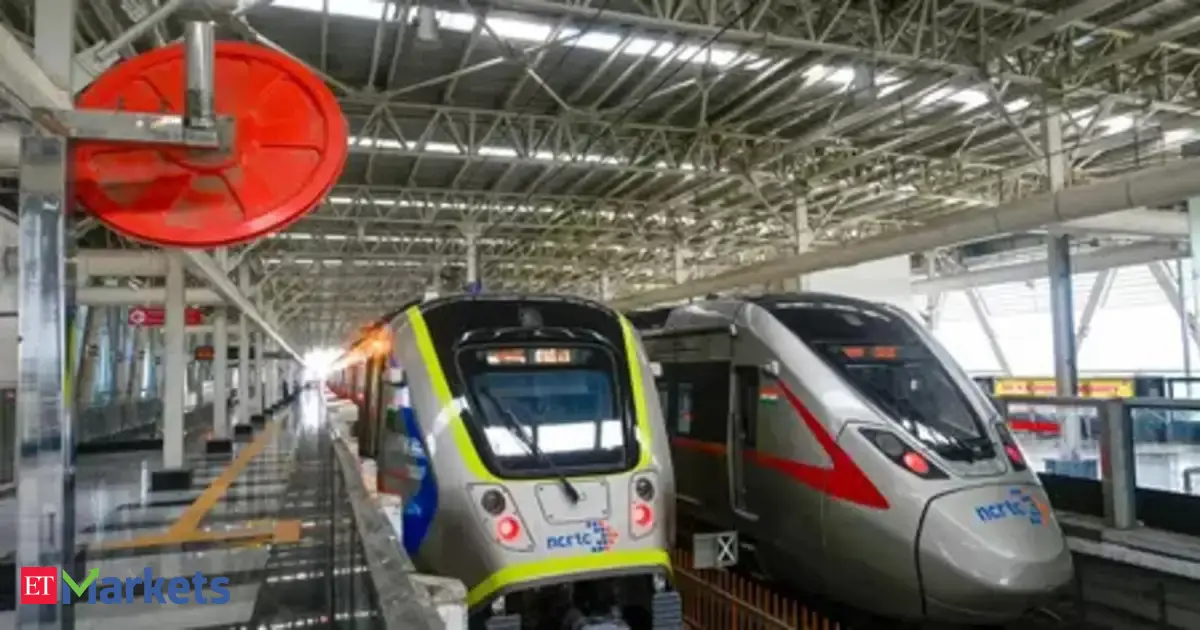
A recent report highlights the significant economic impact of India's Regional Rapid Transit System (RRTS). It reveals that 66% of existing users are keen to buy property in RRTS corridors, while 80% associate improved connectivity with enhanced economic opportunities. This underscores RRTS as a major catalyst for corridor-led investment, making it crucial for understanding urban development and infrastructure's economic role for competitive exams.
Revision structure
Monthly events and exam calendar context
Static GK and one-liner notes
Quiz and mock-test revision path
Key points
Exam-ready takeaways
The report states that nearly 80% of surveyed existing users associate improved RRTS connectivity with enhanced economic opportunities.
The Regional Rapid Transit System (RRTS) is identified as a strong catalyst for corridor-led investment.
The report emphasizes the growing economic potential and investment interest along RRTS routes in the country.
RRTS is emerging as a key driver for property demand and regional economic development in its operational areas.
Detailed analysis
Full exam-oriented breakdown
India's journey towards rapid urbanization has brought with it both immense opportunities and significant challenges, particularly in managing the growing pressure on existing urban infrastructure. The Regional Rapid Transit System (RRTS) emerges as a crucial response to these challenges, aiming to revolutionize regional connectivity and spur economic growth in peri-urban and suburban areas. The recent report highlighting that 66% of existing users are eager to purchase property in RRTS corridors, and 80% associate improved connectivity with enhanced economic opportunities, underscores its transformative potential and its role as a powerful catalyst for corridor-led investment. **Background Context and What Happened:** India's major metropolitan areas, especially the National Capital Region (NCR), have witnessed an exponential increase in population and vehicular traffic over the past few decades. This has led to severe congestion, pollution, and extended commute times, significantly impacting productivity and quality of life. The need for high-speed, high-capacity commuter transit systems connecting regional nodes beyond the immediate city limits became paramount. This necessity gave birth to the RRTS vision. The National Capital Region Transport Corporation (NCRTC), a joint venture of the Government of India and the state governments of Delhi, Haryana, Rajasthan, and Uttar Pradesh, was established in 2013 to implement the RRTS projects. The Delhi-Ghaziabad-Meerut corridor is the first operational RRTS line, marking a significant step in this direction. The report's findings are a testament to the immediate positive perception and tangible impact of the RRTS. The strong desire among existing users to invest in properties along these corridors indicates a burgeoning confidence in the long-term value and economic viability of these regions. This isn't just about faster travel; it's about creating new economic hubs, decentralizing growth, and making previously distant areas accessible and attractive for living and working. **Key Stakeholders Involved:** Several entities are crucial to the success and impact of RRTS: 1. **Government of India (Ministry of Housing and Urban Affairs, NITI Aayog):** Provides policy direction, significant funding, and facilitates inter-state coordination. NITI Aayog often plays a role in strategic planning for such large-scale infrastructure. 2. **State Governments (e.g., Uttar Pradesh, Haryana, Rajasthan, Delhi):** Key partners in funding, land acquisition (a significant challenge in India), providing local clearances, and ensuring last-mile connectivity. 3. **National Capital Region Transport Corporation (NCRTC):** The implementing agency responsible for planning, designing, constructing, operating, and maintaining the RRTS corridors. It’s a specialized body ensuring focused execution. 4. **Multilateral Funding Agencies (e.g., Asian Development Bank - ADB, Asian Infrastructure Investment Bank - AIIB):** Provide substantial financial assistance, crucial for capital-intensive projects like RRTS, often with technical expertise. 5. **Private Developers and Real Estate Companies:** These stakeholders are directly influenced by and, in turn, drive the 'corridor-led investment'. Their willingness to develop residential, commercial, and retail spaces along RRTS routes is critical for realizing the economic potential. 6. **Commuters and Local Populace:** The ultimate beneficiaries, whose travel experience, quality of life, and economic opportunities are directly impacted. **Why This Matters for India (Significance):** RRTS holds immense significance for India's development trajectory: * **Economic Growth and Investment:** It acts as a powerful economic multiplier. The demand for property indicates a surge in real estate development, leading to job creation in construction and ancillary industries. It also fosters industrial and commercial growth along the corridors, turning sleepy towns into vibrant economic centers. This aligns with the 'Make in India' initiative by creating infrastructure that supports industrial expansion. * **Urban Planning and Decongestion:** By offering high-speed connectivity, RRTS facilitates polycentric urban development, reducing the over-reliance and pressure on core cities. It encourages the growth of satellite towns, making them attractive for both residents and businesses, thereby decongesting the main metropolitan areas and improving urban livability. * **Environmental Benefits:** A shift from private vehicles to public transport like RRTS significantly reduces carbon emissions and air pollution, contributing to India's climate change commitments and improving public health. This aligns with the Sustainable Development Goals (SDGs), particularly SDG 11 (Sustainable Cities and Communities). * **Social Impact:** It enhances social equity by providing affordable and efficient transport options, improving access to education, healthcare, and employment opportunities for a wider population, bridging the urban-rural divide within regions. **Historical Context and Constitutional Provisions:** India's urban transport evolution began with local bus services, expanded to suburban rail, and saw a significant leap with the introduction of metro rail systems (e.g., Delhi Metro, operational since 2002). RRTS represents the next logical step, moving beyond intra-city to inter-city regional connectivity. While 'railways' (Entry 22) and 'communications' (Entry 23) fall under the Union List in the **Seventh Schedule** of the Indian Constitution, 'land' (Entry 18), 'public health' (Entry 6), and 'urban planning' (Entry 20) are primarily State List or Concurrent List subjects. This necessitates close collaboration between the Union and State governments for land acquisition, environmental clearances, and integrated urban planning. The **National Urban Transport Policy (NUTP), 2006**, emphasizes sustainable urban transport and the integration of land use and transport planning, providing a policy framework for projects like RRTS. **Future Implications:** The success of the initial RRTS corridors is likely to pave the way for similar projects across other densely populated urban agglomerations in India. This will further fuel the growth of 'smart cities' and integrated regional development. The enhanced connectivity will drive demographic shifts, with more people opting to live in smaller towns and commute to larger cities for work, leading to a more balanced regional development. Furthermore, these corridors could eventually be integrated with freight movement, boosting logistics and supply chains. The long-term vision is to create a robust, multi-modal transport network that is efficient, sustainable, and inclusive, critical for India's ambition to become a developed economy by 2047.
How to study
Turn news into exam marks
Revise monthly events by exam family instead of reading random updates.
Pair one-liners with mock tests so mistakes become the next revision list.
Keep state job pages, calendar pages and GK packs connected in one path.