

India is actively engaged in discussions to finalize trade agreements with the United States.
GK and monthly revision
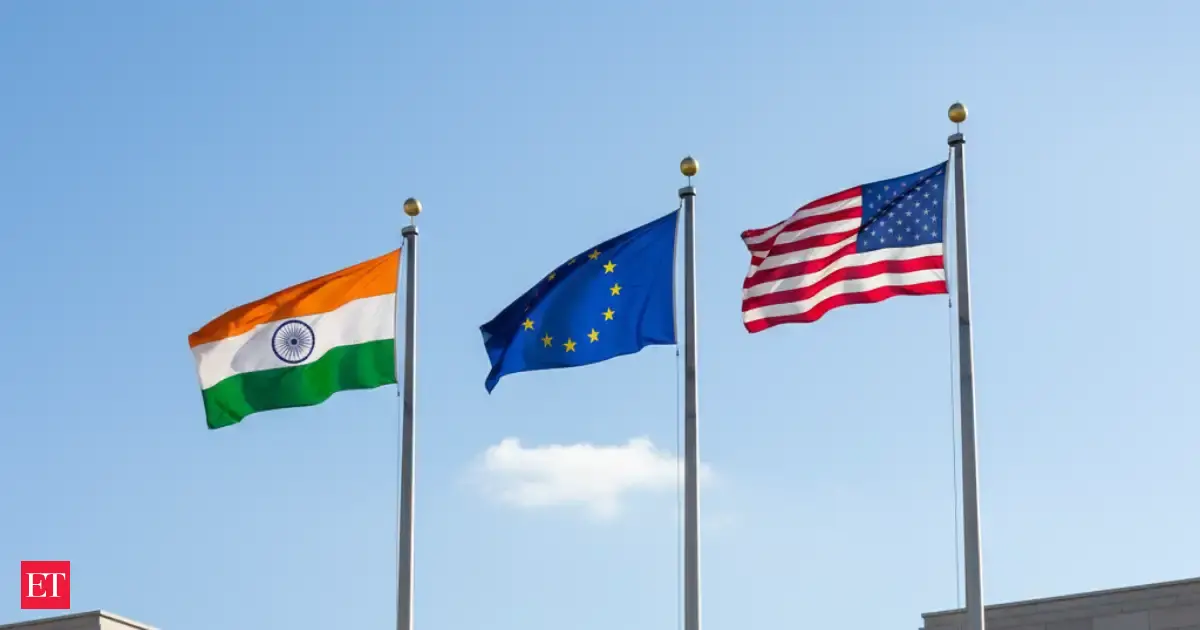
India in active talks with US, EU to conclude trade agreements soon, says MEA
India is actively pursuing trade agreements with the United States and the European Union, with ongoing discussions signaling progress towards mutually beneficial deals. This initiative is crucial for enhancing India's global trade footprint and economic growth, reflecting a strategic focus on international economic diplomacy. The successful conclusion of the New Zealand FTA sets a positive precedent, highlighting India's proactive approach to securing significant trade partnerships, which is a key area for competitive exam preparation.
Revision structure
Monthly events and exam calendar context
Static GK and one-liner notes
Quiz and mock-test revision path
Key points
Exam-ready takeaways
Ongoing negotiations are being pursued by India for a trade agreement with the European Union (EU).
The Ministry of External Affairs (MEA) confirmed India's proactive stance on these trade agreements.
The successful conclusion of the Free Trade Agreement (FTA) with New Zealand is cited as a positive precedent.
These trade agreements are aimed at being fair and mutually beneficial, aligning with India's global trade strategy.
Detailed analysis
Full exam-oriented breakdown
India's proactive engagement in trade agreement discussions with economic giants like the United States and the European Union marks a significant pivot in its global economic strategy. This move, confirmed by the Ministry of External Affairs, signals India's intent to deepen its integration into the global economy, moving beyond its historically cautious approach to trade liberalization. The successful conclusion of the Free Trade Agreement (FTA) with New Zealand serves as a crucial precedent, showcasing India's capability and commitment to securing mutually beneficial deals. **Background Context and Historical Trajectory:** For decades post-independence, India largely pursued an inward-looking, protectionist economic policy, prioritizing self-reliance. The economic reforms of 1991, however, initiated a gradual opening up. While India became a founding member of the World Trade Organization (WTO) in 1995, its engagement with bilateral and regional trade agreements remained measured. A significant shift occurred after India's withdrawal from the Regional Comprehensive Economic Partnership (RCEP) in November 2019, primarily due to concerns over domestic industry protection, particularly agriculture and dairy, and potential trade deficits with certain member countries. This withdrawal spurred a renewed focus on strategic bilateral FTAs with developed economies and key partners, aligning with India's aspiration to become a $5 trillion economy by 2025-26 and enhance its share in global trade. This strategic re-evaluation also takes into account geopolitical shifts, supply chain resilience post-COVID-19, and the need for diversified export markets. **Current Engagements and Key Stakeholders:** India is actively engaged in discussions with the United States, a crucial strategic partner and one of its largest trading partners. These discussions often take place within frameworks like the India-US Trade Policy Forum, addressing issues ranging from market access for agricultural products to intellectual property rights and services. The aim is to resolve long-standing trade irritants and forge a comprehensive, fair, and mutually beneficial trade pact. Key stakeholders on the Indian side include the Ministry of Commerce and Industry, the Ministry of External Affairs, various industry associations (CII, FICCI), and export promotion councils. In the US, the Office of the United States Trade Representative (USTR), various business lobbies, and congressional committees are central players. Similarly, negotiations with the European Union, a significant economic bloc and India's third-largest trading partner, were initially launched in 2007 but stalled in 2013 due to differences over issues such as tariffs, market access for automobiles, and data security. The talks were formally relaunched in June 2022, alongside an Investment Protection Agreement and an Agreement on Geographical Indications. This renewed push underscores a shared commitment to strengthening economic ties amidst global uncertainties. The European Commission leads negotiations on behalf of the EU's 27 member states, with European businesses and consumer groups also being vital stakeholders. **Significance for India:** These trade agreements hold immense significance for India. Economically, they promise enhanced market access for Indian goods and services, particularly in sectors like textiles, pharmaceuticals, IT services, and engineering goods, boosting exports and potentially reducing trade deficits. They can also attract foreign direct investment (FDI) and technology transfer, crucial for the 'Make in India' initiative and job creation. By integrating India more deeply into global value chains, these agreements can improve the competitiveness of Indian industries. Politically and strategically, closer economic ties with the US and EU strengthen India's geopolitical standing, diversify its strategic partnerships, and provide a counter-balance in an evolving global order. For consumers, increased competition could lead to higher quality products at competitive prices, while specific sectors like agriculture might face challenges requiring careful negotiation and domestic support mechanisms. **Constitutional and Policy Framework:** India's ability to enter into and implement international agreements is enshrined in its Constitution. **Article 253** grants Parliament the power to make any law for implementing any treaty, agreement, or convention with any other country or any decision made at any international conference, association, or other body. Furthermore, **Entry 14 of the Union List (List I) in the Seventh Schedule** explicitly lists 'Entering into treaties and agreements with foreign countries and implementing of treaties, agreements and conventions with foreign countries' as a subject for which the Union Parliament has exclusive legislative competence. The **Foreign Trade (Development and Regulation) Act, 1992**, provides the legal framework for governing foreign trade in India, empowering the central government to formulate and implement foreign trade policy. These agreements also align with India's broader foreign policy objectives of economic diplomacy and its National Foreign Trade Policy, which seeks to boost exports and integrate India into the global economy. **Future Implications:** The successful conclusion of these FTAs would be a game-changer for India, positioning it as a more significant player in global trade. It would signal India's commitment to open and rules-based trade, potentially attracting more investment and fostering economic growth. However, challenges remain, including addressing non-tariff barriers, ensuring fair labor standards, environmental protection, and intellectual property rights. The negotiations will require India to balance the interests of its domestic industries, particularly sensitive sectors like agriculture and MSMEs, with the opportunities presented by greater market access. The outcome will not only reshape India's bilateral relations but also influence its stance in multilateral forums and its overall trajectory towards becoming a major economic power, impacting millions of livelihoods and setting precedents for future trade engagements.
How to study
Turn news into exam marks
Revise monthly events by exam family instead of reading random updates.
Pair one-liners with mock tests so mistakes become the next revision list.
Keep state job pages, calendar pages and GK packs connected in one path.