

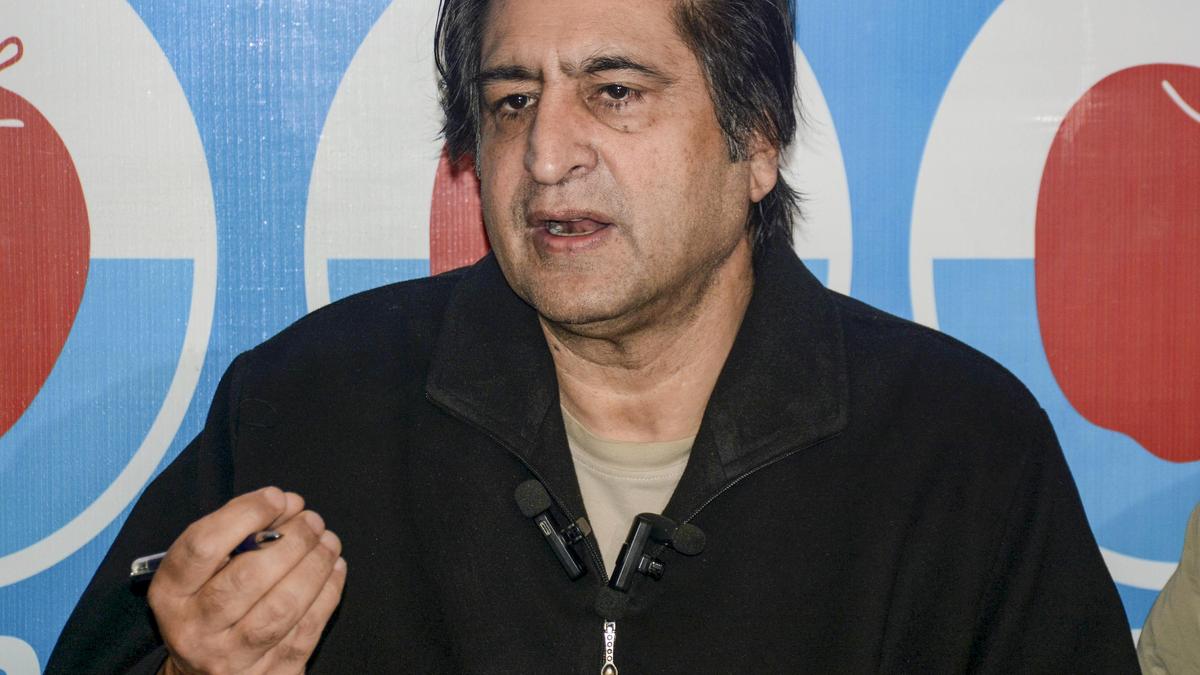
Political leader Sajad Lone stated that harassment of Kashmiris in other states is a "matter of national security."
GK and monthly revision
Harassment of Kashmiris in other states is matter of national security: Sajad Lone
Sajad Lone, a political leader, termed the alleged harassment of Kashmiris in other states a "matter of national security," urging intervention from J&K Lieutenant Governor Manoj Sinha and Chief Minister Omar Abdullah. This statement underscores the ongoing concerns regarding the safety and integration of individuals from Jammu and Kashmir across India, making it relevant for understanding internal security and regional dynamics in competitive exams.
Revision structure
Monthly events and exam calendar context
Static GK and one-liner notes
Quiz and mock-test revision path
Key points
Exam-ready takeaways
Lone urged Jammu and Kashmir Lieutenant Governor Manoj Sinha to intervene in the issue.
He also called upon Chief Minister Omar Abdullah to address the reported harassment.
The core concern raised was the alleged harassment faced by individuals from Jammu and Kashmir.
The statement highlights political discourse surrounding the safety and integration of Kashmiris across India.
Detailed analysis
Full exam-oriented breakdown
Sajad Lone's assertion that the harassment of Kashmiris in other states constitutes a "matter of national security" is a potent statement, highlighting deep-seated issues concerning national integration, internal security, and human rights in India. This declaration, coupled with his appeal to Jammu and Kashmir Lieutenant Governor Manoj Sinha and prominent political leader Omar Abdullah, underscores the urgent need to address the perceived alienation and safety concerns of individuals from the region. **Background Context: **The historical context of Jammu and Kashmir (J&K) is crucial to understanding the gravity of Lone's statement. For decades, J&K enjoyed a unique constitutional status under Article 370 and Article 35A of the Indian Constitution, granting it significant autonomy. This special status was abrogated on August 5, 2019, by the Union Government, which simultaneously reorganized the state into two Union Territories: Jammu & Kashmir and Ladakh, through the Jammu and Kashmir Reorganisation Act, 2019. This monumental decision aimed at fully integrating J&K with the rest of India, but it also led to significant political and social upheaval, a communication blackout, and widespread arrests of political leaders. While the government argued this step would foster development and end separatism, many Kashmiris felt further disempowered and alienated. In the aftermath, there have been sporadic reports and concerns about Kashmiris, particularly students and traders, facing discrimination, harassment, or social boycott in various parts of India, creating an environment of apprehension and mistrust. **What Happened and Key Stakeholders: **Sajad Lone, a prominent political leader from J&K and chairman of the Jammu and Kashmir People's Conference, publicly stated that the alleged harassment of Kashmiris outside their home territory is a "matter of national security." This strong phrasing elevates the issue beyond mere law and order to a concern that could potentially destabilize national cohesion. He urged the intervention of Lieutenant Governor Manoj Sinha, who represents the Union government in the UT of J&K, and Omar Abdullah, a former Chief Minister and a significant political voice of the National Conference. While J&K currently operates as a Union Territory without an elected Chief Minister, Lone's call to Abdullah indicates the enduring influence of established political figures in the region's discourse. The key stakeholders involved are the Kashmiri individuals facing harassment, the state governments where such incidents occur, the Union Territory administration of J&K, the Union Government (especially the Ministry of Home Affairs, responsible for internal security), and various political leaders advocating for the rights and safety of Kashmiris. **Why This Matters for India: **This issue has profound implications for India across several dimensions. Firstly, it directly challenges the principle of **national integration**. If citizens from one part of the country feel unsafe or discriminated against in other parts, it undermines the very idea of 'Ek Bharat, Shreshtha Bharat' (One India, Great India). Such incidents erode trust in the state's ability to protect all its citizens, irrespective of their origin. Secondly, it has significant **internal security ramifications**. Perceived injustice and continuous harassment can foster a sense of alienation, potentially making vulnerable individuals susceptible to radicalization by inimical forces, both internal and external, who seek to exploit grievances to fuel unrest and separatism. This could exacerbate the already complex security situation in J&K. Thirdly, it touches upon fundamental **human rights and constitutional guarantees**. Articles 14 (Equality before law), 15 (Prohibition of discrimination), 19(1)(d) & (e) (Freedom of movement and residence), and 21 (Right to life and personal liberty) are directly implicated. Every Indian citizen has the right to live, work, and move freely across the country without fear of discrimination or harassment. Violations of these rights, especially against a specific community, weaken the democratic fabric of the nation. Economically, such harassment can deter Kashmiri students from pursuing education and professionals from seeking employment outside J&K, limiting their opportunities and hindering their contribution to the national economy. Socially, it creates divisions and prejudices, hindering the development of a truly inclusive society. **Future Implications: **Addressing this issue is critical for the long-term stability and integration of J&K with the Indian mainstream. The future implications include the urgent need for proactive measures from both central and state governments. This involves sensitive and prompt law enforcement action against perpetrators of harassment, robust awareness campaigns to promote tolerance and understanding, and mechanisms for grievance redressal. The upcoming assembly elections in J&K, whenever they are held, will likely see this issue as a prominent point of political discourse. Ensuring the safety and dignity of Kashmiris across India is paramount for building bridges of trust, fostering genuine integration, and ultimately strengthening India's national security and unity. Failure to address these concerns effectively could lead to deeper alienation, further complicating the path to peace and development in the region.
How to study
Turn news into exam marks
Revise monthly events by exam family instead of reading random updates.
Pair one-liners with mock tests so mistakes become the next revision list.
Keep state job pages, calendar pages and GK packs connected in one path.