

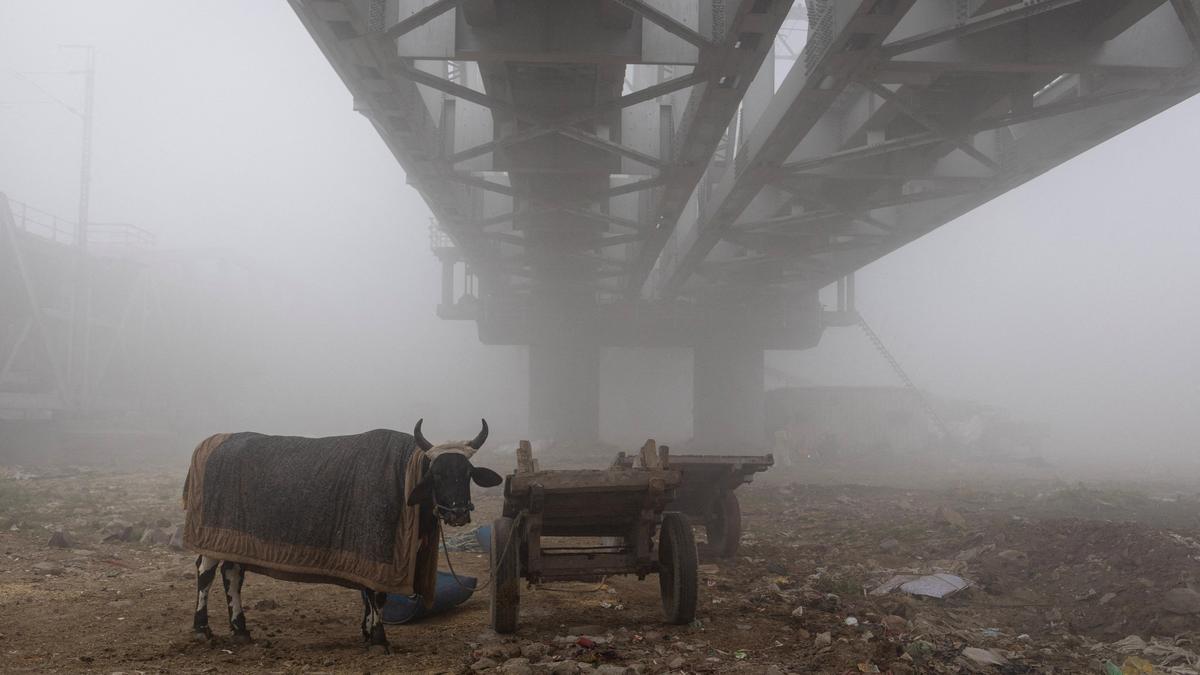
Delhi was shrouded in dense fog, significantly impacting visibility and air quality.
GK and monthly revision
Dense fog shrouds Delhi; air quality lets up, 'very poor' with AQI 388
Delhi experienced dense fog, leading to 'very poor' air quality with an Air Quality Index (AQI) of 388. This recurring environmental issue highlights the challenges of urban pollution and its health impacts, making it crucial for competitive exams focusing on environment, geography, and public health. The persistent 'very poor' outlook for the next six days underscores the severity and ongoing nature of the problem.
Revision structure
Monthly events and exam calendar context
Static GK and one-liner notes
Quiz and mock-test revision path
Key points
Exam-ready takeaways
The Air Quality Index (AQI) in Delhi was recorded at 388.
The air quality category for Delhi was classified as 'very poor'.
The outlook for the subsequent six days indicates that air quality is likely to remain in the 'very poor' range.
The issue of dense fog and 'very poor' air quality is a recurring environmental challenge for Delhi.
Detailed analysis
Full exam-oriented breakdown
The recurring phenomenon of dense fog shrouding Delhi, leading to 'very poor' air quality with an Air Quality Index (AQI) of 388, is not merely a weather event but a stark indicator of India's significant environmental challenges. This situation, particularly prevalent during the winter months, is a complex interplay of geographical factors, meteorological conditions, and anthropogenic activities, making it a critical issue for governance, public health, and sustainable development. **Background Context: The Anatomy of Delhi's Air Crisis** Delhi's geographical location in the Indo-Gangetic Plains, coupled with its landlocked nature, makes it highly susceptible to air pollution. During winter, a meteorological phenomenon called 'temperature inversion' traps pollutants close to the ground. Cold, dense air near the surface, often laden with moisture, prevents the upward dispersion of pollutants, leading to the formation of 'smog' – a portmanteau of smoke and fog. The dense fog mentioned in the article exacerbates this by providing surfaces for particulate matter to condense upon, further reducing visibility and concentrating harmful pollutants. The primary sources of these pollutants include vehicular emissions, industrial discharges, dust from construction activities, biomass burning (including stubble burning in neighbouring states like Punjab, Haryana, and Uttar Pradesh), and domestic heating. This toxic cocktail transforms the city's air into a health hazard every year. **What Happened: A Recurring Nightmare** The report highlights an AQI of 388, categorizing the air quality as 'very poor.' An AQI between 301 and 400 is considered 'very poor,' capable of causing respiratory illness on prolonged exposure. The concerning aspect is the forecast for the next six days, indicating a persistent 'very poor' air quality. This suggests that the contributing factors are deeply entrenched and resistant to immediate short-term solutions, pointing towards systemic issues that demand comprehensive, long-term strategies. **Key Stakeholders and Their Interplay** Addressing Delhi's air pollution involves a multitude of stakeholders. The **Central Government**, primarily through the Ministry of Environment, Forest and Climate Change (MoEFCC) and the Commission for Air Quality Management (CAQM), sets national policies and coordinates efforts. The **Delhi Government** is responsible for implementing these policies at the local level, including managing vehicular traffic, waste, and local industrial emissions. **Neighbouring State Governments** (Punjab, Haryana, Uttar Pradesh) play a crucial role, especially concerning agricultural practices like stubble burning. The **Supreme Court of India** and the **National Green Tribunal (NGT)** have frequently intervened, issuing directives and holding authorities accountable. **Industries** and **construction companies** are direct contributors and are mandated to adhere to emission norms. Finally, **citizens** are both victims and contributors, with their choices in transport, energy consumption, and waste disposal impacting air quality. **Significance for India: A Multifaceted Crisis** This issue holds profound significance for India. From a **health perspective**, prolonged exposure to 'very poor' air leads to a surge in respiratory illnesses, cardiovascular diseases, and even premature deaths, placing an immense burden on public health infrastructure. Economically, it results in lost productivity, increased healthcare expenditures, and impacts sectors like tourism. Socially, it exacerbates inequalities, as the poor often live in more polluted areas and have less access to quality healthcare. Politically, it has become a major electoral issue and a test of governance, often leading to blame games between different levels of government. Internationally, Delhi's persistent air pollution tarnishes India's image, affecting foreign investment and tourism. **Constitutional and Legal Framework** India's commitment to environmental protection is enshrined in its Constitution. **Article 21**, the 'Right to Life,' has been interpreted by the Supreme Court to include the right to a clean environment. **Article 48A** (Directive Principles of State Policy) mandates the State to 'endeavour to protect and improve the environment and to safeguard the forests and wildlife of the country.' **Article 51A(g)** (Fundamental Duties) makes it a duty of every citizen 'to protect and improve the natural environment including forests, lakes, rivers and wildlife, and to have compassion for living creatures.' Legally, the **Environment (Protection) Act, 1986**, and the **Air (Prevention and Control of Pollution) Act, 1981**, provide the legislative framework for pollution control. More recently, the **Commission for Air Quality Management in National Capital Region and Adjoining Areas Act, 2021**, was enacted to provide a statutory body for better coordination and enforcement. The **Graded Response Action Plan (GRAP)**, implemented since 2017, outlines emergency measures based on air quality levels. **Future Implications: A Path Towards Sustainable Air** The persistent nature of Delhi's air pollution necessitates a sustained, multi-pronged approach. This includes stricter enforcement of emission norms for vehicles and industries, promotion of public transport and electric vehicles, better waste management, dust control at construction sites, and most critically, effective solutions for stubble burning. Shifting agricultural practices and providing farmers with alternatives are crucial. Inter-state cooperation, facilitated by bodies like CAQM, is paramount. Investing in renewable energy sources and promoting public awareness and participation are also key. Without these concerted efforts, Delhi's residents will continue to breathe hazardous air, impacting not only their health but also the city's, and by extension, the nation's future development trajectory.
How to study
Turn news into exam marks
Revise monthly events by exam family instead of reading random updates.
Pair one-liners with mock tests so mistakes become the next revision list.
Keep state job pages, calendar pages and GK packs connected in one path.