

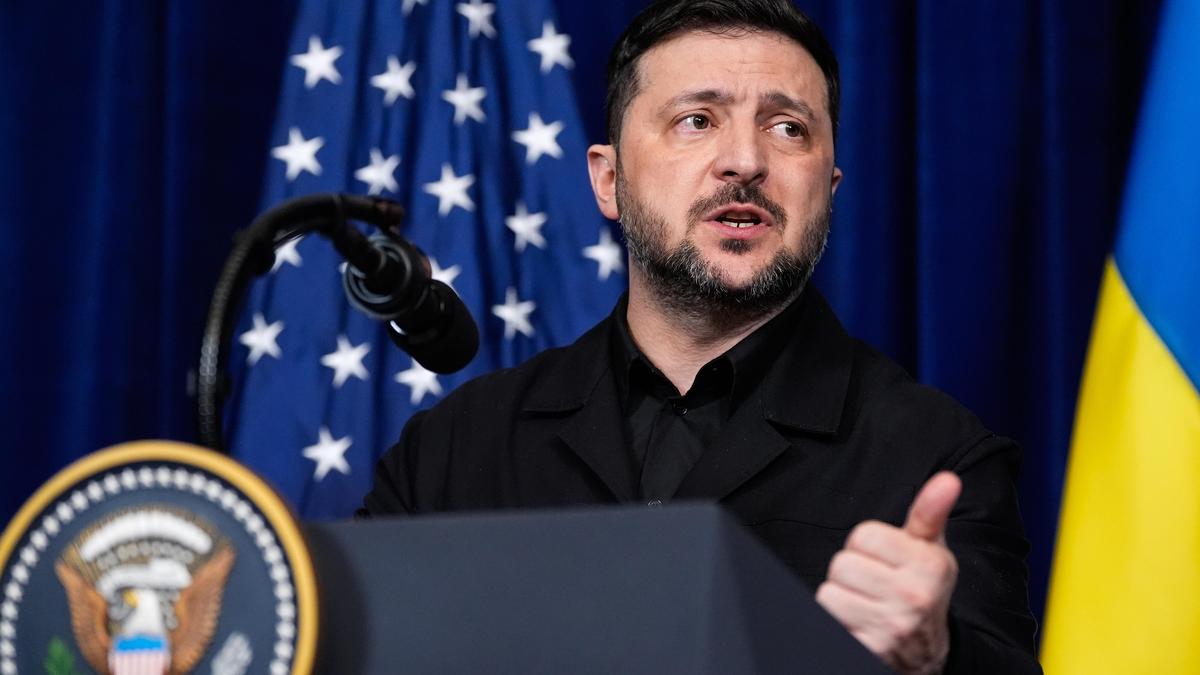
Ukrainian President Zelenskyy stated he would not sign a 'weak deal' that would only prolong the war.
GK and monthly revision
Zelenskyy says he won't sign weak deal that will only prolong war
Ukrainian President Zelenskyy stated he would not sign a weak peace deal, emphasizing that such an agreement would only prolong the ongoing conflict. He highlighted that Ukrainians are exhausted from nearly four years of war, a duration exceeding the German World War Two occupation of many Ukrainian cities. This position is crucial for understanding Ukraine's negotiation stance and the geopolitical implications of potential peace settlements, making it relevant for international relations and current affairs sections in competitive exams.
Revision structure
Monthly events and exam calendar context
Static GK and one-liner notes
Quiz and mock-test revision path
Key points
Exam-ready takeaways
Ukrainians are exhausted from 'nearly four years' of conflict.
The duration of the current war is longer than the 'German World War Two occupation' of many Ukrainian cities.
The statement was made by Ukrainian President Volodymyr Zelenskyy.
The country central to the conflict mentioned is Ukraine.
Detailed analysis
Full exam-oriented breakdown
Ukrainian President Volodymyr Zelenskyy's staunch declaration that he will not sign a "weak deal" that merely prolongs the war underscores the profound and enduring nature of the conflict in Ukraine. This statement is not just a political stance; it reflects the deep exhaustion, immense sacrifice, and unwavering resolve of the Ukrainian people, who have endured nearly four years of large-scale aggression—a period Zelenskyy poignantly noted is longer than the German World War Two occupation of many Ukrainian cities. Understanding this context is crucial for competitive exam aspirants, as it provides insight into global geopolitics, international relations, and India's position on the world stage. The conflict's background is complex, rooted in historical grievances and geopolitical aspirations. Following the collapse of the Soviet Union in 1991, Ukraine gained independence, fostering closer ties with the West, particularly after the 2004 Orange Revolution and the 2014 Maidan Revolution. Russia, viewing NATO's eastward expansion as a direct threat to its security interests, reacted by annexing Crimea in March 2014 and supporting separatists in the Donbas region, initiating a low-intensity conflict. The full-scale invasion launched by Russia on February 24, 2022, escalated this long-simmering tension into a major international crisis, fundamentally altering the European security landscape. Key stakeholders in this conflict are numerous and diverse. At the forefront are **Ukraine** and its President, Volodymyr Zelenskyy, whose primary goal is to restore territorial integrity, sovereignty, and secure a future free from Russian aggression, potentially within the European Union and NATO. The **Russian Federation**, led by President Vladimir Putin, aims to prevent Ukraine's integration into Western alliances, ensure its geopolitical influence in the region, and consolidate control over annexed territories. **NATO and the European Union**, comprising Western powers like the United States, United Kingdom, Germany, and France, are vital supporters of Ukraine, providing extensive military, financial, and humanitarian aid. Their objective is to uphold international law, deter further Russian aggression, and maintain the post-WWII international order. Other international actors include the **United Nations**, which focuses on humanitarian assistance and diplomatic efforts, and **China**, which maintains strategic ties with Russia while calling for peace, often without directly condemning Russia's actions. The Global South, including India, generally advocates for dialogue and peace, while navigating the economic ramifications of the conflict. For India, the Ukraine conflict carries significant implications. India has maintained a delicate geopolitical balancing act, rooted in its historical strategic partnership with Russia (especially in defence and energy) and its growing strategic alignment with Western powers (e.g., through the Quad). India's foreign policy, guided by the principle of strategic autonomy and non-alignment, has seen it refrain from explicitly condemning Russia while consistently calling for a peaceful resolution through dialogue and diplomacy, emphasizing respect for sovereignty and territorial integrity. Economically, the war has had a substantial impact: it has contributed to global inflation, particularly in energy and food prices, given that both Ukraine and Russia are major exporters of crude oil, natural gas, wheat, and sunflower oil. India, as a major oil importer, has faced increased import bills, though it has also capitalized on discounted Russian oil. The conflict also highlights India's efforts to diversify its defence procurement, reducing its historical dependence on Russian military hardware. India's stance is often viewed through the lens of **Article 51 of the Indian Constitution**, a Directive Principle of State Policy, which mandates the state to promote international peace and security, maintain just and honourable relations between nations, foster respect for international law and treaty obligations, and encourage settlement of international disputes by arbitration. This article underpins India's consistent calls for de-escalation and peaceful resolution. The historical context of the war's duration, exceeding the German World War Two occupation, is a powerful rhetorical tool for Zelenskyy, highlighting the immense suffering and existential threat perceived by Ukrainians. It underscores their resolve not to accept a superficial peace that might leave their sovereignty compromised or merely defer future aggression. Looking ahead, Zelenskyy's firm stance suggests a prolonged conflict if a comprehensive and robust peace agreement, addressing Ukraine's core security and territorial concerns, is not reached. This could lead to continued geopolitical realignments, further isolation of Russia from the Western-led international system, and ongoing global economic instability. The conflict also poses fundamental challenges to international law and the principles of the UN Charter, particularly regarding state sovereignty and the prohibition of aggressive force. The future implications for India include navigating a more fragmented global order, managing economic vulnerabilities, and continuing to articulate a foreign policy that balances national interests with global stability and adherence to international norms. In essence, Zelenskyy's statement is a critical indicator of Ukraine's non-negotiable demands for a durable peace, shaped by years of conflict and existential threats. It compels the international community, including India, to consider the long-term consequences of the war and the pathways to a truly sustainable resolution.
How to study
Turn news into exam marks
Revise monthly events by exam family instead of reading random updates.
Pair one-liners with mock tests so mistakes become the next revision list.
Keep state job pages, calendar pages and GK packs connected in one path.