

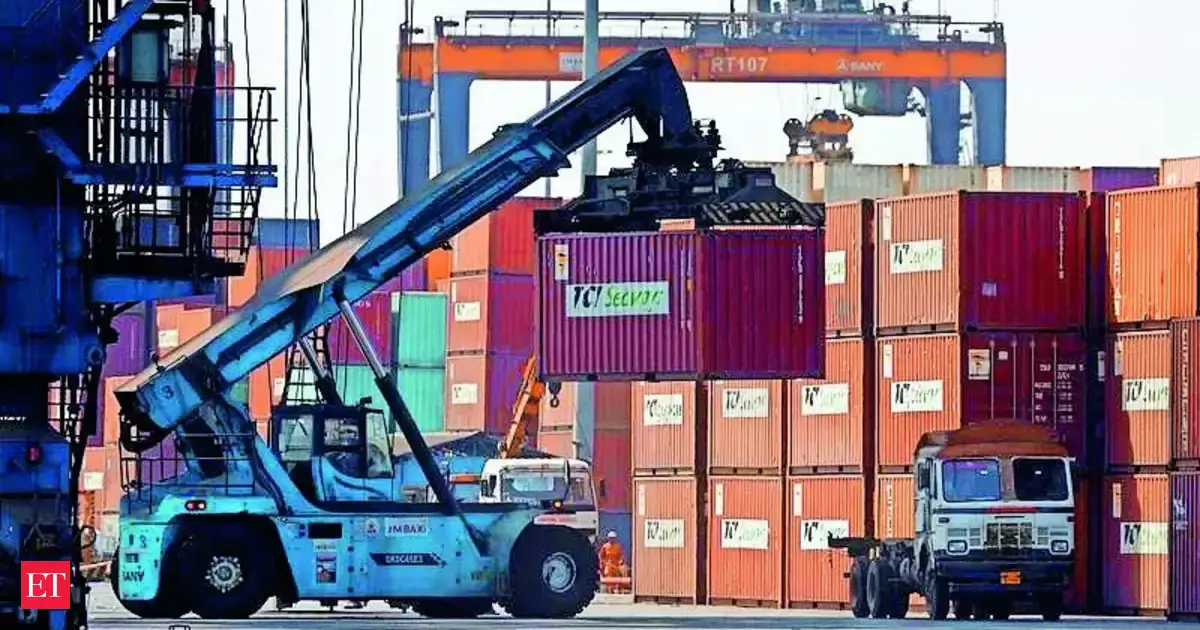
India has launched an export credit support package valued at ₹7,295 crore.
GK and monthly revision
India announces ₹7,295 crore export credit support package to ease financing for exporters
India has launched a significant export credit support package worth ₹7,295 crore, to be implemented over six years starting from 2025. This initiative aims to make trade finance faster and cheaper for exporters by providing interest subvention and collateral support. It is crucial for boosting India's exports and addressing critical trade finance challenges, making it highly relevant for competitive exams on economic policies and government schemes.
Revision structure
Monthly events and exam calendar context
Static GK and one-liner notes
Quiz and mock-test revision path
Key points
Exam-ready takeaways
The export support package is designed to be implemented over a period of six years.
The implementation of this package is scheduled to commence from the year 2025.
Key components of the package include an interest subvention scheme and collateral support.
The primary goal of the initiative is to make trade finance faster and cheaper for Indian exporters.
Detailed analysis
Full exam-oriented breakdown
India's recent announcement of a substantial ₹7,295 crore export credit support package, set to be implemented over six years from 2025, marks a pivotal move in bolstering the nation's trade ambitions. This initiative, designed to provide interest subvention and collateral support, aims to make trade finance both faster and cheaper for Indian exporters, addressing a long-standing bottleneck in their global competitiveness. **Background Context and the Need for Support:** India, a rapidly growing economy, has consistently aimed to increase its share in global trade. However, its exporters often grapple with high costs of credit, limited access to finance, and complex procedural hurdles, especially when compared to competitors from other nations that offer robust state support. The global economic landscape, marked by supply chain disruptions, protectionist tendencies, and fluctuating demand, further intensifies these challenges. Indian businesses, particularly Micro, Small, and Medium Enterprises (MSMEs) which form the backbone of the export sector, find it difficult to secure adequate working capital and post-shipment finance at competitive rates. This often leads to a higher cost of goods, making them less attractive in international markets. Recognising these structural impediments, the government's intervention through such a package becomes crucial to level the playing field and unlock India's export potential. **The Package Explained and Key Stakeholders:** At its core, the ₹7,295 crore package will be disbursed over six years, starting from 2025. The two main components, interest subvention and collateral support, are direct financial incentives. Interest subvention essentially means the government will bear a part of the interest cost on export credit, reducing the burden on exporters. Collateral support, on the other hand, helps exporters, especially those with limited assets, to secure loans by providing guarantees to banks, thereby mitigating the risk for financial institutions. Key stakeholders in this initiative include: 1. **Government of India:** Primarily the Ministry of Commerce & Industry and the Ministry of Finance, responsible for policy formulation, fund allocation, and overall oversight. 2. **Reserve Bank of India (RBI):** Plays a crucial role in regulating the financial system, ensuring adequate credit flow to the export sector, and monitoring the implementation of various banking schemes. 3. **Commercial Banks and Financial Institutions:** These are the frontline agencies that disburse export credit to businesses. They will be instrumental in implementing the interest subvention and collateral support schemes. 4. **Export Credit Guarantee Corporation of India (ECGC):** An important entity that provides credit risk insurance and related services to Indian exporters, thereby enhancing the creditworthiness of export proposals and making it easier for banks to lend. 5. **Indian Exporters:** The ultimate beneficiaries, ranging from large corporations to MSMEs across various sectors like textiles, engineering goods, pharmaceuticals, and agricultural products. **Significance for India and Historical Context:** This package holds immense significance for India's economic trajectory. By making finance cheaper and more accessible, it directly boosts export competitiveness, leading to increased foreign exchange earnings, which are vital for managing the Balance of Payments and strengthening the Rupee. A vibrant export sector also fuels industrial growth, promotes the 'Make in India' and 'Atmanirbhar Bharat' initiatives by encouraging domestic manufacturing for global markets, and creates significant employment opportunities across various skill levels. Historically, India has had various export promotion schemes, evolving from the Merchandise Exports from India Scheme (MEIS) to the Remission of Duties and Taxes on Exported Products (RoDTEP) scheme, which became WTO-compliant. This new package signifies a continuous, adaptive approach by the government to support exporters within global trade norms. **Constitutional and Policy Framework:** While there isn't a single constitutional article directly mandating export credit support, the overall framework for promoting trade and economic development is enshrined in the Constitution. For instance, **Part XIII (Articles 301-307)** deals with the freedom of trade, commerce, and intercourse within the territory of India, providing the foundational principle for economic activity. The actual implementation of such schemes falls under the executive powers of the Union government. The primary legislative backing for foreign trade comes from the **Foreign Trade (Development and Regulation) Act, 1992**, which empowers the government to formulate and implement the Foreign Trade Policy (FTP). The Directorate General of Foreign Trade (DGFT), under the Ministry of Commerce & Industry, is the nodal agency for implementing these policies. The RBI's role in credit policy is governed by the **Reserve Bank of India Act, 1934**. **Future Implications:** This export credit package is expected to play a crucial role in helping India achieve its ambitious export targets, potentially pushing closer to the goal of $1 trillion in merchandise exports by 2030. It could lead to the diversification of India's export basket, reducing over-reliance on a few sectors and markets. However, its success will depend on effective implementation, timely disbursal of funds, and a responsive banking sector. Challenges such as global economic slowdowns, geopolitical tensions, and the need for continuous infrastructure development will remain. Nevertheless, this proactive measure demonstrates India's commitment to integrating deeper into global supply chains and establishing itself as a significant player in international trade, fostering sustainable economic growth and resilience in the face of global uncertainties.
How to study
Turn news into exam marks
Revise monthly events by exam family instead of reading random updates.
Pair one-liners with mock tests so mistakes become the next revision list.
Keep state job pages, calendar pages and GK packs connected in one path.