

The Russian army captured over 5,600 square kilometres of Ukrainian territory.
GK and monthly revision
Russia scores highest Ukraine gains since first year of war
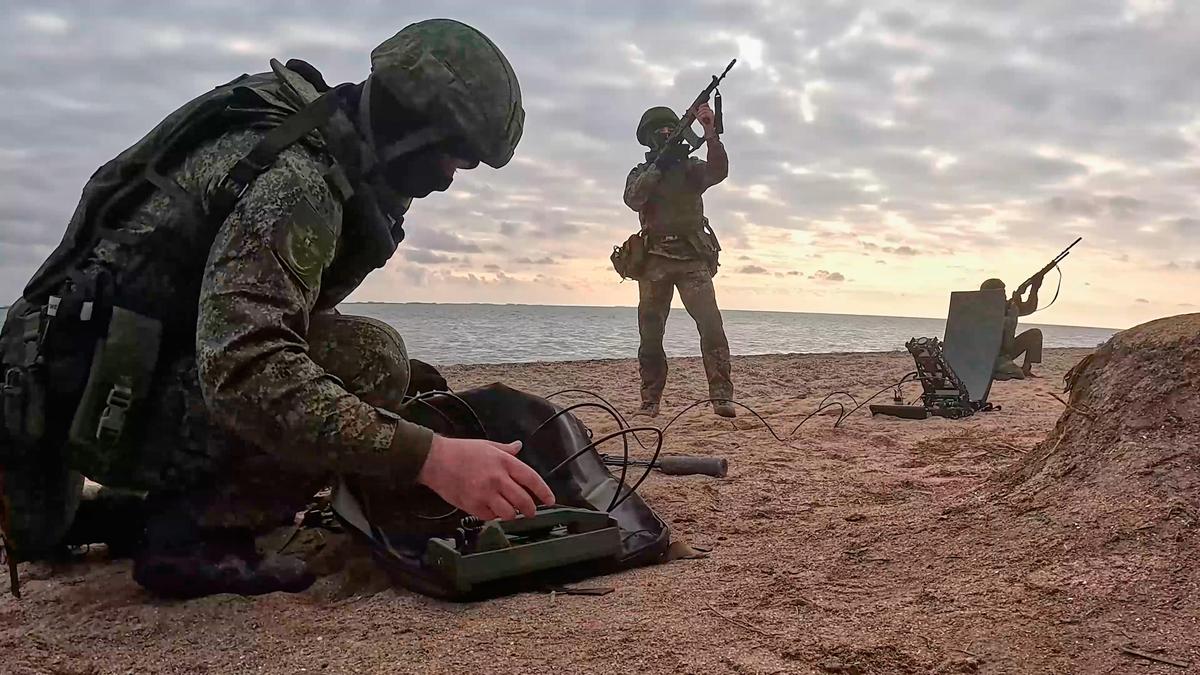
Russia's army captured over 5,600 square kilometres, or nearly one percent, of Ukrainian territory in 2025. This marks the highest territorial gain for Russia since the first year of the conflict. This development is crucial for understanding the evolving geopolitical landscape, international relations, and the ongoing Russia-Ukraine war, making it highly relevant for competitive exams focusing on current affairs and global events.
Revision structure
Monthly events and exam calendar context
Static GK and one-liner notes
Quiz and mock-test revision path
Key points
Exam-ready takeaways
These territorial gains occurred in the year 2025.
The captured area constitutes nearly one percent of Ukrainian territory.
This represents Russia's highest territorial gains since the first year of the war.
The conflict involves Russia and Ukraine.
Detailed analysis
Full exam-oriented breakdown
The news of Russia's significant territorial gains in Ukraine in 2025, capturing over 5,600 square kilometres, represents a critical development in an ongoing conflict that has reshaped global geopolitics. This marks the largest territorial acquisition by Russia since the initial year of its full-scale invasion, indicating a potential shift in the war's dynamics and raising profound questions about international law, sovereignty, and regional stability. To understand this development, we must first revisit the **background context** of the Russia-Ukraine conflict. Ukraine, a former Soviet republic, gained independence in 1991. Its aspirations to align more closely with Western institutions like NATO and the European Union have been a persistent point of contention with Russia, which views NATO expansion as a threat to its security interests. The conflict escalated dramatically in 2014 when Russia annexed Crimea following a pro-Russian uprising and supported separatists in the Donbas region (eastern Ukraine), leading to a low-intensity conflict for eight years. The full-scale invasion launched by Russia on February 24, 2022, aimed to 'demilitarize' and 'denazify' Ukraine, but was widely condemned as an unprovoked act of aggression. After initial rapid advances, Russian forces faced stiff Ukrainian resistance, backed by substantial Western military and financial aid, leading to a protracted war of attrition. **What happened** in 2025, according to the report, is that the Russian army captured an additional 5,600 square kilometres of Ukrainian territory. This area, approximately one percent of Ukraine's total landmass, signifies a renewed offensive capability or a weakening of Ukrainian defenses. Such gains, if confirmed, would be strategically important for Russia, potentially solidifying its control over key land corridors, access to the Black Sea, or industrial regions, and could strengthen its bargaining position in any future peace negotiations. **Key stakeholders** involved in this intricate conflict are numerous. Russia, led by President Vladimir Putin, seeks to reassert its sphere of influence, prevent Ukraine's Western integration, and potentially establish a land bridge to Crimea. Ukraine, under President Volodymyr Zelenskyy, is fighting for its territorial integrity, sovereignty, and democratic future, relying heavily on international support. The United States and its NATO allies (e.g., UK, Germany, France) are providing extensive military, financial, and humanitarian aid to Ukraine, viewing the conflict as a challenge to the rules-based international order and a direct threat to European security. The European Union has imposed severe sanctions on Russia and is working towards reducing its energy dependence on Russia. China, while not directly involved, maintains a complex relationship, supporting Russia economically but generally advocating for peace and respecting territorial integrity. India, navigating its strategic autonomy, balances its historical ties and defense dependence on Russia with its growing partnerships with Western nations. This development holds significant **importance for India**. Economically, a prolonged war exacerbates global supply chain disruptions, impacts crude oil prices, and affects the availability and cost of essential commodities like food grains (wheat, sunflower oil) and fertilizers. India, a major importer of crude oil, faces inflationary pressures and current account deficit challenges. Strategically, India's foreign policy is tested as it seeks to maintain its 'strategic autonomy' – the ability to make independent foreign policy choices without being aligned with any major power bloc. India has refrained from explicitly condemning Russia, emphasizing dialogue and diplomacy, while also providing humanitarian assistance to Ukraine. This balancing act is crucial given India's defense dependence on Russia and its growing strategic partnerships with the US and other QUAD members. The conflict also provides lessons for India regarding border security, hybrid warfare, and the importance of indigenous defense capabilities. India's aspirations for a multipolar world and reforms in global institutions like the UN Security Council are also impacted by the shifting geopolitical landscape. From a **historical context** perspective, this conflict is a continuation of centuries of complex relations between Russia and Ukraine, punctuated by periods of Russian imperial control, Soviet domination, and Ukraine's struggle for national identity. The 2014 events of Crimea's annexation and the Donbas conflict set the stage for the 2022 invasion, marking a clear departure from post-Cold War European security architecture. The 2025 gains, therefore, are not an isolated event but a grim chapter in an ongoing historical struggle. **Future implications** are profound. A prolonged conflict with significant territorial shifts could lead to a 'frozen conflict' scenario, similar to Transnistria or Abkhazia, or it could escalate further, potentially drawing in other regional powers. It will continue to fuel the global energy crisis, disrupt food security, and intensify the humanitarian crisis in Ukraine. Geopolitically, it accelerates the formation of new alliances and strengthens existing ones, pushing the world towards a more fragmented and potentially confrontational order. For India, it necessitates a continued recalibration of its foreign policy, balancing national interests with global responsibilities, and adapting to a volatile international environment. While no direct **constitutional articles** of India apply to a foreign conflict, India's foreign policy principles, which guide its response, are implicitly rooted in the spirit of its Constitution. Article 51 of the Directive Principles of State Policy (DPSP) mandates the state to 'endeavour to promote international peace and security,' 'maintain just and honourable relations between nations,' 'foster respect for international law and treaty obligations,' and 'encourage settlement of international disputes by arbitration.' India's stance of advocating for a peaceful resolution, respecting sovereignty and territorial integrity (principles enshrined in the UN Charter), and providing humanitarian aid aligns with these constitutional directives. Furthermore, the Preamble's ideals of justice and liberty also resonate with the global call for a rules-based international order.
How to study
Turn news into exam marks
Revise monthly events by exam family instead of reading random updates.
Pair one-liners with mock tests so mistakes become the next revision list.
Keep state job pages, calendar pages and GK packs connected in one path.