

Telangana Chief Minister Revanth Reddy held discussions regarding the state's stand.
GK and monthly revision
State to present strong case against expansion works of Polavaram Project by A.P.
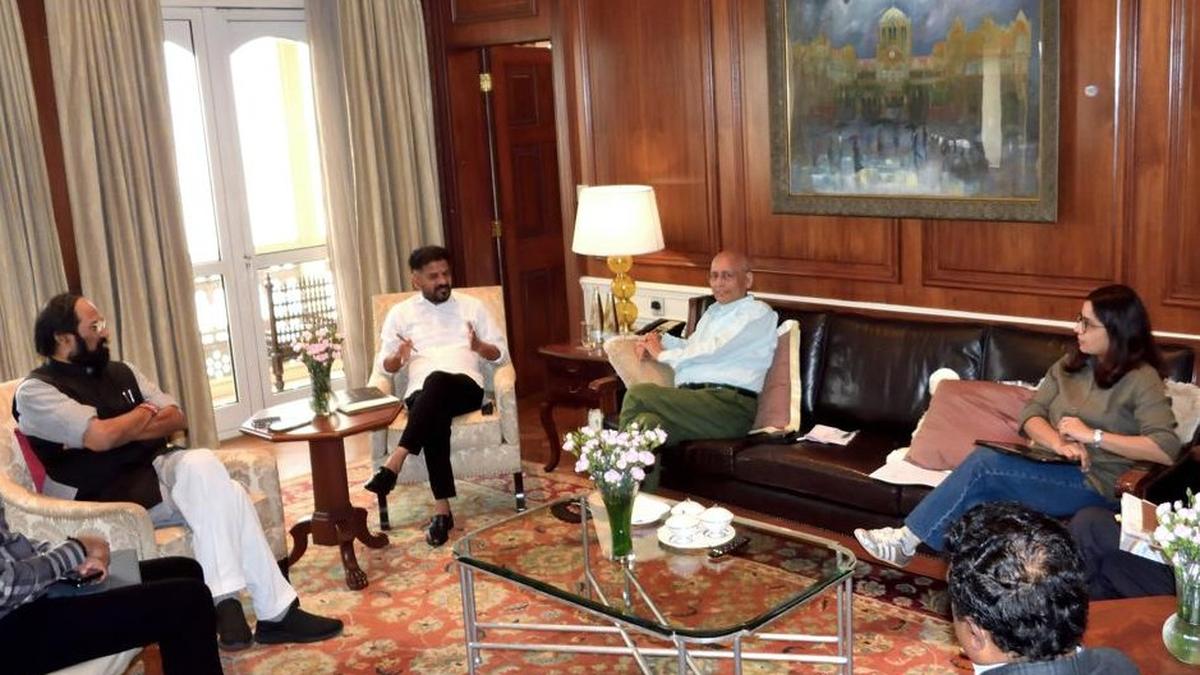
Telangana Chief Minister Revanth Reddy and Irrigation Minister Uttam Kumar Reddy consulted Senior Advocate Abhishek Singhvi to prepare their state's case in the Supreme Court. Telangana is challenging Andhra Pradesh's expansion works on the Polavaram Project, highlighting an ongoing inter-state river water dispute. This development is significant for understanding federal relations, water governance, and the Supreme Court's role in resolving inter-state conflicts for competitive exams.
Revision structure
Monthly events and exam calendar context
Static GK and one-liner notes
Quiz and mock-test revision path
Key points
Exam-ready takeaways
Telangana's Minister for Irrigation, Uttam Kumar Reddy, was involved in the consultations.
Senior Advocate Abhishek Singhvi provided legal advice for the upcoming Supreme Court case.
The case in the Supreme Court concerns the expansion works of the Polavaram Project.
Telangana is presenting its stand against the expansion works undertaken by Andhra Pradesh.
Detailed analysis
Full exam-oriented breakdown
The ongoing legal battle concerning the Polavaram Project, particularly Telangana's challenge to its expansion works in the Supreme Court, is a critical illustration of the complexities inherent in India's federal structure, inter-state river water governance, and the often-contentious nature of large-scale infrastructure projects. This specific development, where Telangana Chief Minister Revanth Reddy and Irrigation Minister Uttam Kumar Reddy consulted Senior Advocate Abhishek Singhvi, underscores the high stakes involved for both states. **Background Context:** The Polavaram Project, officially the Indira Sagar Polavaram Project, is a multi-purpose irrigation project on the Godavari River in Andhra Pradesh. Conceived decades ago, its primary objectives are to provide irrigation to vast agricultural lands, generate hydroelectric power, supply drinking water, and facilitate inter-basin transfer of water to the Krishna basin. After the bifurcation of Andhra Pradesh in 2014, the project was declared a 'National Project' under Section 90 of the Andhra Pradesh Reorganisation Act, 2014, with the Union Government committing to fund its irrigation component. This declaration was intended to expedite its completion, but it also brought the Union government into the fold of potential disputes. **What Happened:** The current controversy stems from Telangana's apprehension regarding the project's design and potential impact, particularly concerning submergence. Telangana alleges that the project's design, especially its height and storage capacity, was altered by Andhra Pradesh without adequate consultation and environmental impact assessment, post-bifurcation. A key concern for Telangana is the potential submergence of several villages, particularly tribal habitations, in its Bhadrachalam district, and the adverse impact on the Kothagudem thermal power plant due to backwater effects. Telangana contends that the project's current design, particularly the increase in Full Reservoir Level (FRL), poses an existential threat to these areas. Their move to the Supreme Court signifies a formal legal challenge to halt or modify these expansion works, seeking judicial intervention to protect its interests and people. **Key Stakeholders Involved:** The primary stakeholders are the **Government of Telangana**, led by Chief Minister Revanth Reddy, which is challenging the project; the **Government of Andhra Pradesh**, which is implementing the project and defending its design; the **Supreme Court of India**, which will adjudicate the dispute; and the **Central Government**, through bodies like the Ministry of Jal Shakti, the Polavaram Project Authority (PPA), and the Godavari River Management Board (GRMB), which have oversight responsibilities for national projects and inter-state river issues. Senior Advocate Abhishek Singhvi represents Telangana's legal strategy. Crucially, the **local communities**, especially the tribal populations in the submergence zones across both states, are significant but often marginalized stakeholders whose lives and livelihoods are directly impacted. **Why This Matters for India:** This dispute highlights several critical issues for India. Firstly, it underscores the persistent challenges in **inter-state water governance**. Water, being a state subject (Entry 17 of the State List, Seventh Schedule), often leads to disputes when rivers traverse multiple states. Secondly, it tests the principles of **cooperative federalism**, where states are expected to collaborate on resource management, but often resort to legal battles. Thirdly, it brings to the fore the **environmental and social costs of large infrastructure projects**. Concerns about submergence, displacement, and rehabilitation are central to such projects and often lead to human rights issues. Fourthly, the role of the **judiciary** as an arbiter in complex technical and political disputes is emphasized. The Supreme Court's decision will not only impact the Polavaram Project but also set precedents for future inter-state conflicts. Economically, delays can escalate project costs and deprive beneficiaries of intended benefits, while politically, these disputes often become highly charged, impacting electoral outcomes and inter-state relations. **Constitutional and Legal Context:** The legal framework for resolving inter-state water disputes is primarily laid out in **Article 262 of the Indian Constitution**, which empowers Parliament to legislate for the adjudication of any dispute or complaint with respect to the use, distribution, or control of the waters of, or in, any inter-state river or river valley. Pursuant to this, Parliament enacted the **Inter-State River Water Disputes Act, 1956**, which provides for the constitution of tribunals to adjudicate such disputes. While tribunals are typically formed for new disputes, existing disputes can also reach the Supreme Court under its original jurisdiction (Article 131) or appellate jurisdiction (Article 136), especially if it involves interpretation of constitutional provisions or fundamental rights. The **Andhra Pradesh Reorganisation Act, 2014**, specifically mentions the Polavaram Project, declaring it a national project and entrusting certain responsibilities to the Union government and the Polavaram Project Authority (PPA) for its execution and monitoring. **Future Implications:** The Supreme Court's verdict will have far-reaching implications. A ruling in favor of Telangana could necessitate a redesign or modification of the project, leading to significant delays and cost overruns. Conversely, a ruling favoring Andhra Pradesh could accelerate project completion but potentially exacerbate environmental and social concerns raised by Telangana. Beyond the immediate project, the outcome could influence how future inter-state river disputes are approached and resolved, emphasizing either a more collaborative, negotiated approach or a reliance on judicial intervention. It also highlights the need for robust environmental impact assessments (EIAs) and resettlement and rehabilitation (R&R) policies that genuinely address the concerns of affected populations. Ultimately, this case serves as a crucial reminder that while large projects are vital for development, their execution must balance economic growth with environmental sustainability and social justice, all within the delicate framework of India's federal system.
How to study
Turn news into exam marks
Revise monthly events by exam family instead of reading random updates.
Pair one-liners with mock tests so mistakes become the next revision list.
Keep state job pages, calendar pages and GK packs connected in one path.