

The article centers on the advocacy of acid attack survivor and social activist Shaheen Malik.
GK and monthly revision
Where does India stand on acid attacks? | Explained
The article explores India's complex landscape regarding acid attacks, highlighting the fight of survivor Shaheen Malik. It delves into critical issues like the latest National Crime Records Bureau (NCRB) data for 2023, the severe under-reporting of these crimes, and the persistently low conviction rates despite existing laws. This analysis is crucial for competitive exams, covering social justice, criminal law, and women's safety aspects.
Revision structure
Monthly events and exam calendar context
Static GK and one-liner notes
Quiz and mock-test revision path
Key points
Exam-ready takeaways
It references the National Crime Records Bureau (NCRB) data for 2023 as the latest available for acid attack cases.
A significant issue discussed is the severe under-reporting of acid attack crimes across India.
The analysis addresses the challenge of a low conviction rate for acid attack cases despite existing legal frameworks.
The piece implicitly examines the efficacy and challenges within India's legal provisions designed to combat acid attacks.
Detailed analysis
Full exam-oriented breakdown
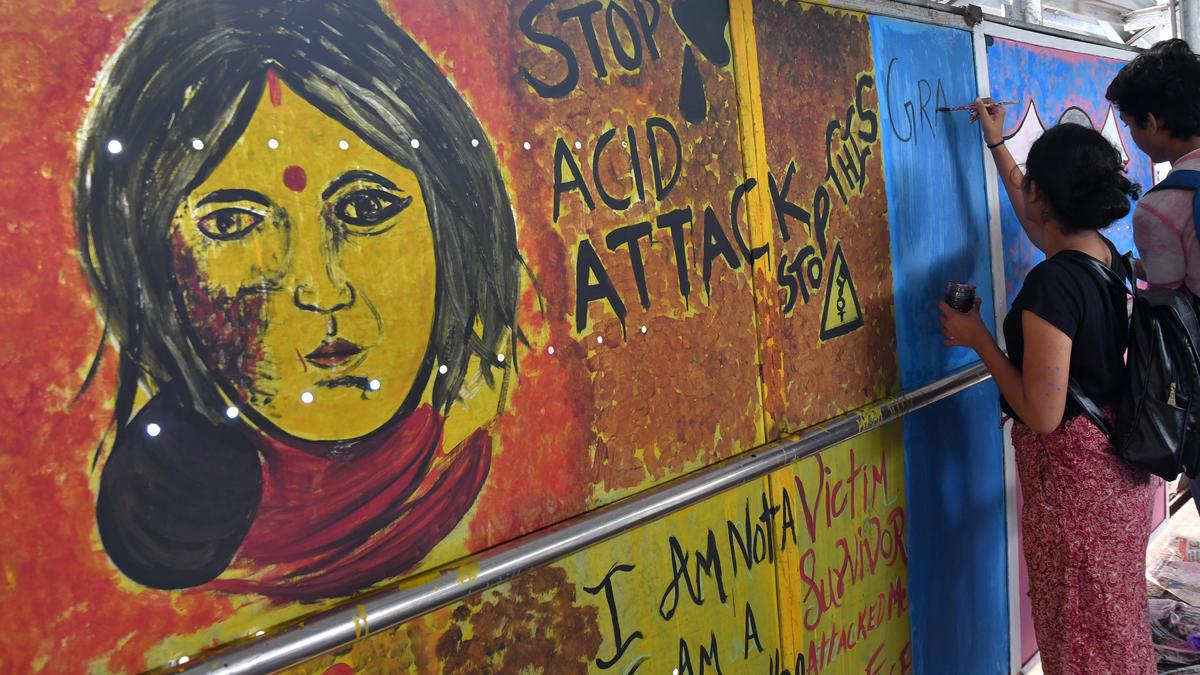
Acid attacks represent one of the most heinous forms of gender-based violence, leaving survivors with not only severe physical disfigurement but also profound psychological trauma and social ostracism. India, despite having specific laws, grapples with a complex reality, as highlighted by the advocacy of survivor Shaheen Malik and the consistent issues of under-reporting and low conviction rates, reflected in the National Crime Records Bureau (NCRB) data for 2023. Historically, acid attacks were often prosecuted under general sections of the Indian Penal Code (IPC) related to grievous hurt (e.g., Section 326), which did not adequately address the unique brutality and consequences of these crimes. The turning point came significantly after the horrific Nirbhaya case in December 2012, which led to widespread public outrage and demands for stronger laws against crimes targeting women. The Justice J.S. Verma Committee recommendations played a crucial role, prompting the Criminal Law (Amendment) Act, 2013. This amendment specifically introduced Sections 326A and 326B into the IPC, making acid attacks a distinct and severe offence. Section 326A prescribes punishment of not less than 10 years, extending to life imprisonment, along with a fine, for voluntarily causing grievous hurt by the use of acid. Section 326B deals with voluntarily throwing or attempting to throw acid, with a punishment of not less than 5 years, extending to 8 years, and a fine. Furthermore, the Supreme Court, in the landmark case of *Laxmi v. Union of India (2013)*, issued crucial guidelines for regulating the sale of acid, mandating victim compensation, and ensuring free medical treatment. The article underscores that despite these legal advancements, the situation on the ground remains challenging. The NCRB data for 2023, while providing official figures, likely represents only a fraction of the actual incidents due to severe under-reporting. Victims often face immense pressure from perpetrators, social stigma, fear of retaliation, and a lack of faith in the justice system, deterring them from lodging formal complaints. This under-reporting is a critical barrier to justice and accurate policy formulation. Compounding this, the low conviction rate, despite specific laws, points to systemic failures within the criminal justice system. Issues such as inadequate investigation, lack of forensic evidence, witness hostility, judicial delays, and sometimes, a lack of sensitivity among law enforcement and judicial personnel contribute to this dismal outcome. Key stakeholders in this battle include the **survivors** themselves, like Shaheen Malik, who often transform their personal tragedy into powerful advocacy for change, demanding justice, rehabilitation, and prevention. **Non-governmental organizations (NGOs)** such as 'Stop Acid Attacks' and 'Make Love Not Scars' play a vital role in providing legal aid, medical support, rehabilitation, and psychological counseling to survivors. The **Government**, encompassing the **Legislature** (for law-making), the **Executive** (police for investigation, district administration for compensation and rehabilitation, health departments for treatment), and the **Judiciary** (for delivering justice and interpreting laws), bears the primary responsibility. The **police** are crucial for initial response and investigation, while **medical professionals** provide essential immediate and long-term care. Society at large, with its prevailing gender norms and attitudes towards violence against women, also plays a significant, albeit often negative, role. This issue holds immense significance for India. Socially, acid attacks represent a grave violation of fundamental human rights, particularly **Article 21 (Right to Life and Personal Liberty)**, which includes the right to live with dignity, and **Article 14 (Equality before Law)**. Economically, survivors often lose their livelihoods, incur massive medical expenses, and become dependent, impacting their families and the broader economy. Politically, the failure to effectively curb such crimes and ensure justice undermines public trust in governance and the rule of law, reflecting poorly on India's commitment to gender justice and human rights on national and international platforms. **Article 39A**, which mandates free legal aid, becomes particularly relevant for survivors who often lack resources. Looking ahead, future implications demand a multi-pronged approach. There is an urgent need for stricter implementation of Supreme Court guidelines on acid sales, ensuring that acid is not easily accessible. Fast-track courts for acid attack cases, coupled with sensitisation training for police, prosecutors, and judges, could improve conviction rates. Adequate and timely compensation and comprehensive rehabilitation packages (including medical, psychological, and vocational support) are crucial for survivors' reintegration into society. Public awareness campaigns challenging patriarchal norms and promoting gender equality are essential for long-term prevention. Furthermore, leveraging technology for better reporting mechanisms and tracking cases could enhance accountability. India's progress on this front will be a litmus test for its commitment to protecting its most vulnerable citizens and upholding the principles of justice and human dignity. This topic is intrinsically linked to broader themes of gender justice, criminal justice reform, human rights, and social welfare, making it a critical area of study for competitive exams.
How to study
Turn news into exam marks
Revise monthly events by exam family instead of reading random updates.
Pair one-liners with mock tests so mistakes become the next revision list.
Keep state job pages, calendar pages and GK packs connected in one path.