

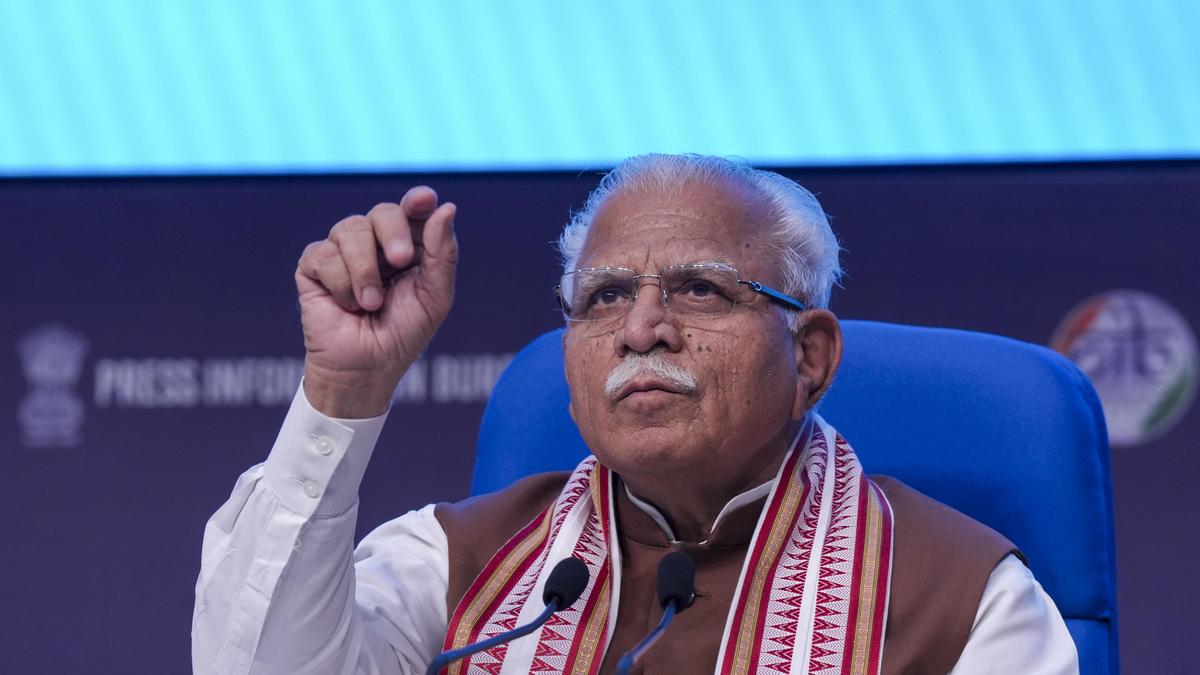
Union Power Minister Manohar Lal called for the desilting of the Salal hydel project.
GK and monthly revision
With Indus Waters Treaty in abeyance, Manohar Lal calls for desilting of Salal project
Union Power Minister Manohar Lal called for the desilting of the Salal hydel project in Jammu and Kashmir, emphasizing maximum water utilization. This move is significant given the context of the Indus Waters Treaty being in abeyance, indicating India's strategic focus on optimizing its share of water resources from the Indus basin rivers. This development is crucial for understanding India's water diplomacy and infrastructure development in border regions for competitive exams.
Revision structure
Monthly events and exam calendar context
Static GK and one-liner notes
Quiz and mock-test revision path
Key points
Exam-ready takeaways
The Salal project is located in Jammu and Kashmir (J&K).
The call for desilting is made in the context of the Indus Waters Treaty (IWT) being 'in abeyance'.
The primary objective is to ensure maximum water utilisation from the project.
The Minister also reviewed other hydel projects in Jammu and Kashmir.
Detailed analysis
Full exam-oriented breakdown
The Union Power Minister Manohar Lal's directive for the desilting of the Salal hydel project in Jammu and Kashmir, coupled with an emphasis on maximum water utilization, marks a significant development in India's water diplomacy and strategic infrastructure development. This move gains particular prominence given the backdrop of the Indus Waters Treaty (IWT) being considered 'in abeyance' by India, signaling a more assertive stance on its riparian rights. **Background Context: The Indus Waters Treaty (IWT)** To truly grasp the significance, we must first understand the IWT. Signed on September 19, 1960, between India and Pakistan, with the World Bank acting as a mediator, the treaty resolved a critical post-Partition water dispute. The division of the vast Indus River system was crucial for the agricultural economies of both nations. The IWT allocated the waters of the Eastern Rivers—Ravi, Beas, and Sutlej—to India for unrestricted use. Conversely, the Western Rivers—Indus, Jhelum, and Chenab—were primarily allocated to Pakistan. However, India was granted certain rights on the Western Rivers, including the right to develop run-of-the-river hydroelectric projects, limited irrigation, and storage, provided these uses do not impede the flow of water to Pakistan. The Permanent Indus Commission (PIC) was established under the treaty to resolve disputes and implement its provisions. For decades, despite wars and political tensions, the IWT has largely endured, often hailed as one of the most successful water-sharing treaties globally. **The 'Abeyance' Context and What Happened** India's declaration of the IWT being 'in abeyance' is a strong diplomatic signal. This stance emerged prominently after escalating cross-border terrorism, particularly following the Uri attack in 2016 and the Pulwama attack in 2019. India has consistently argued that 'blood and water cannot flow together.' In January 2023, India issued a notice to Pakistan, seeking a review and modification of the IWT, citing Pakistan's 'intransigence' in resolving disputes over Indian hydropower projects on the Western Rivers. While not an abrogation, this notice signifies India's intent to re-examine and maximize its permissible water usage under the treaty. In this context, the Union Power Minister's review of hydel projects in J&K and the specific call for desilting the Salal project on the Chenab River (a Western River) directly reflects India's renewed focus on optimizing its existing infrastructure and utilizing its full share of water resources. **Key Stakeholders Involved** Several key players are involved. **India**, through its Union Power Ministry and Ministry of Jal Shakti, is the primary stakeholder, driving the policy and implementation. The **National Hydroelectric Power Corporation (NHPC)**, a Public Sector Undertaking, is responsible for the construction and maintenance of these projects, including Salal. The **Jammu and Kashmir Union Territory administration** is crucial for facilitating these projects and ensuring regional development. **Pakistan** is an indirect but significant stakeholder, as any perceived deviation from the treaty's spirit could escalate tensions. The **World Bank**, as the guarantor of the IWT, also remains a silent observer, ready to intervene if disputes arise. **Significance for India and Future Implications** This development holds immense significance for India. Firstly, it underscores India's commitment to **energy security**. Hydropower projects in J&K, like Salal, contribute significantly to the national grid and regional energy needs. Desilting ensures the optimal functioning and extended lifespan of these vital assets. Secondly, it's about **water security and efficient utilization**. By maximizing water use for power generation and potential irrigation within treaty limits, India addresses its growing demands for water and energy. Thirdly, it is a crucial component of **regional development** in J&K, fostering economic activity, employment generation, and infrastructure growth in a strategically sensitive region. Politically, it signals India's resolve to exert its legitimate rights under the IWT and serves as a subtle diplomatic lever in its relations with Pakistan, emphasizing that cooperation on water is intertwined with broader bilateral conduct. Historically, post-independence, water resource management has been a complex issue, both inter-state and internationally. The IWT was a landmark agreement. India's current stance reflects a shift from a purely passive adherence to a more active assertion of its rights, particularly in response to perceived non-cooperation from Pakistan on other fronts. This move could lead to increased hydropower generation and irrigation potential in J&K. It also signals that India may accelerate other projects on Western Rivers, such as the Pakal Dul, Ratle, and Kiru projects on the Chenab, which have faced objections from Pakistan. This assertive strategy could either compel Pakistan to engage constructively on treaty modifications or potentially escalate diplomatic tensions. **Related Constitutional Articles, Acts, or Policies** The management of water resources in India is primarily governed by the **Seventh Schedule of the Constitution**. 'Water' is primarily a State subject (Entry 17 in the State List), but the Union List (Entry 56) allows the Union Parliament to regulate and develop inter-state rivers and river valleys if declared by Parliament to be expedient in the public interest. This provides the constitutional basis for central government intervention in projects like Salal. Furthermore, **Article 262** empowers Parliament to provide for the adjudication of any dispute or complaint with respect to the use, distribution, or control of the waters of, or in, any inter-State river or river valley. The **Indus Waters Treaty Act, 1960**, passed by the Indian Parliament, gives legal backing to the international treaty within India. India's **National Water Policy** also emphasizes optimal, economical, and equitable utilization of water resources, aligning with the current drive to maximize water use from projects like Salal.
How to study
Turn news into exam marks
Revise monthly events by exam family instead of reading random updates.
Pair one-liners with mock tests so mistakes become the next revision list.
Keep state job pages, calendar pages and GK packs connected in one path.