

An alleged U.S. operation in Venezuela reportedly killed 32 Cuban officers.
GK and monthly revision
32 Cuban officers were killed in U.S. operation in Venezuela
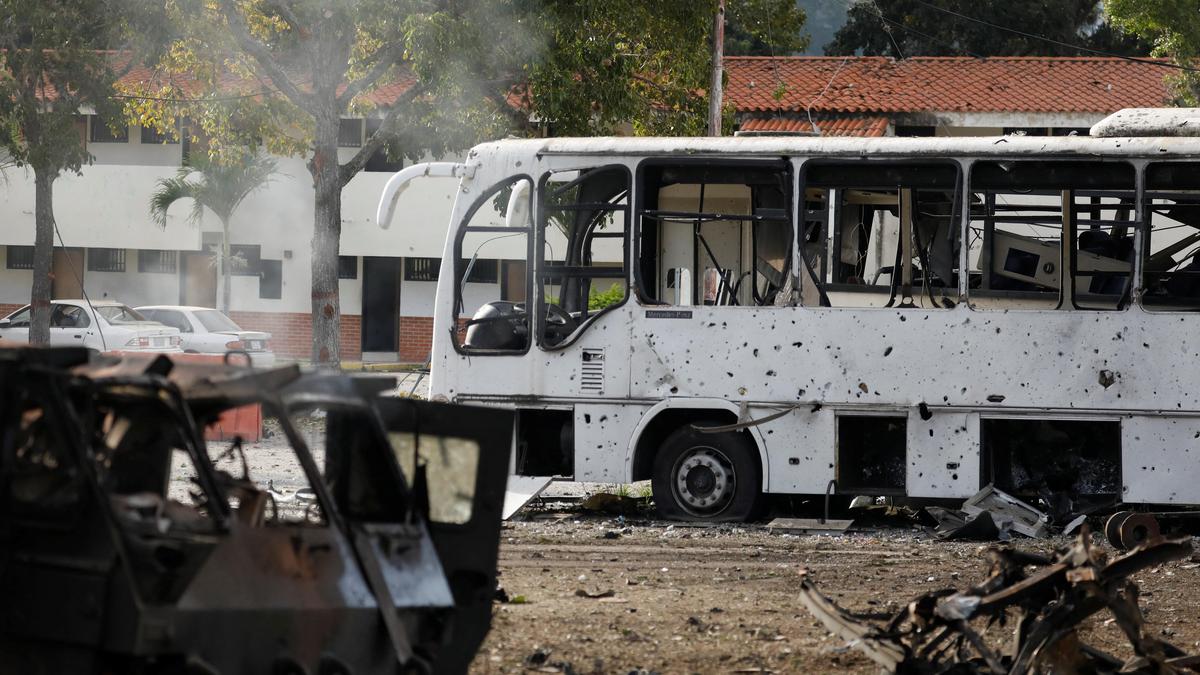
An alleged U.S. operation in Venezuela reportedly resulted in the deaths of 32 Cuban officers. While Venezuela's government acknowledged that some individuals died in American blasts, it did not confirm the specific number of casualties. This incident highlights ongoing geopolitical tensions involving the U.S., Cuba, and Venezuela, making it significant for understanding international relations and current affairs for competitive exams.
Revision structure
Monthly events and exam calendar context
Static GK and one-liner notes
Quiz and mock-test revision path
Key points
Exam-ready takeaways
The nationality of the officers allegedly killed was Cuban.
The incident occurred in Venezuela, involving alleged 'American blasts'.
The U.S. was identified as the country conducting the alleged operation.
Venezuela's government acknowledged deaths from American blasts but did not confirm the specific number of those killed.
Detailed analysis
Full exam-oriented breakdown
The alleged U.S. operation in Venezuela, resulting in the reported deaths of 32 Cuban officers, is a significant event that underscores the complex and often volatile nature of international relations, particularly involving the United States, Cuba, and Venezuela. For Indian competitive exam aspirants, understanding this incident requires delving into its deep historical roots, geopolitical implications, and relevance to India's foreign policy. **Background Context and Historical Roots:** This incident is not an isolated event but a manifestation of decades-long animosity and ideological clashes. The United States has historically viewed socialist governments in its 'backyard'—Latin America—with suspicion, often leading to interventions, both overt and covert. The 1959 Cuban Revolution, which brought Fidel Castro to power, marked a turning point, establishing a communist state just 90 miles off Florida's coast and initiating a hostile relationship with the U.S. This animosity deepened during the Cold War, culminating in events like the Bay of Pigs invasion (1961) and the Cuban Missile Crisis (1962). Cuba, in turn, has often allied itself with other anti-U.S. regimes in the region. Venezuela's trajectory under Hugo Chávez, beginning in 1999, further complicated regional dynamics. Chávez, a charismatic socialist leader, forged strong ties with Cuba, providing oil in exchange for Cuban medical personnel, intelligence, and security assistance. This alliance continued under his successor, Nicolás Maduro. The U.S. has consistently opposed the socialist governments in both Cuba and Venezuela, imposing stringent economic sanctions, accusing them of human rights abuses, undermining democracy, and sponsoring terrorism. The U.S. has openly supported opposition movements in Venezuela, advocating for regime change against Maduro, whom it considers illegitimate. **What Happened and Key Stakeholders:** The core of the news is an alleged U.S. operation involving 'American blasts' in Venezuela, leading to the reported deaths of 32 Cuban officers. Venezuela's government acknowledged deaths from these blasts but refrained from confirming the specific number or nationality of casualties, indicating a cautious approach, perhaps to avoid escalating an already tense situation or to manage internal perceptions. The U.S. has typically maintained silence or denied involvement in such alleged covert operations. **Key Stakeholders Involved:** * **The United States:** As the alleged perpetrator, the U.S.'s involvement would align with its stated policy of pressuring the Maduro regime. Its motivations could include disrupting Venezuelan military capabilities, targeting Cuban intelligence/military presence, or generally destabilizing the government. Such actions, if confirmed, highlight the U.S.'s willingness to employ kinetic force or covert operations to achieve its foreign policy objectives. * **Venezuela:** The Maduro government is fighting for its survival amidst a severe economic crisis, hyperinflation, and widespread international condemnation. Its reliance on Cuban support for security and intelligence is well-documented. The incident poses a direct challenge to Venezuela's sovereignty and territorial integrity. Its understated acknowledgment of casualties suggests a delicate balancing act between condemning foreign intervention and preventing an all-out military confrontation. * **Cuba:** As the reported victim, Cuba's role is critical. Its military and intelligence presence in Venezuela is a cornerstone of its foreign policy, strengthening its socialist ally and projecting influence. The alleged deaths would be a significant blow and a direct challenge to its national security interests and personnel abroad. This incident would further solidify its anti-U.S. stance and commitment to its allies. **Significance for India:** This incident, though geographically distant, holds significant implications for India, primarily concerning its foreign policy, energy security, and commitment to international law: 1. **Upholding International Law and Sovereignty:** India, a proponent of multilateralism and a signatory to the UN Charter, has consistently advocated for non-interference in the internal affairs of sovereign states and respect for territorial integrity. Unilateral military actions, especially alleged covert ones, challenge these fundamental principles. India's stance would generally align with the principles enshrined in **Article 2(4) of the UN Charter**, which prohibits the threat or use of force against the territorial integrity or political independence of any state. 2. **Energy Security:** Venezuela possesses the world's largest proven oil reserves. While U.S. sanctions have severely curtailed Venezuela's oil exports, global geopolitical instability, particularly in major oil-producing regions, impacts international oil prices. India, a major oil importer, is highly vulnerable to such fluctuations. Any escalation in Venezuela could disrupt global energy markets, affecting India's economic stability and import bills. 3. **Strategic Autonomy and Non-Alignment:** India has historically pursued a policy of strategic autonomy, engaging with diverse global powers without aligning with any single bloc. This incident presents a challenge for India to balance its growing strategic partnership with the U.S. against its traditional commitment to non-alignment and supporting developing nations against external coercion. India's foreign policy, guided by principles like Panchsheel and enshrined in **Article 51 of the Constitution** (promoting international peace and security, fostering respect for international law), would necessitate a careful diplomatic approach. 4. **Precedent for Unilateral Actions:** If such alleged operations become commonplace, it sets a dangerous precedent for international relations, potentially undermining global stability and the rule of law. India, as an emerging global power, has a vested interest in a stable, rule-based international order. **Future Implications:** The immediate future could see an escalation of rhetoric and possibly covert actions. The incident could further entrench the Maduro regime's reliance on Cuba and other allies like Russia and China, creating a more entrenched geopolitical standoff. For India, navigating this complex landscape will require astute diplomacy, balancing its economic and strategic interests with its principled stand on international law and sovereignty. It reinforces the need for a robust, independent foreign policy that can adapt to evolving global challenges and uphold its values on the world stage. This incident serves as a stark reminder of the enduring struggles for power and influence, the fragility of national sovereignty in the face of powerful actors, and the critical importance of international law and diplomacy in preventing wider conflicts.
How to study
Turn news into exam marks
Revise monthly events by exam family instead of reading random updates.
Pair one-liners with mock tests so mistakes become the next revision list.
Keep state job pages, calendar pages and GK packs connected in one path.