

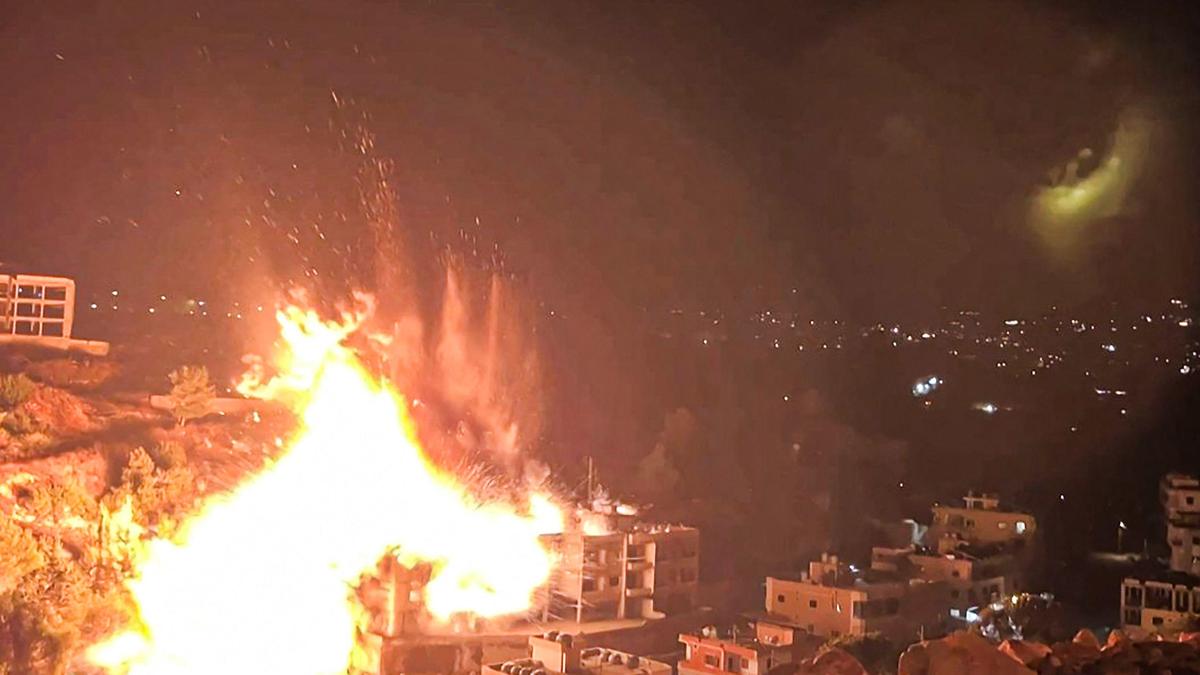
The Israeli military conducted strikes in south and east Lebanon.
GK and monthly revision
Israel strikes south, east Lebanon after evacuation warnings
The Israeli military launched strikes against Hezbollah and Hamas terror targets in south and east Lebanon, following prior evacuation warnings. This action signifies a significant escalation in the ongoing regional conflict, expanding beyond Gaza into Lebanon. For competitive exams, understanding the geopolitical actors (Israel, Hezbollah, Hamas), their locations (Lebanon), and the nature of the conflict is crucial for international relations and current affairs sections.
Revision structure
Monthly events and exam calendar context
Static GK and one-liner notes
Quiz and mock-test revision path
Key points
Exam-ready takeaways
The strikes targeted 'Hezbollah and Hamas terror targets' within Lebanon.
The military action followed evacuation warnings in the affected areas.
The strikes indicate an expansion of the ongoing conflict into Lebanese territory.
Hezbollah and Hamas are identified as the specific groups targeted by Israel.
Detailed analysis
Full exam-oriented breakdown
The recent Israeli military strikes against Hezbollah and Hamas targets in south and east Lebanon mark a significant and concerning expansion of the ongoing conflict that began with Hamas's October 7th attacks on Israel. This development escalates an already volatile situation, drawing Lebanon more directly into the regional conflagration and raising fears of a wider Middle East war. Understanding this complex geopolitical event requires delving into its immediate triggers, historical roots, key actors, and potential ramifications, especially for a global player like India. The genesis of the current escalation lies in the unprecedented October 7, 2023, attacks by Hamas from Gaza into southern Israel. These attacks, which resulted in significant Israeli casualties and abductions, prompted a robust and ongoing Israeli military response in Gaza, aimed at dismantling Hamas's military and governance capabilities. However, almost immediately after October 7th, the Israel-Lebanon border also saw increased skirmishes, primarily involving Hezbollah, a powerful Shia militant group and political party in Lebanon, launching rockets and anti-tank missiles into northern Israel. Israel responded with its own strikes into southern Lebanon. These exchanges, while significant, had largely been contained to border areas until the latest widespread strikes into deeper Lebanese territory, which followed explicit evacuation warnings. Key stakeholders in this escalating crisis include, first and foremost, **Israel**. Its primary objective is national security, seeking to neutralize threats from both Hamas and Hezbollah, which it views as Iranian proxies aiming for its destruction. For Israel, the strikes are a defensive measure to degrade the capabilities of groups threatening its northern border. **Hezbollah**, a formidable non-state actor with a sophisticated military arsenal, operates as a 'state within a state' in Lebanon, heavily backed by Iran. Its involvement is driven by solidarity with Palestinian factions, its anti-Israel ideology, and its role as a key component of Iran's 'Axis of Resistance'. **Hamas**, though primarily based in Gaza, has a presence and operational networks in Lebanon, which Israel is now targeting. **Lebanon**, a sovereign nation already grappling with profound economic and political crises, finds itself unwillingly dragged into this conflict due to Hezbollah's presence and actions. The Lebanese government is weak and largely unable to control Hezbollah, making it a vulnerable bystander. **Iran** is a crucial, albeit indirect, stakeholder, as it provides significant financial, military, and ideological support to both Hezbollah and Hamas, seeing them as strategic assets against Israel and Western influence in the region. The **United States** and other international powers are also stakeholders, working to prevent a wider regional war and address humanitarian concerns. This situation holds significant implications for India. India has deep historical ties with West Asia, a region crucial for its **energy security** as a major importer of crude oil. Any significant disruption to oil supplies or transit routes, such as the Strait of Hormuz or the Suez Canal, due to a wider conflict, could lead to a sharp increase in global oil prices, impacting India's economy and inflation. Furthermore, the region hosts millions of **Indian diaspora** workers whose safety and well-being are paramount. A destabilized region could necessitate complex evacuation efforts and impact remittances. From a **foreign policy** perspective, India has historically maintained a balanced approach, supporting the Palestinian cause while also fostering growing strategic and economic ties with Israel. This conflict tests India's diplomatic dexterity and its commitment to international peace and security. India also staunchly opposes terrorism in all its forms, and its stance on groups like Hamas and Hezbollah, while nuanced by geopolitical realities, aligns with its broader counter-terrorism efforts. India's participation in initiatives like the I2U2 (India, Israel, UAE, USA) and the India-Middle East-Europe Economic Corridor (IMEC) underscores its interest in regional stability and connectivity, which could be severely hampered by extended conflict. Historically, the region has been a hotbed of conflict, from the Arab-Israeli wars to the Lebanese Civil War (1975-1990) and the 2006 Lebanon War between Israel and Hezbollah. These conflicts have shaped the current political landscape and the deep-seated animosities. The expansion of strikes into Lebanon echoes these historical cycles of violence, raising fears of a repeat of large-scale devastation. The future implications are grim: a full-blown regional war involving Israel, Hezbollah, Lebanon, and potentially Iran, could lead to an unprecedented humanitarian crisis, massive displacement, and severe economic consequences globally. The delicate balance of power in the Middle East could be irrevocably altered. International efforts for de-escalation, ceasefires, and humanitarian aid will be critical. While specific Indian constitutional articles don't directly govern foreign military actions, India's foreign policy is guided by principles enshrined in its Constitution. **Article 51** of the Directive Principles of State Policy mandates that the State shall endeavor to promote international peace and security, maintain just and honorable relations between nations, foster respect for international law and treaty obligations, and encourage settlement of international disputes by arbitration. India's diplomatic efforts in the UN and other international forums, calling for de-escalation and a two-state solution, reflect these constitutional ideals. Furthermore, India's commitment to combating terrorism, as reflected in its domestic laws and international cooperation, informs its perspective on the actions of groups like Hamas and Hezbollah.
How to study
Turn news into exam marks
Revise monthly events by exam family instead of reading random updates.
Pair one-liners with mock tests so mistakes become the next revision list.
Keep state job pages, calendar pages and GK packs connected in one path.