

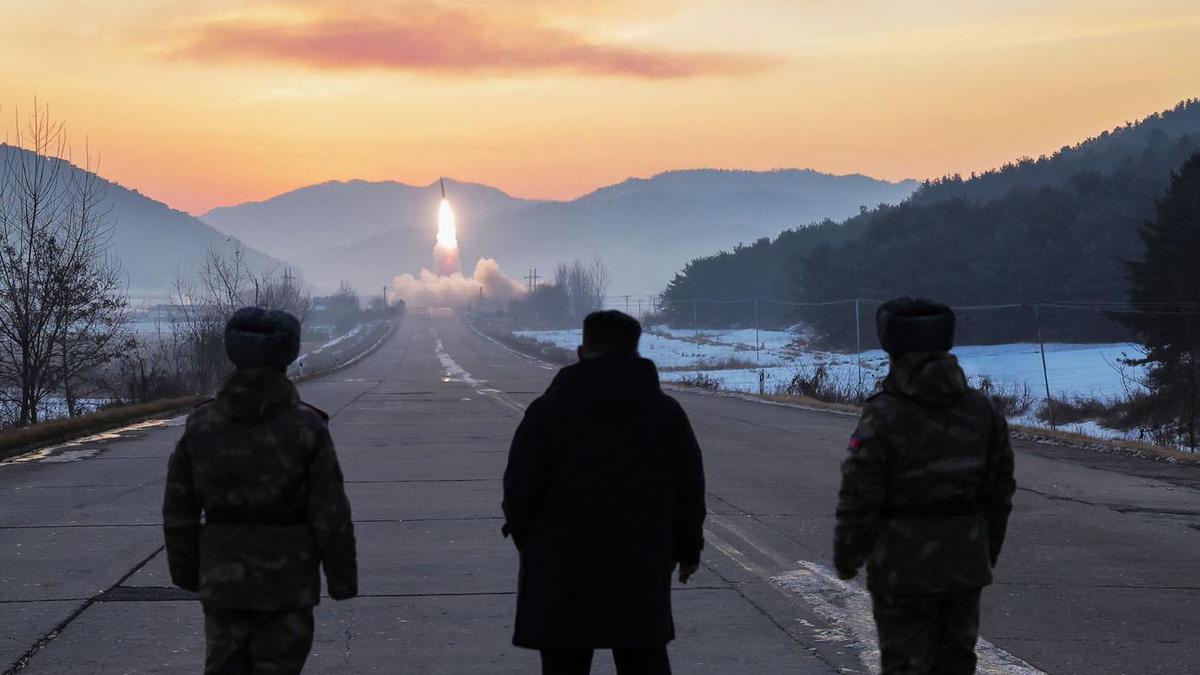
North Korea announced missile tests of a hypersonic weapons system.
GK and monthly revision
North Korea says latest missile tests involves hypersonic weapons system
North Korea conducted missile tests involving a hypersonic weapons system, marking a significant advancement in its military capabilities. This development occurred strategically just hours before South Korean President Lee Jae Myung's departure for a summit with Chinese President Xi Jinping in China. The timing underscores geopolitical tensions in East Asia, making it crucial for understanding international relations and defense technology for competitive exams.
Revision structure
Monthly events and exam calendar context
Static GK and one-liner notes
Quiz and mock-test revision path
Key points
Exam-ready takeaways
The tests occurred hours before South Korean President Lee Jae Myung's departure for China.
South Korean President Lee Jae Myung was scheduled to meet Chinese President Xi Jinping.
The planned summit between South Korea and China was to take place in China.
The weapon system tested by North Korea was specifically identified as a hypersonic weapon.
Detailed analysis
Full exam-oriented breakdown
North Korea's recent test of a hypersonic weapons system, strategically timed just hours before South Korean President Lee Jae Myung's departure for a summit with Chinese President Xi Jinping, represents a significant escalation in regional tensions and a notable advancement in Pyongyang's military capabilities. To truly grasp its implications, we must delve into the intricate geopolitical landscape of East Asia. **Background Context:** North Korea, officially the Democratic People's Republic of Korea (DPRK), has a long and contentious history of pursuing nuclear weapons and ballistic missile programs. Emerging from the devastating Korean War (1950-1953), which ended in an armistice rather than a peace treaty, the two Koreas remain technically at war. Guided by its 'Juche' ideology of self-reliance, North Korea has consistently prioritized military strength as a means of regime survival and deterrence against perceived external threats, primarily from the United States and South Korea. This pursuit has led to numerous UN Security Council resolutions imposing sanctions on Pyongyang, yet it has continued to develop its arsenal, including six nuclear tests since 2006 and a plethora of missile launches. **What Happened:** The specific event involved North Korea announcing a successful test of a new hypersonic missile system. Hypersonic missiles are a class of weapons capable of traveling at speeds greater than Mach 5 (five times the speed of sound) and, crucially, can maneuver in flight, making them extremely difficult for existing missile defense systems to intercept. Unlike traditional ballistic missiles that follow a predictable parabolic trajectory, hypersonic glide vehicles (HGVs) and hypersonic cruise missiles (HCMs) offer enhanced evasion capabilities. The timing of this test, coinciding with a high-profile diplomatic engagement between South Korea and China, was a deliberate move by Pyongyang to assert its strategic importance, signal its military prowess, and potentially sow discord or exert pressure on regional powers. **Key Stakeholders Involved:** * **North Korea (DPRK):** The primary actor, driven by a desire for deterrence, regime security, and gaining leverage in future negotiations. The development of advanced weaponry like hypersonic missiles enhances its bargaining position and technological prestige. * **South Korea (ROK):** Directly threatened by North Korea's advancements, Seoul seeks regional stability and has historically attempted both engagement and deterrence. The summit with China aimed to discuss regional security, making the missile test a direct challenge. * **China:** North Korea's closest political and economic ally, China plays a complex balancing act. While it values stability on its border and officially supports denuclearization, it also fears the collapse of the DPRK regime, which could lead to a refugee crisis and increased U.S. influence in the region. The test complicates China's efforts to project itself as a responsible regional power. * **United States:** A key security guarantor for South Korea and Japan, the U.S. leads international efforts to denuclearize North Korea through sanctions and diplomatic pressure. The development of advanced North Korean capabilities challenges U.S. regional security interests and missile defense strategies. * **Japan:** Another direct target of North Korean missiles, Japan views these tests with grave concern, often responding with strengthened alliances and enhanced defense capabilities. * **United Nations:** Through its Security Council, the UN has imposed extensive sanctions on North Korea, condemning its missile and nuclear tests as violations of international law and threats to global peace and security. **Why This Matters for India:** While geographically distant, developments in East Asia have significant implications for India. India's 'Act East' policy emphasizes stronger economic and strategic ties with Southeast and East Asian nations. Instability in this region can affect global trade routes, energy security, and the overall Indo-Pacific security architecture, where India is a key player. From a defense technology perspective, North Korea's advancements highlight the global arms race in hypersonic technology, prompting India to accelerate its own research and development in this domain (e.g., the BrahMos-II missile project). Furthermore, India, as a responsible nuclear power and a proponent of non-proliferation, views any proliferation of WMDs and advanced delivery systems with concern, aligning with its commitment to international peace and security, as implicitly guided by the Directive Principles of State Policy, particularly **Article 51**, which advocates for the promotion of international peace and security and respect for international law. **Historical Context:** The pursuit of advanced weaponry by North Korea is a continuation of a decades-long strategy. From its first nuclear test in 2006 to the development of intercontinental ballistic missiles (ICBMs) capable of reaching the U.S. mainland, Pyongyang has consistently defied international norms. The current leadership under Kim Jong Un has accelerated these programs, viewing them as non-negotiable for national survival. This latest test fits into a pattern of using military provocations to test regional resolve, gain attention, and potentially force concessions. **Future Implications:** This test signals a new phase in North Korea's military modernization and could trigger an arms race in the region, with South Korea, Japan, and the U.S. potentially accelerating their own defensive and offensive capabilities. It further complicates denuclearization efforts, making future negotiations even more challenging, as North Korea's perceived leverage increases. The timing also adds strain to the already complex U.S.-China relationship, as both powers grapple with how to manage Pyongyang's provocations. For India, it reinforces the need for strategic autonomy, robust defense capabilities, and active participation in multilateral forums to shape a stable and secure global order. **Related Constitutional Articles, Acts, or Policies:** While no specific Indian constitutional article directly addresses North Korea's missile tests, India's foreign policy framework is guided by principles enshrined in the Constitution. The Preamble's ideals of justice and peace, coupled with **Article 51** of the Directive Principles of State Policy, which directs the state to promote international peace and security, maintain just and honourable relations between nations, foster respect for international law, and encourage settlement of international disputes by arbitration, underpin India's stance on non-proliferation and regional stability. India's 'Act East' policy (formerly 'Look East' policy, launched in 1991 and upgraded in 2014) is a crucial foreign policy initiative that drives its engagement with East Asian nations and underscores its interest in the security and stability of the region.
How to study
Turn news into exam marks
Revise monthly events by exam family instead of reading random updates.
Pair one-liners with mock tests so mistakes become the next revision list.
Keep state job pages, calendar pages and GK packs connected in one path.