

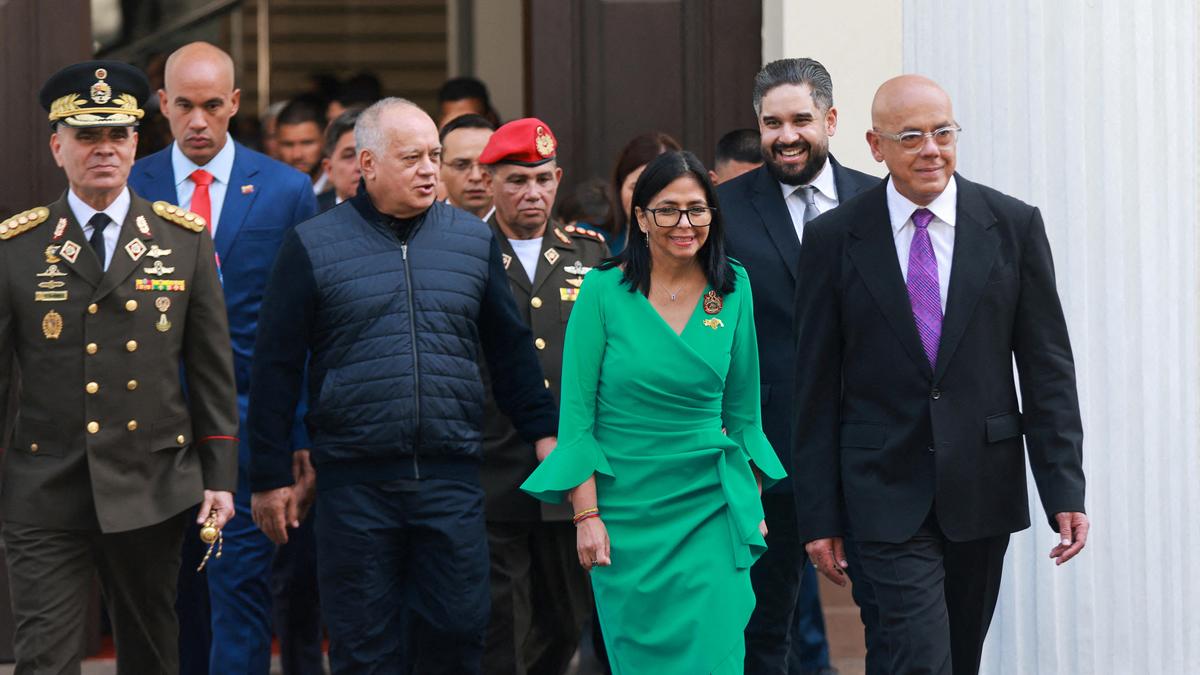
Ms. Rodriguez is identified as the new leader of Venezuela.
GK and monthly revision
New Venezuela leader says 'no foreign power' running country
Ms. Rodriguez has emerged as the new leader of Venezuela, succeeding the toppled Nicolas Maduro. She has asserted Venezuela's sovereignty, declaring that no foreign power is running the country. Her varied signals regarding cooperation with Mr. Trump indicate potential shifts in Venezuela's foreign policy, making this a significant development for understanding international relations and geopolitical dynamics for competitive exams.
Revision structure
Monthly events and exam calendar context
Static GK and one-liner notes
Quiz and mock-test revision path
Key points
Exam-ready takeaways
She previously served as Vice-President under the toppled leader Nicolas Maduro.
Ms. Rodriguez stated that 'no foreign power' is running Venezuela, emphasizing national sovereignty.
She has given mixed signals regarding her preparedness to cooperate with Mr. Trump (USA).
The political transition follows the toppling of former leader Nicolas Maduro.
Detailed analysis
Full exam-oriented breakdown
The political landscape of Venezuela has been tumultuous for over a decade, marked by profound economic distress, social unrest, and significant international scrutiny. The emergence of Ms. Rodriguez as a new leader, succeeding Nicolas Maduro, signals a potential shift in the country's domestic and foreign policy, with significant implications for international relations, particularly concerning the United States. **Background Context and What Happened:** Venezuela, a nation blessed with the world's largest proven oil reserves, has been in a state of severe crisis since the mid-2010s. The 'Bolivarian Revolution' initiated by Hugo Chavez in 1999, which aimed to establish a socialist state, saw a period of oil-fueled prosperity and significant social programs. However, over-reliance on oil exports, coupled with a lack of economic diversification, made the country highly vulnerable to global oil price fluctuations. When oil prices plummeted in 2014, the economy spiraled into hyperinflation, food and medicine shortages, and a massive humanitarian crisis that led millions to flee the country. Nicolas Maduro, Chavez's handpicked successor since 2013, inherited this deteriorating situation. His presidency was marked by increasing authoritarianism, contested elections (notably the 2018 presidential election, which many international observers deemed fraudulent), and widespread allegations of human rights abuses. This led to significant international pressure, including harsh economic sanctions from the United States and its allies, aiming to force Maduro from power. The US, along with dozens of other countries, recognized opposition leader Juan Guaidó as the interim president in 2019, further isolating Maduro's government. The term "toppled leader" in the context of Maduro often refers to this international delegitimization and the sustained efforts to remove him, rather than a clear internal coup. Ms. Rodriguez, who served as Vice-President under Maduro, now appears to have ascended to a new leadership role, as indicated by her statements on national sovereignty and foreign cooperation. **Key Stakeholders Involved:** 1. **Ms. Rodriguez**: The new leader of Venezuela, her past role as Vice-President under Maduro suggests continuity but her mixed signals towards the US indicate a potential pragmatic shift. Her assertion of national sovereignty is a common theme in Venezuelan politics, appealing to nationalist sentiments. 2. **Nicolas Maduro**: The former leader, whose policies and legitimacy were heavily contested. His legacy is tied to the country's economic collapse and political polarization. 3. **United States (Mr. Trump/US Administration)**: A major player due to its extensive sanctions regime, its recognition of the opposition, and its consistent pressure on the Venezuelan government. The US's stance is crucial for Venezuela's economic recovery and international reintegration. 4. **Venezuelan People**: The primary sufferers of the crisis, enduring hyperinflation, poverty, and lack of basic services. Their aspirations for stability and prosperity are central to any political transition. 5. **Russia and China**: Key allies of the Maduro regime, providing economic assistance, military support, and diplomatic backing. Their influence counters Western efforts to isolate Venezuela. 6. **Regional Powers (e.g., Colombia, Brazil)**: Directly impacted by the Venezuelan migrant crisis and often divided in their political stance, reflecting broader ideological splits in Latin America. **Why This Matters for India:** India, as a rapidly growing economy and a major energy consumer, has a vested interest in global stability and energy security. Venezuela possesses the largest proven oil reserves globally, making it a potentially crucial energy partner. Historically, India imported significant quantities of crude oil from Venezuela. However, US sanctions on Venezuela, particularly those targeting its state-owned oil company PDVSA, forced Indian refiners to reduce or halt these imports, impacting India's diversification strategy for oil sources. A stable Venezuela, potentially with eased sanctions, could reopen this avenue for India, enhancing its energy security and potentially influencing global oil prices. From a geopolitical perspective, India's foreign policy emphasizes non-interference in the internal affairs of other nations and the promotion of international peace and security (as enshrined in **Article 51** of the Indian Constitution). India has generally maintained a neutral stance, advocating for a peaceful resolution to Venezuela's crisis through dialogue, rather than endorsing one faction over another. Any shift in Venezuela's alignment or stability impacts the broader geopolitical balance, which India closely monitors to safeguard its strategic interests and maintain its independent foreign policy. **Historical Context and Future Implications:** The current crisis is a culmination of decades of political and economic choices, intensified by global dynamics. Chavez's '21st Century Socialism' and anti-imperialist rhetoric laid the groundwork for a confrontational relationship with the US. Maduro largely continued this trajectory, exacerbating the economic woes. Ms. Rodriguez's mixed signals — conciliatory at times, defiant at others — could indicate an attempt to balance domestic nationalist sentiments with the dire need for international engagement and economic relief. The future implications are multi-faceted: 1. **Political Stability**: Will Ms. Rodriguez consolidate power effectively? Will her leadership be recognized internally and externally, leading to a more stable political environment or further fragmentation? 2. **Economic Recovery**: A critical challenge. Any meaningful recovery will likely require an easing or lifting of US sanctions, which would depend on Venezuela's willingness to engage in democratic reforms and respect human rights. Diversification beyond oil is also essential. 3. **International Relations**: A rapprochement with the US could significantly alter the geopolitical landscape of Latin America. Conversely, continued defiance could deepen Venezuela's reliance on Russia and China, intensifying great power competition in the region. 4. **Humanitarian Crisis**: The well-being of the Venezuelan people hinges on political stability and economic recovery. Improved governance could lead to a reversal of the migrant crisis and better living conditions. For India, understanding these dynamics is crucial for navigating its energy diplomacy and maintaining its strategic autonomy in an increasingly complex world. India's adherence to multilateralism and its emphasis on dialogue, consistent with its foreign policy principles, will continue to shape its engagement with Venezuela and other nations facing similar challenges.
How to study
Turn news into exam marks
Revise monthly events by exam family instead of reading random updates.
Pair one-liners with mock tests so mistakes become the next revision list.
Keep state job pages, calendar pages and GK packs connected in one path.