

German Chancellor Friedrich Merz was on a two-day visit to India.
GK and monthly revision
German Chancellor Friedrich Merz on two-day visit to India; to meet PM Modi in Ahmedabad on Jan. 12
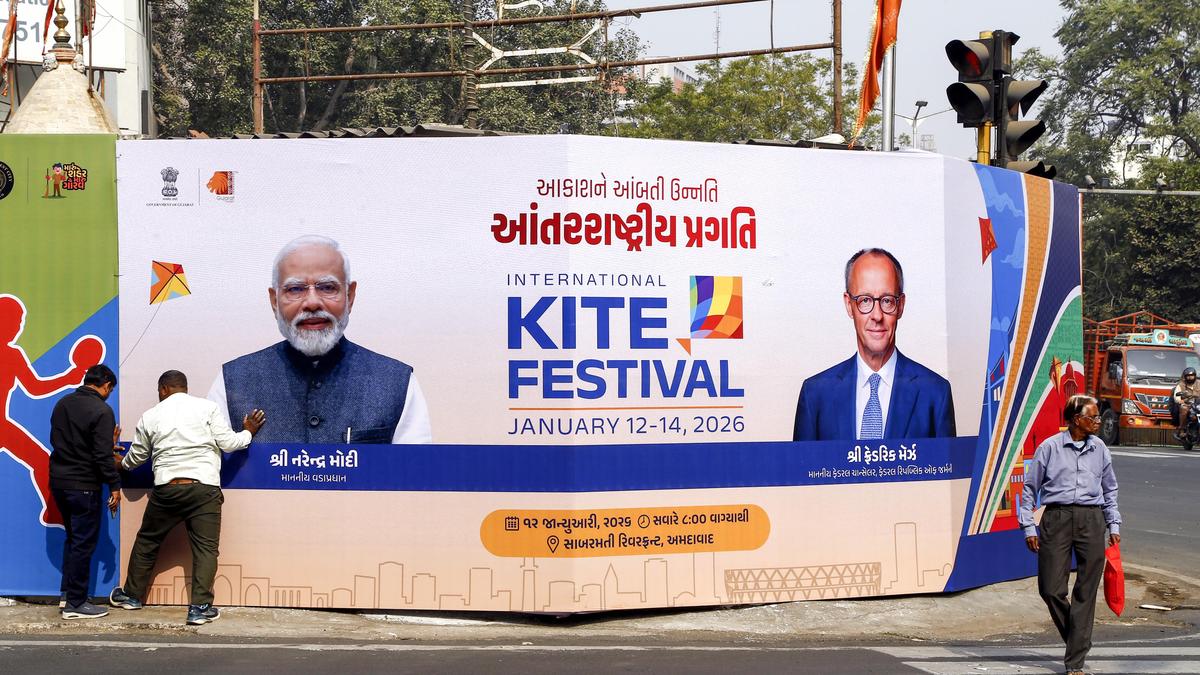
German Chancellor Friedrich Merz undertook a two-day visit to India, meeting PM Modi in Ahmedabad on January 12. This high-level visit signifies strengthening bilateral ties between India and Germany, a key European partner. The leaders' joint participation in cultural events like the International Kite Festival and a visit to Sabarmati Ashram highlights cultural diplomacy and shared historical reverence, important for international relations questions.
Revision structure
Monthly events and exam calendar context
Static GK and one-liner notes
Quiz and mock-test revision path
Key points
Exam-ready takeaways
He met Prime Minister Narendra Modi in Ahmedabad on January 12.
The leaders visited the historic Sabarmati Ashram in Ahmedabad.
They participated in the International Kite Festival at the Sabarmati Riverfront.
The visit aimed at strengthening bilateral relations between India and Germany.
Detailed analysis
Full exam-oriented breakdown
The visit of German Chancellor Friedrich Merz to India, culminating in a meeting with Prime Minister Narendra Modi in Ahmedabad on January 12, marks a significant moment in the robust and evolving strategic partnership between India and Germany. This high-level engagement underscores the mutual commitment to deepen bilateral ties across various sectors, from economic cooperation to cultural exchanges and global strategic alignment. **Background Context and Historical Ties:** India and Germany share a long-standing relationship, with diplomatic ties established in 1951. Germany has historically been one of India's most important partners in Europe, particularly in trade, investment, and technology transfer. Over the decades, this relationship has evolved into a 'Strategic Partnership,' formalized in 2000, and further strengthened by the biennial Inter-Governmental Consultations (IGC), a unique mechanism that brings together ministers from both sides. This framework allows for comprehensive discussions on a wide array of issues, reflecting the depth and breadth of their cooperation. Germany, as an economic powerhouse within the European Union (EU), plays a crucial role in shaping EU policy towards India, making bilateral engagements even more critical for India's broader engagement with Europe. **What Transpired During the Visit:** The two-day visit by Chancellor Merz was characterized by both formal diplomatic discussions and symbolic cultural engagements. The core event was his meeting with Prime Minister Modi in Ahmedabad on January 12. Beyond the formal talks, the leaders' joint participation in the International Kite Festival at the Sabarmati Riverfront and a visit to the historic Sabarmati Ashram were notable. These cultural elements serve a dual purpose: they highlight the 'soft power' dimension of international relations, fostering people-to-people connections, and demonstrate shared values. The Sabarmati Ashram, associated with Mahatma Gandhi, holds immense symbolic value, representing peace, non-violence, and India's struggle for independence, resonating with global leaders. **Key Stakeholders Involved:** On the Indian side, Prime Minister Narendra Modi and the Ministry of External Affairs (MEA) were the primary stakeholders, representing the government's foreign policy objectives. Key economic ministries, such as Commerce and Industry, Finance, and those related to renewable energy and skill development, would also be closely involved in the outcomes. From Germany, Chancellor Friedrich Merz, leading the German government, was the central figure. German businesses, particularly those with interests in India's growing market and manufacturing capabilities, are also significant stakeholders, eager to capitalize on strengthened bilateral ties. Broader entities like the European Union also indirectly benefit from enhanced India-Germany relations, as Germany often champions stronger EU-India engagement. **Significance for India:** This visit holds profound significance for India across multiple dimensions. Economically, Germany is a critical source of Foreign Direct Investment (FDI) and advanced technology. Enhanced cooperation can boost India's 'Make in India' initiative, particularly in manufacturing, automotive, and high-tech sectors. India seeks German expertise in green technologies, renewable energy (especially green hydrogen), and sustainable development, aligning with its ambitious climate goals. Politically, Germany's support for India's permanent membership in a reformed United Nations Security Council (UNSC) is vital. Both nations share concerns over global challenges like climate change, counter-terrorism, and supply chain resilience, making them natural partners in multilateral forums like the G7 and G20. The cultural exchanges during the visit also reinforce India's growing global influence and its emphasis on cultural diplomacy as a tool for international engagement. Furthermore, stronger ties with Germany are crucial for India's 'Act West' policy, aiming to deepen engagement with Europe amidst evolving geopolitical dynamics, particularly in the Indo-Pacific region. **Future Implications and Policy Connects:** The visit is expected to pave the way for increased trade and investment, potentially accelerating negotiations for the India-EU Free Trade Agreement, where Germany's influence is considerable. Collaboration on 'green hydrogen' production and other renewable energy projects is a key area for future growth, aligning with India's National Green Hydrogen Mission. There could be further cooperation in defense manufacturing, skill development programs under 'Skill India,' and academic exchanges. While no specific constitutional article directly governs foreign visits, the executive power of the Union, derived from **Articles 53 and 73**, implicitly covers the conduct of foreign policy and international relations. Furthermore, **Article 253** of the Indian Constitution empowers Parliament to make laws for implementing international treaties, agreements, or conventions, which could become relevant if new pacts are signed. India's Foreign Trade Policy and various industrial policies will also guide the economic aspects of this partnership. The visit reinforces India's commitment to a multi-polar world order and its role as a responsible global actor, seeking partnerships that contribute to its economic growth and strategic autonomy. In essence, Chancellor Merz's visit was not just a diplomatic formality but a strategic affirmation of a crucial bilateral relationship, poised for deeper collaboration in a rapidly changing global landscape.
How to study
Turn news into exam marks
Revise monthly events by exam family instead of reading random updates.
Pair one-liners with mock tests so mistakes become the next revision list.
Keep state job pages, calendar pages and GK packs connected in one path.