

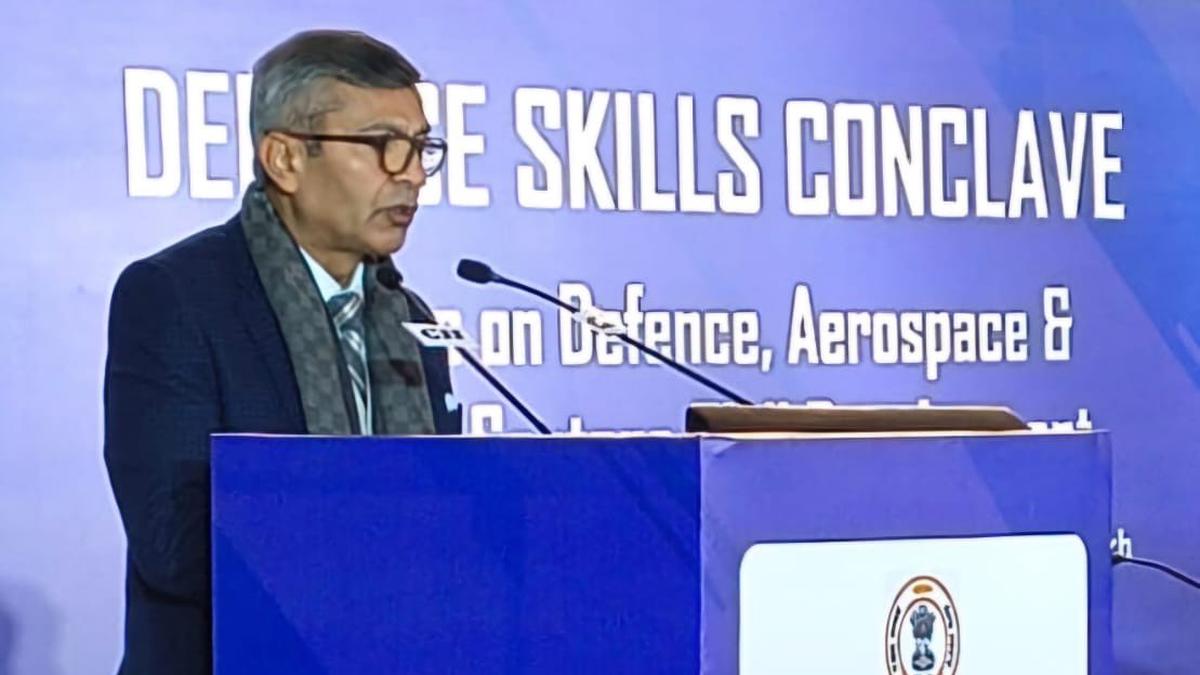
Defence Secretary Rajesh Kumar Singh stated that self-reliance in defence is crucial for India.
GK and monthly revision
Self-reliance in defence is crucial for India’s strategic autonomy: Defence Secretary
Defence Secretary Rajesh Kumar Singh emphasized that self-reliance in the defence sector is crucial for India's strategic autonomy. He noted that evolving global supply chains and rapidly advancing technologies present both challenges and opportunities for the nation's defence capabilities. This statement underscores India's ongoing commitment to indigenous defence production and reducing reliance on foreign imports, a key aspect of the 'Atmanirbhar Bharat' initiative, highly relevant for competitive exams.
Revision structure
Monthly events and exam calendar context
Static GK and one-liner notes
Quiz and mock-test revision path
Key points
Exam-ready takeaways
The primary objective of defence self-reliance is to ensure India's strategic autonomy.
Evolving global supply chains were identified as presenting both challenges and opportunities for the defence sector.
Rapidly advancing technologies were also highlighted as a significant factor impacting India's defence capabilities.
The statement aligns with India's 'Atmanirbhar Bharat' initiative, focusing on indigenous defence manufacturing.
Detailed analysis
Full exam-oriented breakdown
India's Defence Secretary Rajesh Kumar Singh's statement on the criticality of self-reliance in the defence sector for ensuring strategic autonomy resonates deeply with the nation's evolving geopolitical ambitions and economic imperatives. This emphasis is not new but represents a renewed vigour under the 'Atmanirbhar Bharat' (Self-Reliant India) initiative, aiming to transform India from a major defence importer into a significant defence exporter. Historically, India has been one of the world's largest importers of defence equipment. Following independence in 1947, India inherited a nascent industrial base and, facing immediate security challenges, relied heavily on foreign suppliers, initially from the UK and later from the Soviet Union/Russia, France, and the USA. Events like the 1962 Sino-Indian War and the 1965 and 1971 wars with Pakistan underscored the urgent need for a robust indigenous defence industry. However, despite the establishment of Defence Public Sector Undertakings (DPSUs) and the Defence Research and Development Organisation (DRDO) in 1958, progress was often slow, plagued by bureaucratic hurdles, technology denial regimes, and a lack of private sector participation. The Kargil War in 1999, which exposed critical gaps in India's defence preparedness and reliance on urgent foreign procurements, served as another stark reminder of the vulnerabilities of import dependence. This historical context laid the groundwork for the current push towards indigenization. The Defence Secretary's remarks highlight two crucial dynamics: evolving global supply chains and rapidly advancing technologies. The COVID-19 pandemic severely disrupted global supply chains, demonstrating the fragility of relying on external sources for critical components. Geopolitical tensions, such as the Russia-Ukraine conflict, have further exposed vulnerabilities to sanctions and export restrictions, directly impacting India's defence procurement from traditional partners. Simultaneously, the rapid pace of technological advancements, particularly in areas like artificial intelligence, cyber warfare, drone technology, space-based assets, and quantum computing, means that defence capabilities are constantly evolving. India must not only catch up but also innovate to maintain a competitive edge and protect its national interests. Key stakeholders in this drive for defence self-reliance include the Ministry of Defence (MoD), which formulates policies and oversees procurement; the Indian Armed Forces, who are the end-users and provide critical requirements; Defence Public Sector Undertakings (DPSUs) like Hindustan Aeronautics Limited (HAL), Bharat Electronics Limited (BEL), and Mazagon Dock Shipbuilders Limited (MDL), which are the backbone of indigenous production; and the DRDO, responsible for research and development. Crucially, the private sector, both large corporations and MSMEs, is now being actively encouraged to participate through policies like the 'Make in India' and 'Atmanirbhar Bharat' initiatives. Foreign defence partners, while still vital for technology transfer and joint ventures, are increasingly viewed through the lens of facilitating indigenous production rather than merely supplying finished goods. This push for self-reliance matters immensely for India. Firstly, it directly ensures **strategic autonomy**. By reducing reliance on foreign suppliers, India gains greater flexibility in its foreign policy decisions, free from the potential leverage that supplier nations might exert. Secondly, it has significant **economic implications**. Indigenous manufacturing stimulates economic growth, creates high-skill jobs, fosters a robust industrial base, and boosts R&D investment. It also reduces capital outflow associated with imports and holds the potential for India to become a net defence exporter, earning valuable foreign exchange. Thirdly, it enhances **national security**. Tailor-made solutions for India's unique operational environment can be developed, and critical equipment availability is ensured during times of conflict or crisis. Finally, it positions India as a more influential player on the global stage, contributing to regional stability and becoming a 'net security provider' in the Indo-Pacific region. Several policies and acts underpin this vision. The overarching framework is the **Atmanirbhar Bharat Abhiyan**, launched in May 2020, which emphasizes local manufacturing across various sectors, including defence. Specific to defence, the **Defence Acquisition Procedure (DAP) 2020** prioritizes procurement from Indian vendors under categories like 'Buy (Indian – IDDM)', 'Buy (Indian)', and 'Make' categories. It also introduced a 'Positive Indigenisation List' (also known as the Negative Import List), which identifies specific defence items that must be procured from domestic sources, with timelines for their import embargo. The government has also progressively increased the Foreign Direct Investment (FDI) limit in defence manufacturing, from 49% to 74% under the automatic route, and up to 100% with government approval, to attract foreign technology and investment while still promoting domestic production. Additionally, the establishment of **Defence Industrial Corridors** in Uttar Pradesh and Tamil Nadu aims to create dedicated ecosystems for defence manufacturing. The future implications are profound. We can expect continued government support for indigenous R&D, potentially through increased budgetary allocations and incentives for private sector innovation. There will be a greater emphasis on developing cutting-edge technologies crucial for future warfare, such as AI, quantum computing, and space capabilities. India's aspirations to become a major defence exporter will likely see more proactive diplomacy and marketing of its defence products. However, challenges persist, including bridging existing technology gaps, ensuring quality control, streamlining bureaucratic processes, and fostering a culture of innovation and risk-taking within the defence ecosystem. Success in this endeavor is not just about manufacturing equipment; it's about securing India's strategic future and elevating its global standing.
How to study
Turn news into exam marks
Revise monthly events by exam family instead of reading random updates.
Pair one-liners with mock tests so mistakes become the next revision list.
Keep state job pages, calendar pages and GK packs connected in one path.