

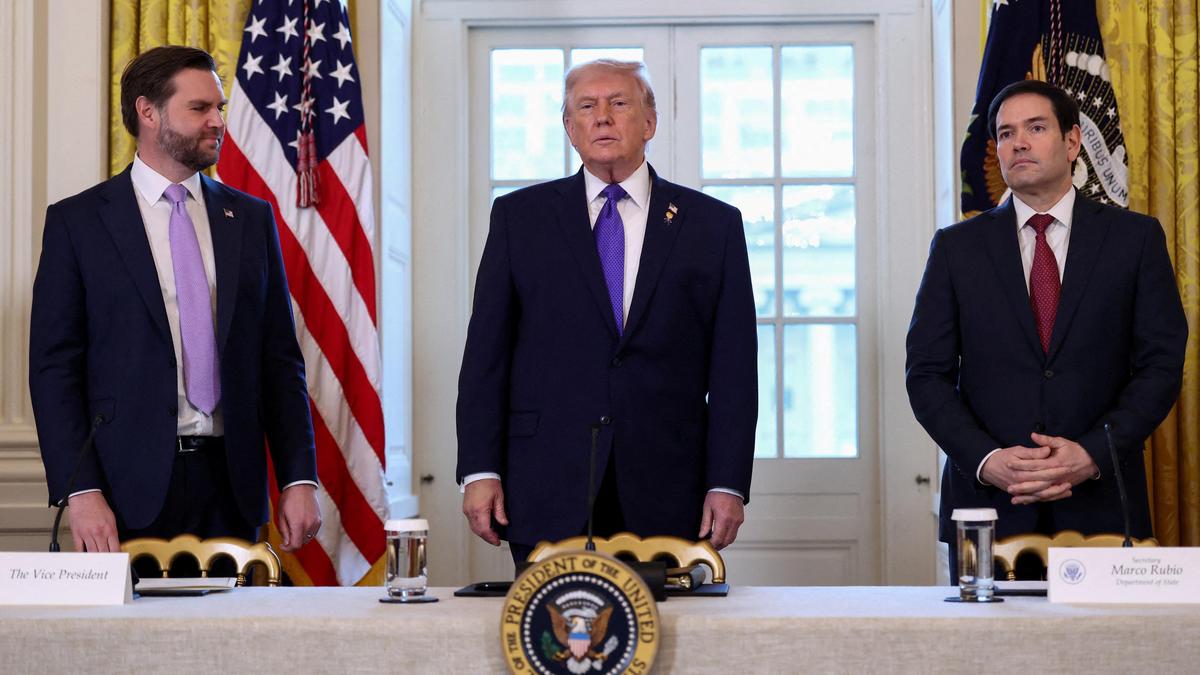
Former U.S. President Donald Trump stated the U.S. needs to acquire Greenland.
GK and monthly revision
Trump says U.S. needs to own Greenland to deter Russia, China
Former U.S. President Donald Trump asserted that the U.S. should acquire Greenland to effectively deter geopolitical rivals like Russia and China. This statement highlights the strategic importance of Greenland in Arctic geopolitics, despite the existing U.S. military presence under a 1951 agreement. For competitive exams, this underscores the evolving dynamics of international relations and the strategic significance of the Arctic region.
Revision structure
Monthly events and exam calendar context
Static GK and one-liner notes
Quiz and mock-test revision path
Key points
Exam-ready takeaways
The primary reason cited for acquisition was to deter Russia and China.
The U.S. already maintains a military presence on Greenland.
This existing U.S. military presence is established under a 1951 agreement.
Trump argued that current deals, like the 1951 agreement, are insufficient to guarantee Greenland's defense.
Detailed analysis
Full exam-oriented breakdown
Former U.S. President Donald Trump's assertion that the U.S. should acquire Greenland to deter geopolitical rivals like Russia and China might sound like a relic from a bygone era of colonial expansion, but it vividly underscores the intensifying strategic importance of the Arctic region in contemporary international relations. This statement, made in 2019, though rejected by Denmark and Greenland, brought the remote, ice-covered island into the global geopolitical spotlight, highlighting underlying tensions and strategic calculations. **Background Context and What Happened:** Greenland, the world's largest island, is an autonomous territory within the Kingdom of Denmark. Its strategic significance stems from its unique geographical position: it sits between the North Atlantic and the Arctic Ocean, offering critical access points and surveillance opportunities. The melting of Arctic ice, a consequence of climate change, is rapidly opening up new shipping routes (like the Northern Sea Route and the Northwest Passage) and making vast, previously inaccessible natural resources (oil, gas, rare earth minerals) more attainable. This has transformed the Arctic from a frozen periphery into a potential geopolitical hotspot. Trump's suggestion wasn't entirely new; the U.S. has a historical interest in Greenland. In 1867, U.S. Secretary of State William Seward, known for acquiring Alaska, explored the possibility of buying Greenland and Iceland. Later, in 1946, President Harry Truman offered Denmark $100 million for Greenland. The U.S. already maintains a significant military presence on the island, notably the Thule Air Base, under a 1951 defense agreement with Denmark. This base is crucial for missile warning, space surveillance, and Arctic defense. Trump's argument was that existing agreements were insufficient to guarantee Greenland's defense against emerging threats, necessitating outright ownership. **Key Stakeholders Involved:** 1. **United States:** Views Greenland as vital for its national security, particularly for missile defense and projecting power in the Arctic. It aims to counter the growing influence of Russia and China in the region. 2. **Denmark:** As the sovereign power, Denmark firmly rejected Trump's offer, emphasizing that Greenland is not for sale. The incident strained diplomatic relations but also reaffirmed Denmark's commitment to Greenland's autonomy and territorial integrity. 3. **Greenland (Kalaallit Nunaat):** As a self-governing territory, Greenland has significant autonomy in internal affairs and aspirations for greater independence. While it seeks foreign investment for economic development, its leaders vehemently opposed the idea of being 'bought,' asserting their right to self-determination and dignity. They are wary of becoming a pawn in great power rivalries. 4. **Russia:** Has significantly increased its military presence, economic activities, and scientific research in its Arctic territories. It views the Northern Sea Route as a national shipping lane and seeks to assert its dominance in the region. 5. **China:** Declared itself a
How to study
Turn news into exam marks
Revise monthly events by exam family instead of reading random updates.
Pair one-liners with mock tests so mistakes become the next revision list.
Keep state job pages, calendar pages and GK packs connected in one path.