

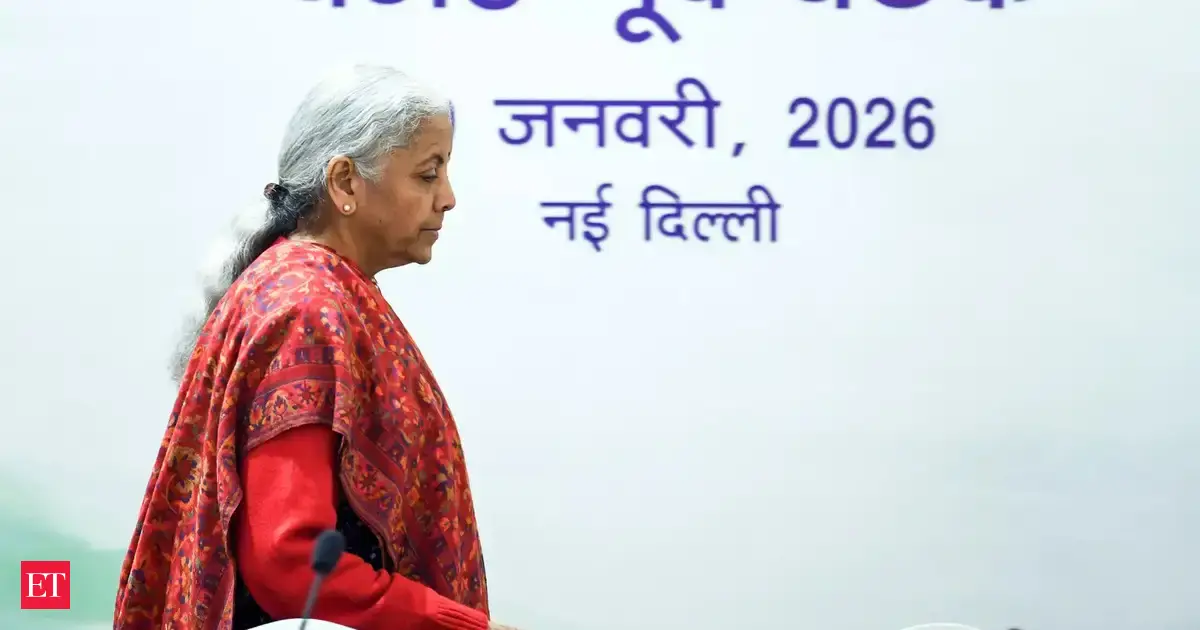
States met with Finance Minister Nirmala Sitharaman for pre-Budget consultations ahead of the FY27 Union Budget.
GK and monthly revision
Budget 2026: States seek higher capex aid, GST loss compensation in pre-Budget talks with Sitharaman
States held pre-Budget talks with Finance Minister Nirmala Sitharaman for the FY27 budget, seeking increased special assistance for capital investments and compensation for GST revenue losses. They also requested more funding for urban and rural schemes, housing, and disaster management. This highlights ongoing fiscal federalism issues and the states' role in achieving India's 'Developed Nation by 2047' goal, making it crucial for understanding government finances and policy direction.
Revision structure
Monthly events and exam calendar context
Static GK and one-liner notes
Quiz and mock-test revision path
Key points
Exam-ready takeaways
Key demands from states included higher special assistance for capital investments and compensation for Goods and Services Tax (GST) revenue losses.
States also requested increased funding for urban and rural development schemes, housing programs, and disaster management.
Finance Minister Sitharaman urged states to undertake reforms to contribute to India's goal of becoming a 'Developed Nation' by 2047.
The discussions are part of the preparatory process for the Union Budget for the financial year 2026-27 (FY27).
Detailed analysis
Full exam-oriented breakdown
The pre-Budget consultations between state finance ministers and the Union Finance Minister, Nirmala Sitharaman, for the Financial Year 2026-27 (FY27) Union Budget underscore the dynamic and often complex nature of fiscal federalism in India. These discussions are a crucial annual exercise where states articulate their financial needs and policy priorities to the central government, influencing the allocation of resources and the overall direction of national economic policy. **Background Context and What Happened:** India operates on a federal structure where both the Union and state governments have distinct, yet often overlapping, responsibilities in public finance. The Union Budget, typically presented in February, is the most significant annual financial statement, outlining the central government's estimated receipts and expenditures. Prior to its finalization, the Finance Ministry engages in extensive consultations with various stakeholders, including state governments, industry bodies, and economists, to gather inputs and understand diverse perspectives. In the recent consultations for FY27, states primarily sought increased 'special assistance for capital investments'. This refers to interest-free loans or grants provided by the Centre to states specifically for capital expenditure, which creates long-term assets, generates employment, and boosts economic growth. The demand for such assistance has been prominent, especially post-pandemic, as states strive to revive their economies and build critical infrastructure. A significant and recurring demand was also for 'compensation for Goods and Services Tax (GST) revenue losses'. When GST was introduced via the 101st Constitutional Amendment Act in 2016, states were guaranteed compensation for any revenue loss arising from its implementation for a period of five years, which ended in June 2022. Despite the expiration, many states continue to argue for its extension or an alternative mechanism, citing ongoing revenue shortfalls. Additionally, states requested enhanced funding for crucial social and developmental schemes, including urban and rural development, housing programs, and disaster management, highlighting their on-ground responsibilities. In response, Finance Minister Sitharaman urged states to undertake reforms, emphasizing their pivotal role in achieving India's ambitious goal of becoming a 'Developed Nation' by 2047. **Key Stakeholders Involved:** * **Union Finance Ministry:** Led by the Finance Minister, it is responsible for formulating the Union Budget, managing central government finances, and overseeing fiscal transfers to states. It balances national priorities with states' demands. * **State Governments:** Represented by their respective Finance Ministers or officials, states are primary implementers of welfare schemes and infrastructure projects. Their fiscal health is vital for national development. They are the demand-side stakeholders in these consultations. * **Finance Commission:** While not directly involved in these pre-Budget talks, the recommendations of the Finance Commission (constituted under Article 280 of the Constitution) fundamentally shape the framework of Centre-state fiscal relations, including the vertical and horizontal devolution of taxes and grants-in-aid. Its reports set the baseline for transfers, upon which these annual demands are built. **Why This Matters for India:** These consultations are critical for several reasons. Economically, capital expenditure by states is a potent driver of growth, stimulating demand, creating jobs, and enhancing productive capacity. Increased central support for state capex can thus amplify national economic recovery and development. Politically, the discussions highlight the intricate balance of fiscal federalism. States often feel constrained by centrally imposed schemes and limited fiscal autonomy, making these platforms crucial for airing grievances and seeking more resources. The debate over GST compensation is a prime example of this ongoing tension; while GST aimed to simplify indirect taxation, its implementation has altered states' revenue-generating capacities. Socially, adequate funding for urban and rural schemes, housing, and disaster management directly impacts the welfare of citizens, addressing poverty, inequality, and vulnerability. The Finance Minister's call for state-level reforms aligns with the broader national vision of 'Developed India by 2047', emphasizing that sustained economic growth and efficient governance require concerted efforts from both levels of government. **Historical Context and Constitutional Provisions:** India's fiscal federalism has evolved significantly since independence. The Constitution itself lays down the framework for financial relations, with distinct powers for taxation and expenditure. For instance, **Article 246A** (inserted by the 101st Amendment) specifically deals with the power to legislate on GST, granting concurrent powers to both Parliament and State Legislatures. **Article 280** mandates the President to constitute a Finance Commission every five years to make recommendations on the distribution of net proceeds of taxes between the Union and the states (vertical devolution) and among the states themselves (horizontal devolution), and grants-in-aid of the revenues of the states (**Article 275**). Additionally, **Article 282** allows both the Union and states to make grants for any public purpose, even if it falls outside their legislative competence, which often forms the basis for discretionary grants like special assistance. The initial five-year GST compensation period was a unique mechanism under the **GST (Compensation to States) Act, 2017**, to allay states' fears of revenue loss. **Future Implications:** The ongoing dialogue suggests that fiscal federalism will remain a key area of policy discourse. States will likely continue to push for greater fiscal autonomy and predictable revenue streams, especially as they bear the brunt of implementing social welfare programs and developing infrastructure. The Union government, in turn, will likely continue to tie financial assistance to performance-based reforms and adherence to national development goals. The future of GST compensation, or a similar revenue-stabilization mechanism for states, will be a critical determinant of Centre-state financial harmony. The emphasis on 'Developed India by 2047' means that states are expected to play a proactive role in reforms, including ease of doing business, urban planning, and leveraging digital technologies, to attract investment and foster growth. This collaborative yet occasionally contentious relationship is essential for India's sustained progress.
How to study
Turn news into exam marks
Revise monthly events by exam family instead of reading random updates.
Pair one-liners with mock tests so mistakes become the next revision list.
Keep state job pages, calendar pages and GK packs connected in one path.