

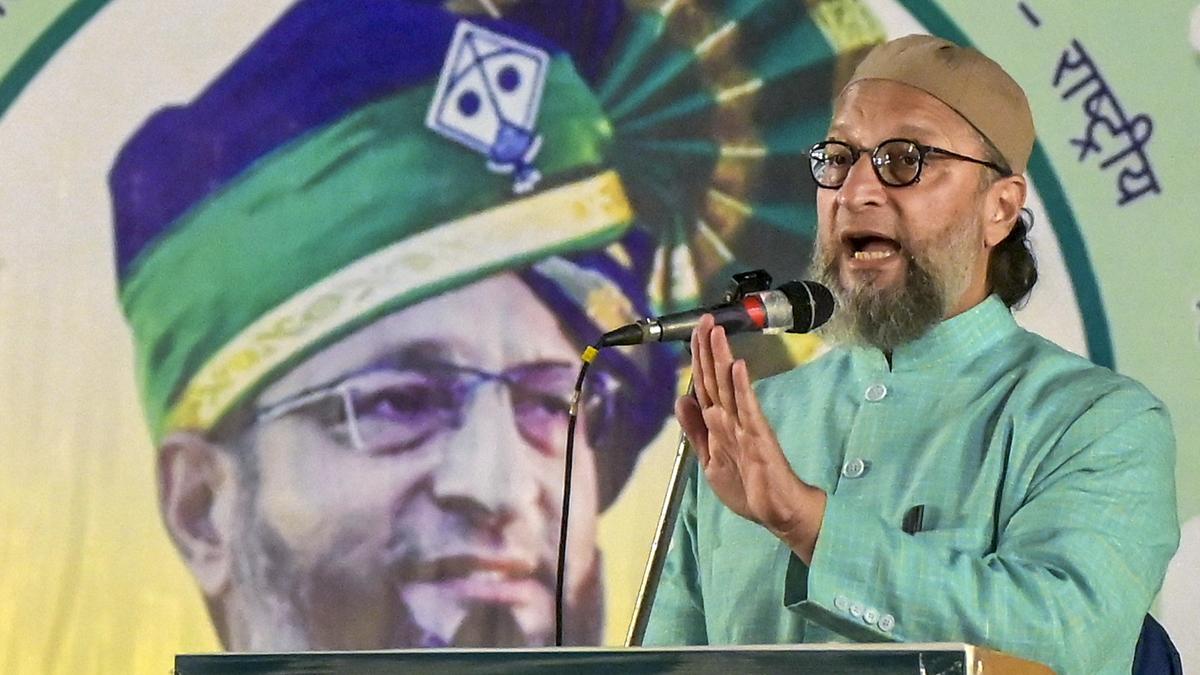
AIMIM chief Asaduddin Owaisi made the statement criticizing Congress.
GK and monthly revision
Owaisi targets Congress over UAPA, denial of bail to Khalid and Imam
AIMIM chief Asaduddin Owaisi criticized Congress, accusing it of political opportunism by using 'secularism' to gain votes while allegedly acting against Muslims, Dalits, and tribals. He specifically targeted Congress over its stance on the Unlawful Activities (Prevention) Act (UAPA) and the denial of bail to activists Umar Khalid and Sharjeel Imam. This highlights ongoing political debate around UAPA's application and its impact on civil liberties, crucial for understanding contemporary Indian polity.
Revision structure
Monthly events and exam calendar context
Static GK and one-liner notes
Quiz and mock-test revision path
Key points
Exam-ready takeaways
The criticism centers on the Unlawful Activities (Prevention) Act (UAPA).
Owaisi specifically mentioned the denial of bail to activists Umar Khalid and Sharjeel Imam.
He accused Congress of using 'political secularism' to gain votes.
Owaisi alleged that Congress is an 'enemy of Muslims, Dalits, and tribals'.
Detailed analysis
Full exam-oriented breakdown
The statement by AIMIM chief Asaduddin Owaisi, criticizing the Congress party over the Unlawful Activities (Prevention) Act (UAPA) and the denial of bail to activists Umar Khalid and Sharjeel Imam, opens a crucial window into several complex and intertwined aspects of Indian polity: the debate surrounding national security laws, civil liberties, the nature of secularism, and the dynamics of identity politics. To understand this, we must first delve into the **background context** of the UAPA. Enacted in 1967, the UAPA was initially designed to combat unlawful associations and activities threatening India's sovereignty and territorial integrity. However, it underwent significant amendments, particularly in 2004, 2008, 2012, and 2019, which dramatically expanded its scope, transforming it into India's primary anti-terror legislation. The 2004 amendment, notably, brought 'terrorist acts' under its purview following the repeal of the Prevention of Terrorism Act (POTA) in the same year. Subsequent amendments further strengthened the state's powers, with the 2019 amendment allowing the central government to designate individuals as 'terrorists' without a prior judicial process. These amendments, passed under various governments including those led by the Congress and BJP, reflect a bipartisan consensus, at different points, on the need for stringent anti-terror laws, even as their implementation draws increasing criticism. **What happened** in this specific instance is Owaisi’s direct accusation that Congress, despite projecting itself as secular, has historically contributed to and now tacitly supports the stringent application of UAPA. He highlights the cases of Umar Khalid and Sharjeel Imam, activists arrested in connection with the 2020 Delhi riots, whose bail pleas have been repeatedly denied, facing prolonged incarceration under UAPA's stringent provisions. Owaisi contends that Congress's 'political secularism' is a mere vote-garnering tactic, while its actions or inactions demonstrate an adversarial stance towards Muslims, Dalits, and tribals, who are often disproportionately affected by such laws. **Key stakeholders** involved include: **AIMIM and Asaduddin Owaisi**, who articulate the concerns of minority communities and challenge mainstream political narratives on secularism and justice. The **Congress Party**, which finds itself on the defensive, having historically championed secularism but also having been instrumental in strengthening UAPA's provisions. **Activists like Umar Khalid and Sharjeel Imam** represent civil society voices, whose cases exemplify the challenges to civil liberties and freedom of speech under UAPA. The **Indian Judiciary** plays a critical role in interpreting the law and adjudicating bail applications, often navigating the difficult balance between national security and individual rights, particularly given UAPA's high threshold for bail. Finally, the **Union Government and State Governments** are the enforcing authorities, wielding significant power under UAPA. This issue **matters significantly for India** for several reasons. Firstly, it underscores the persistent tension between national security imperatives and the protection of fundamental rights, particularly **Article 19(1)(a)** (freedom of speech and expression), **Article 19(1)(b)** (right to assemble peacefully), and **Article 21** (right to life and personal liberty, including due process). UAPA's stringent bail conditions, particularly Section 43D(5), which states that bail shall not be granted if the court is of the opinion that there are reasonable grounds for believing that the accusation is prima facie true, often lead to prolonged pre-trial detention, effectively making 'bail the exception and jail the norm'. This raises serious questions about due process and the presumption of innocence. Secondly, it highlights the ongoing debate about the nature of Indian secularism and the political instrumentalization of identity. Owaisi's criticism suggests a perception among certain communities that 'secular' parties do not always defend their rights when it comes to issues like national security. Thirdly, it impacts the space for dissent and free speech, as activists and critics fear arbitrary arrests and prolonged detention under UAPA, potentially leading to a chilling effect on democratic discourse. Looking at **historical context**, while the UAPA was enacted in 1967, its modern, more draconian form evolved significantly after major terror attacks. The repeal of POTA in 2004 by the UPA government was seen as a move to protect civil liberties, but many of POTA's stringent provisions were subsequently integrated into UAPA, illustrating a continuity in the state's approach to anti-terror legislation across political dispensations. This evolution reveals a consistent legislative trend towards empowering the state in matters of internal security, often at the expense of individual freedoms. **Future implications** are profound. Continued reliance on UAPA and similar stringent laws without robust judicial oversight or accountability mechanisms could further erode civil liberties and deepen the trust deficit between the state and its citizens, especially marginalized communities. It could also lead to increased political polarization and international scrutiny regarding India's human rights record. The judiciary will face increasing pressure to provide clearer guidelines on the application of UAPA, especially concerning bail, to ensure that the law is not used as a tool for political suppression rather than genuine counter-terrorism. The debate also prompts a re-evaluation of secularism in India, pushing political parties to move beyond rhetorical secularism to concrete actions that protect all communities equally under the law.
How to study
Turn news into exam marks
Revise monthly events by exam family instead of reading random updates.
Pair one-liners with mock tests so mistakes become the next revision list.
Keep state job pages, calendar pages and GK packs connected in one path.