

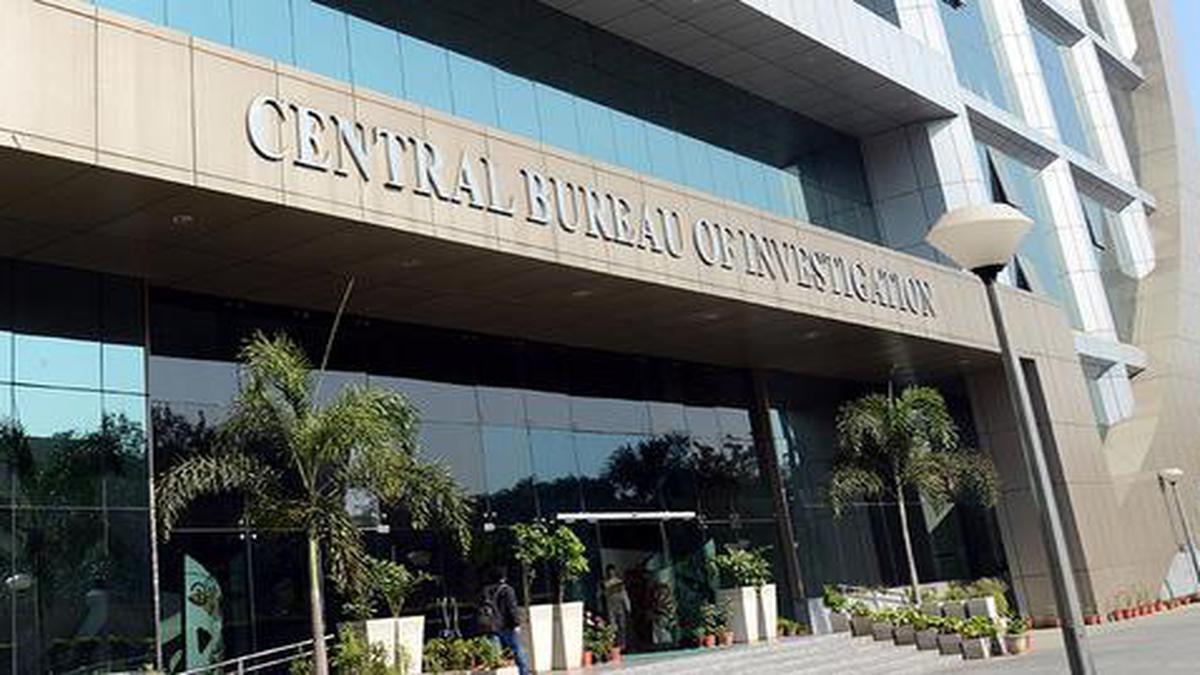
The Central Bureau of Investigation (CBI) has registered a case concerning a banking fraud.
GK and monthly revision
CBI books former Punjab & Sind Bank branch heads in ₹1,621 crore mule account scam
The Central Bureau of Investigation (CBI) has registered a case against former branch heads of Punjab & Sind Bank for their alleged involvement in a ₹1,621 crore 'mule account' scam. This significant banking fraud utilized forged KYC documents and false rent agreements to open illicit accounts. The case underscores the importance of robust banking regulations and vigilance against financial crimes, making it relevant for exams focusing on economic offenses and governance.
Revision structure
Monthly events and exam calendar context
Static GK and one-liner notes
Quiz and mock-test revision path
Key points
Exam-ready takeaways
The scam involves former branch heads of the public sector bank, Punjab & Sind Bank.
The alleged fraud amounts to a significant ₹1,621 crore.
The nature of the fraud is identified as a 'mule account' scam.
The modus operandi included the use of forged KYC documents and false rent agreements for account opening.
Detailed analysis
Full exam-oriented breakdown
The Central Bureau of Investigation (CBI)'s action against former branch heads of Punjab & Sind Bank in a colossal ₹1,621 crore 'mule account' scam unveils a critical vulnerability within India's financial system and underscores the persistent challenge of financial fraud. This incident isn't just another news headline; it's a profound lesson in economic governance, internal security, and the integrity of public institutions. At its core, a 'mule account' scam involves the use of bank accounts, often opened using fraudulent identities or by individuals who are unwittingly or willingly used as conduits, to receive and quickly transfer illicit funds. These accounts act as intermediaries, helping fraudsters distance themselves from the original source of illegal money, thus making it harder for law enforcement agencies to trace the actual perpetrators. In the case of Punjab & Sind Bank, the modus operandi was alarmingly simple yet effective: forged Know Your Customer (KYC) documents, false rent agreements, and other fabricated supporting papers were used to open these illicit accounts. This points to a significant lapse in the bank's internal controls and the complicity of its employees. Key stakeholders in this intricate web include the **Central Bureau of Investigation (CBI)**, India's premier investigative agency, which is tasked with uncovering and prosecuting such high-profile cases. Their involvement highlights the serious nature and inter-state, possibly international, ramifications of the scam. **Punjab & Sind Bank**, a public sector bank, is both a victim of the fraud and, through its allegedly complicit employees, an enabler. The **former branch heads** are the primary accused, suspected of abusing their positions of trust and authority to facilitate the opening of these 'mule accounts'. The **fraudsters** are the masterminds who orchestrate these schemes, often involving cybercrimes, phishing, or other illicit activities to acquire funds, which are then laundered through these mule accounts. Finally, the **'mule account holders'** themselves, who could be either innocent individuals duped into opening accounts or those who knowingly participate for a commission, form the final link in the chain. This scam carries immense significance for India. Economically, a fraud of ₹1,621 crore is a substantial loss, potentially impacting the bank's balance sheet, its ability to lend, and ultimately, the taxpayer. Such incidents erode public trust in the banking system, particularly in public sector banks (PSBs), which are often perceived as more secure. It also highlights the persistent challenges in combating money laundering and financial terrorism, as mule accounts are a common tool for both. From a governance perspective, it raises serious questions about the effectiveness of internal audit mechanisms, compliance with regulatory guidelines, and the ethical conduct of bank employees. Historically, India has grappled with numerous banking scams, from the Harshad Mehta scam of the early 1990s to more recent cases involving Nirav Modi and Vijay Mallya, underscoring a recurring pattern of financial irregularities and the need for continuous reform. The legal framework to combat such crimes is robust but requires stringent implementation. The **Prevention of Money Laundering Act (PMLA), 2002**, is directly applicable here, as mule accounts are instrumental in money laundering. The CBI would likely invoke sections of the **Indian Penal Code (IPC)**, such as Section 420 (cheating and dishonestly inducing delivery of property), Section 467 (forgery of valuable security), Section 468 (forgery for purpose of cheating), and Section 120B (criminal conspiracy). The **Banking Regulation Act, 1949**, along with the **Reserve Bank of India (RBI)'s Master Directions on KYC/AML**, forms the regulatory backbone intended to prevent such frauds. The alleged use of forged KYC documents indicates a deliberate circumvention of these critical guidelines, which mandate thorough due diligence during account opening. Looking ahead, this incident will likely prompt enhanced scrutiny and stricter enforcement of KYC norms across all banks. There will be a greater push for technological solutions, such as Artificial Intelligence and Machine Learning, to detect anomalous transaction patterns indicative of mule accounts. Banks may also invest more in employee training on fraud prevention and ethical conduct, alongside strengthening their whistleblower policies. For India, ensuring the integrity of its financial system is paramount for economic stability and attracting foreign investment. The fight against financial crime is an ongoing battle that demands constant vigilance, technological upgrades, and unwavering commitment from all stakeholders.
How to study
Turn news into exam marks
Revise monthly events by exam family instead of reading random updates.
Pair one-liners with mock tests so mistakes become the next revision list.
Keep state job pages, calendar pages and GK packs connected in one path.