

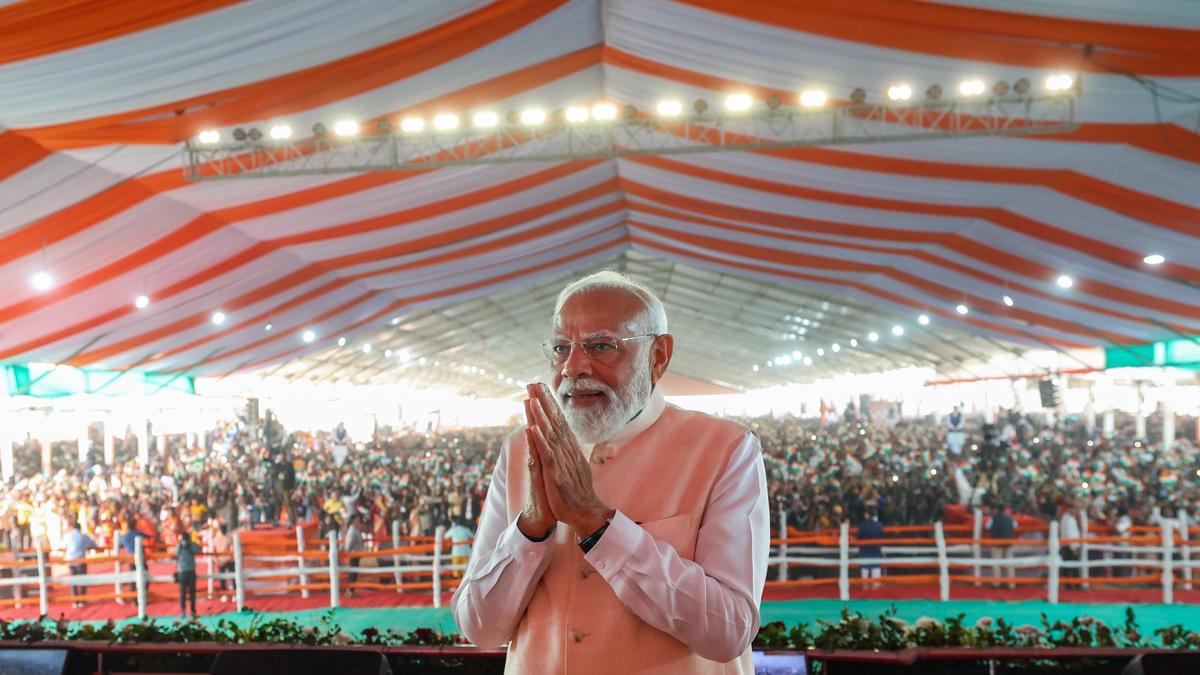
Prime Minister Narendra Modi unveiled development projects worth over ₹830 crore.
GK and monthly revision
PM Modi unveils development projects worth over ₹830 crore, flags off three Amrit Bharat trains in Bengal
Prime Minister Narendra Modi launched development projects exceeding ₹830 crore in Bengal, significantly boosting regional infrastructure. Key initiatives included flagging off three Amrit Bharat trains and inaugurating the Jayrambati-Barogopinathpur-Maynapur rail line. This highlights the government's focus on enhancing railway connectivity and development, crucial for competitive exams covering government schemes and infrastructure.
Revision structure
Monthly events and exam calendar context
Static GK and one-liner notes
Quiz and mock-test revision path
Key points
Exam-ready takeaways
The projects and train flag-offs took place in Bengal.
Three Amrit Bharat trains were flagged off by PM Modi.
The Jayrambati-Barogopinathpur-Maynapur rail line was inaugurated.
A train service between Maynapur and Jayrambati was flagged off on the newly inaugurated line.
Detailed analysis
Full exam-oriented breakdown
Prime Minister Narendra Modi's recent unveiling of development projects worth over ₹830 crore and the flagging off of three Amrit Bharat trains in Bengal represents a significant stride in India's ongoing infrastructure push. This event, which also saw the inauguration of the Jayrambati-Barogopinathpur-Maynapur rail line and a new train service, underscores the government's commitment to enhancing connectivity, stimulating economic growth, and modernizing the nation's vital railway network. **Background Context and What Happened:** India has, for decades, grappled with the challenge of uneven infrastructure development, leading to regional disparities in economic growth and access to essential services. Recognizing infrastructure as a critical enabler for achieving its vision of a developed nation by 2047 (Amrit Kaal), the current government has placed an unprecedented emphasis on large-scale infrastructure projects. The railway sector, often considered the lifeline of the nation, is at the forefront of this transformation, moving beyond mere expansion to focus on modernization, speed, and passenger experience. The Amrit Bharat Express, an initiative launched in late 2023, is a testament to this vision. These non-AC, LHB coach trains are designed to offer an improved travel experience for the common man, featuring better amenities, modern interiors, and faster turnaround times, bridging the gap between premium services like Vande Bharat and conventional passenger trains. The recent event in Bengal saw the Prime Minister dedicate projects valued at over ₹830 crore. The highlight was the flagging off of three Amrit Bharat Express trains, which are expected to significantly enhance connectivity on their respective routes. Additionally, the inauguration of the Jayrambati-Barogopinathpur-Maynapur rail line is crucial for connecting historically underserved or less developed areas within West Bengal, facilitating easier movement of people and goods. The immediate flagging off of a train service between Maynapur and Jayrambati on this new line ensures its operationalization and immediate benefit to the local populace. **Key Stakeholders Involved:** Several key stakeholders are integral to such large-scale projects. The **Government of India**, primarily through the **Prime Minister's Office** and the **Ministry of Railways**, acts as the initiator, policymaker, and primary funder. **Indian Railways** itself is the implementing agency, responsible for the planning, construction, operation, and maintenance of these lines and services. While the projects are central government-led, the **State Government of West Bengal** plays a crucial role in facilitating land acquisition, providing necessary local clearances, and ensuring law and order during project execution. Ultimately, the **local population, commuters, businesses, and industries** are the direct beneficiaries, gaining improved access to transportation, markets, and economic opportunities. **Significance for India and Historical Context:** This development holds immense significance for India. Economically, improved rail connectivity boosts regional economies by facilitating the movement of raw materials and finished goods, reducing logistics costs, and promoting trade and tourism. It also creates direct and indirect employment opportunities, from construction to operations. Socially, it enhances access to education, healthcare, and markets for people in remote areas, thereby reducing regional disparities. Politically, such initiatives reinforce the government's commitment to inclusive development, aligning with the 'Sabka Saath, Sabka Vikas, Sabka Vishwas' (Collective Efforts, Inclusive Growth, Trust of All) philosophy, even in states with differing political landscapes. Historically, Indian Railways, established during the British colonial era, has been a cornerstone of national integration. Post-independence, the focus shifted from consolidating the network to expanding it and, more recently, to modernization. The introduction of trains like the Amrit Bharat Express signifies a paradigm shift towards enhancing the quality of travel for all segments of society, not just premium passengers, reflecting a more equitable approach to rail development. **Future Implications and Constitutional/Policy References:** These projects are part of a larger, integrated vision for India's infrastructure. They align directly with the **PM Gati Shakti National Master Plan**, launched in 2021, which aims to break departmental silos and ensure integrated planning and synchronized implementation of infrastructure projects across various ministries. This holistic approach seeks to optimize resource utilization and accelerate project delivery. The continued rollout of Amrit Bharat trains and new rail lines implies a sustained focus on improving last-mile connectivity and offering modern, affordable travel options nationwide. From a constitutional perspective, **Railways fall under Entry 22 of the Union List in the Seventh Schedule** of the Indian Constitution, granting the central government exclusive legislative and executive powers over this sector. Funding for such projects often comes from the **Union Budget**, with provisions under **Article 282** allowing the Union or a State to make grants for public purposes. The overall framework for railway operations and development is governed by the **Railway Act, 1989**. These projects also reflect the government's broader economic strategy to leverage infrastructure investment as a counter-cyclical measure and a long-term growth driver, aiming to make India a $5 trillion economy. The future implications are substantial: a more connected India, reduced travel times, lower transportation costs, increased accessibility to remote regions, and a significant boost to regional economies. Such investments are crucial for India's continued growth trajectory and its ambition to become a global economic powerhouse, ensuring that the benefits of development reach every corner of the country.
How to study
Turn news into exam marks
Revise monthly events by exam family instead of reading random updates.
Pair one-liners with mock tests so mistakes become the next revision list.
Keep state job pages, calendar pages and GK packs connected in one path.