

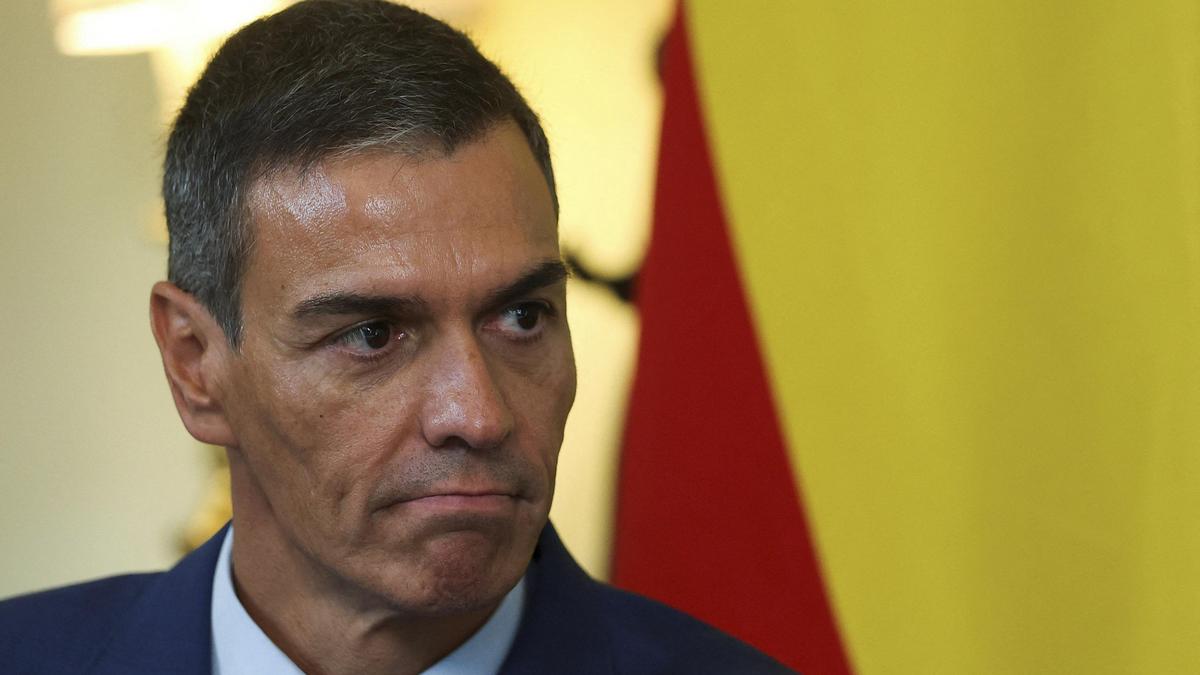
Spanish Prime Minister Pedro Sanchez made the statement regarding Greenland.
GK and monthly revision
Spanish PM Sanchez says U.S. invasion of Greenland 'would make Putin happiest man on earth'
Spanish Prime Minister Pedro Sanchez warned that any hypothetical U.S. military action against Greenland, a Danish territory, would severely damage NATO's unity. He further stated that such an act would legitimize Russia's invasion of Ukraine, making Russian President Vladimir Putin "the happiest man on earth." This statement underscores the geopolitical sensitivities surrounding Arctic regions and the importance of alliances like NATO, crucial for understanding international relations in competitive exams.
Revision structure
Monthly events and exam calendar context
Static GK and one-liner notes
Quiz and mock-test revision path
Key points
Exam-ready takeaways
He warned against a hypothetical U.S. military action on Greenland.
Greenland is identified as Denmark's vast Arctic island.
Sanchez stated that such an action would damage the North Atlantic Treaty Organization (NATO).
He also linked the hypothetical action to legitimizing Russia's invasion of Ukraine.
Detailed analysis
Full exam-oriented breakdown
The statement by Spanish Prime Minister Pedro Sanchez, warning against a hypothetical U.S. military action on Greenland, underscores the profound geopolitical sensitivities surrounding the Arctic region and the critical importance of international law and alliance cohesion. While the idea of the U.S. invading a Danish territory might seem far-fetched, Sanchez's remarks highlight deep-seated concerns within NATO about maintaining unity and upholding the principles of sovereignty, especially in the wake of Russia's invasion of Ukraine. **Background Context:** Greenland, the world's largest island, is an autonomous territory within the Kingdom of Denmark. Its strategic importance has surged due to climate change, which is melting Arctic ice, opening up new shipping routes (like the Northern Sea Route) and making previously inaccessible vast reserves of minerals (including rare earths), oil, and gas more reachable. This has transformed the Arctic into a new arena for geopolitical competition. Historically, the U.S. has shown interest in Greenland, notably with President Trump's inquiry about purchasing the island in 2019, which Denmark promptly dismissed as 'absurd.' Prior to that, the U.S. had attempted to buy Greenland in 1867 and again in 1946. This history gives context to Sanchez's 'hypothetical' scenario, suggesting it's not entirely without precedent in American thought, even if legally and politically untenable today. **What Happened:** Spanish Prime Minister Pedro Sanchez publicly stated that any military action by the U.S. against Greenland would be deeply damaging to NATO, the transatlantic military alliance, and would, crucially, legitimize Russia's ongoing invasion of Ukraine. He emphasized that such an action would make Russian President Vladimir Putin "the happiest man on earth," implying that it would create a catastrophic rift within the Western alliance, undermine the rules-based international order, and provide a convenient justification for Russia's aggression, which also violated another nation's sovereignty. **Key Stakeholders Involved:** 1. **Spain (PM Sanchez):** As a key NATO member, Spain's Prime Minister is articulating concerns about alliance solidarity and the sanctity of international law. His statement reflects a broader European anxiety about unilateral actions and their potential to fragment the collective security framework. 2. **United States:** The hypothetical aggressor in this scenario. The U.S. has significant strategic interests in the Arctic, including military bases (like Thule Air Base in Greenland), missile defense, and resource access. Its past interest in acquiring Greenland, though rejected, shows a long-standing strategic view of the island. 3. **Denmark:** The sovereign nation of which Greenland is an autonomous part. Denmark is a staunch NATO ally and would view any such action as a direct assault on its sovereignty and territorial integrity, triggering Article 5 of the NATO treaty (collective defense). 4. **Greenland:** An autonomous region with significant self-governance, it holds the key to vast resources and strategic locations. Its people have a right to self-determination, and any external military action would be a severe violation of their rights and sovereignty. 5. **NATO (North Atlantic Treaty Organization):** A military alliance founded on the principle of collective defense (Article 5). A U.S. invasion of a fellow member's territory would represent an unprecedented internal conflict, effectively destroying the alliance's credibility and purpose. 6. **Russia:** Actively militarizing its Arctic frontier and seeking to assert its dominance in the region. Any Western disunity or violation of international law would serve Russia's geopolitical interests, providing a pretext for its own actions and weakening its adversaries. **Why This Matters for India:** While seemingly distant, this issue has significant implications for India. India is an observer state to the Arctic Council and released its 'Arctic Policy' in 2022, outlining its interests in scientific research, environmental protection, economic and human development, and international cooperation in the region. Instability or conflict in the Arctic directly impacts India's strategic, economic, and environmental interests: * **Strategic & Economic:** The opening of new Arctic shipping routes (e.g., Northern Sea Route) could significantly reduce transit times between Europe and Asia, impacting global trade and India's maritime economy. India also has an interest in the sustainable exploitation of Arctic resources. * **Climate Change:** Changes in the Arctic profoundly affect global climate patterns, including the Indian monsoon, sea levels, and extreme weather events. India, being highly vulnerable to climate change, has a vested interest in a stable and environmentally sound Arctic. * **Multilateralism & International Law:** India is a strong proponent of a rules-based international order. A unilateral invasion, even hypothetical, challenges the very tenets of state sovereignty, territorial integrity, and non-interference, principles vital for India's own security and foreign policy, enshrined in **Article 51 of the Directive Principles of State Policy**, which mandates the state to promote international peace and security, maintain just and honorable relations between nations, foster respect for international law, and encourage settlement of international disputes by arbitration. Such an act would set a dangerous precedent that could be exploited elsewhere, including in regions of direct concern to India. **Future Implications:** The Spanish PM's statement serves as a stark reminder of the fragile state of the international order. It highlights the potential for increased militarization in the Arctic, as nations vie for strategic advantage and resource control. The unity of NATO remains paramount in deterring aggression and maintaining stability. Any internal discord, even hypothetical, weakens the alliance's stance against external threats. For India, the evolving geopolitics of the Arctic necessitate continued engagement, robust scientific research, and adherence to international conventions like the United Nations Convention on the Law of the Sea (UNCLOS) to ensure a peaceful and cooperative future for the region. This incident underscores the interconnectedness of global affairs. A hypothetical situation in the Arctic can resonate through international alliances, impact ongoing conflicts, and influence the foreign policy doctrines of distant nations like India, emphasizing the need for diplomacy, respect for sovereignty, and adherence to international law.
How to study
Turn news into exam marks
Revise monthly events by exam family instead of reading random updates.
Pair one-liners with mock tests so mistakes become the next revision list.
Keep state job pages, calendar pages and GK packs connected in one path.