

The Supreme Court intervened regarding "logical discrepancies" in West Bengal's SIR.
GK and monthly revision
TMC welcomes Supreme Court’s intervention on ‘logical discrepancies’ in West Bengal SIR
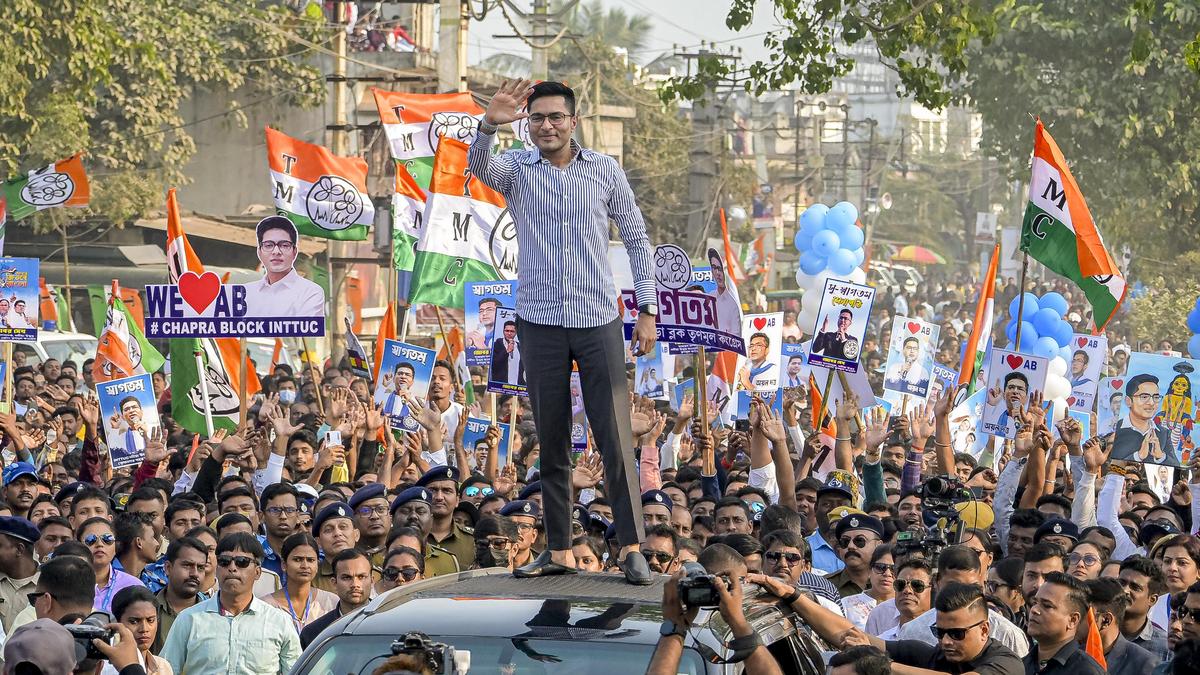
The Supreme Court intervened concerning "logical discrepancies" in West Bengal's SIR, a move strongly welcomed by TMC General Secretary Abhishek Banerjee. This judicial intervention is significant as Banerjee asserted it protects the voting rights of the people of West Bengal. It underscores the judiciary's role in ensuring electoral integrity, a key topic for competitive exams.
Revision structure
Monthly events and exam calendar context
Static GK and one-liner notes
Quiz and mock-test revision path
Key points
Exam-ready takeaways
TMC General Secretary Abhishek Banerjee welcomed the Supreme Court's intervention.
Banerjee stated the Supreme Court order is a "slap" to those attempting to remove voting rights.
The issue specifically pertains to the voting rights of people in West Bengal.
The intervention highlights the judiciary's role in overseeing electoral processes and safeguarding democratic principles.
Detailed analysis
Full exam-oriented breakdown
The Supreme Court's intervention regarding "logical discrepancies" in West Bengal's Summary Revision of Electoral Rolls (SIR) is a crucial development that underscores the judiciary's pivotal role in safeguarding India's democratic processes. This move, strongly welcomed by Trinamool Congress (TMC) General Secretary Abhishek Banerjee, highlights the continuous vigilance required to ensure free and fair elections, a cornerstone of Indian democracy. **Background Context:** The Election Commission of India (ECI), under Article 324 of the Constitution, is tasked with the superintendence, direction, and control of elections. A fundamental aspect of this responsibility is the preparation and periodic revision of electoral rolls. The Summary Revision of Electoral Rolls (SIR) is an annual exercise conducted by the ECI to update voter lists by adding new eligible voters, removing deceased or shifted voters, and correcting errors. This process is governed primarily by the Representation of the People Act, 1950. In West Bengal, like other states, this revision is critical, especially given the state's highly politicized electoral landscape and history of closely contested elections. Allegations of discrepancies in electoral rolls – ranging from duplicate entries and fraudulent inclusions to arbitrary deletions – are not uncommon and often become contentious political issues, leading to mistrust and legal challenges. **What Happened:** The Supreme Court intervened following petitions or concerns raised regarding alleged "logical discrepancies" in West Bengal's electoral rolls during the SIR process. While the exact nature of these discrepancies wasn't fully detailed in the brief, such issues typically involve a high number of deletions without proper verification, inexplicable additions, inconsistencies in demographic data, or a failure to follow due process as laid out by the ECI guidelines. The TMC's strong reaction, particularly Abhishek Banerjee's statement calling the order a "slap to those trying to take away the voting rights of the people of West Bengal," suggests that the ruling party perceived the revision process, or at least certain aspects of it, as politically motivated or flawed, potentially leading to voter disenfranchisement. The Supreme Court's intervention implies that prima facie, there were grounds to believe that the revision process might not have been entirely fair or transparent, thus necessitating judicial oversight to protect the fundamental right to vote. **Key Stakeholders Involved:** 1. **Supreme Court of India:** As the ultimate arbiter of constitutional matters and guardian of fundamental rights, the SC intervened to ensure electoral integrity and uphold the rule of law. Its role is to interpret laws and ensure that administrative actions, even by constitutional bodies like the ECI, adhere to legal and constitutional principles. 2. **Election Commission of India (ECI):** The primary constitutional body responsible for conducting elections. While the ECI's authority is vast (Article 324), its actions are subject to judicial review to ensure fairness and adherence to statutes like the Representation of the People Act, 1950. 3. **Trinamool Congress (TMC):** The ruling party in West Bengal, which welcomed the intervention, viewing it as a validation of their concerns regarding potential voter suppression. 4. **Opposition Parties (e.g., BJP, CPI(M), Congress):** Although not explicitly named, these parties are implicitly part of the political dynamic. Depending on their stance on the electoral roll revision, they could be seen as the 'those' Banerjee referred to, or they could have also raised concerns independently. 5. **Voters of West Bengal:** The ultimate beneficiaries or victims of the electoral roll revision process. Their right to vote (a statutory right under the Representation of the People Act, 1950, and a constitutional right in a broader sense, essential for democratic participation under Article 326) is directly impacted by the accuracy and fairness of the electoral rolls. **Why This Matters for India:** This incident is highly significant for India for several reasons. Firstly, it reinforces the principle of **electoral integrity**, a non-negotiable aspect of any vibrant democracy. Accurate and fair electoral rolls are the bedrock upon which free and fair elections are built. Any perceived tampering or systematic errors can erode public trust in the electoral system. Secondly, it highlights the crucial role of **judicial oversight** in India's governance structure. Even constitutional bodies like the ECI are not immune to scrutiny, and the judiciary acts as a vital check and balance, ensuring that democratic processes are upheld. This intervention reaffirms the judiciary's commitment to protecting citizens' fundamental rights, including the right to vote. Thirdly, it has significant **political implications**, particularly in a state like West Bengal, which frequently witnesses intense political contests. Allegations of electoral malpractice can destabilize the political environment and impact election outcomes. The Supreme Court's intervention can help restore faith in the process ahead of future elections, be they Panchayat, Assembly, or Lok Sabha polls. **Historical Context and Constitutional Provisions:** The process of electoral roll revision has historically been contentious. The **Representation of the People Act, 1950**, lays down the framework for the preparation and revision of electoral rolls. Section 21 of this Act specifically deals with the preparation and revision of electoral rolls. Over the decades, various electoral reforms have been suggested and implemented to make the process more robust and transparent, often involving judicial interventions or ECI initiatives. The right to vote, while not a fundamental right in the same vein as those in Part III of the Constitution, is a statutory right under the RPA, 1950, and a crucial constitutional right underpinning universal adult franchise guaranteed by **Article 326**. The Supreme Court's intervention is often rooted in protecting this right by ensuring that the administrative machinery functions justly and without bias. **Future Implications:** This Supreme Court order is likely to lead to increased scrutiny and potential recalibration of the electoral roll revision process in West Bengal. The ECI may be directed to implement more stringent verification mechanisms, conduct thorough investigations into reported discrepancies, and ensure greater transparency in the deletion and addition of voters. This could set a precedent for other states facing similar allegations, reinforcing the need for robust and transparent electoral administration nationwide. Furthermore, it might spur renewed calls for comprehensive electoral reforms, including a more streamlined and foolproof system for electoral roll management, possibly leveraging technology more effectively while safeguarding against data manipulation. Ultimately, it strengthens the institutional framework of Indian democracy by reaffirming the judiciary's commitment to safeguarding the integrity of the electoral process.
How to study
Turn news into exam marks
Revise monthly events by exam family instead of reading random updates.
Pair one-liners with mock tests so mistakes become the next revision list.
Keep state job pages, calendar pages and GK packs connected in one path.