

The primary subject of contention is the 'Draft Seeds Bill'.
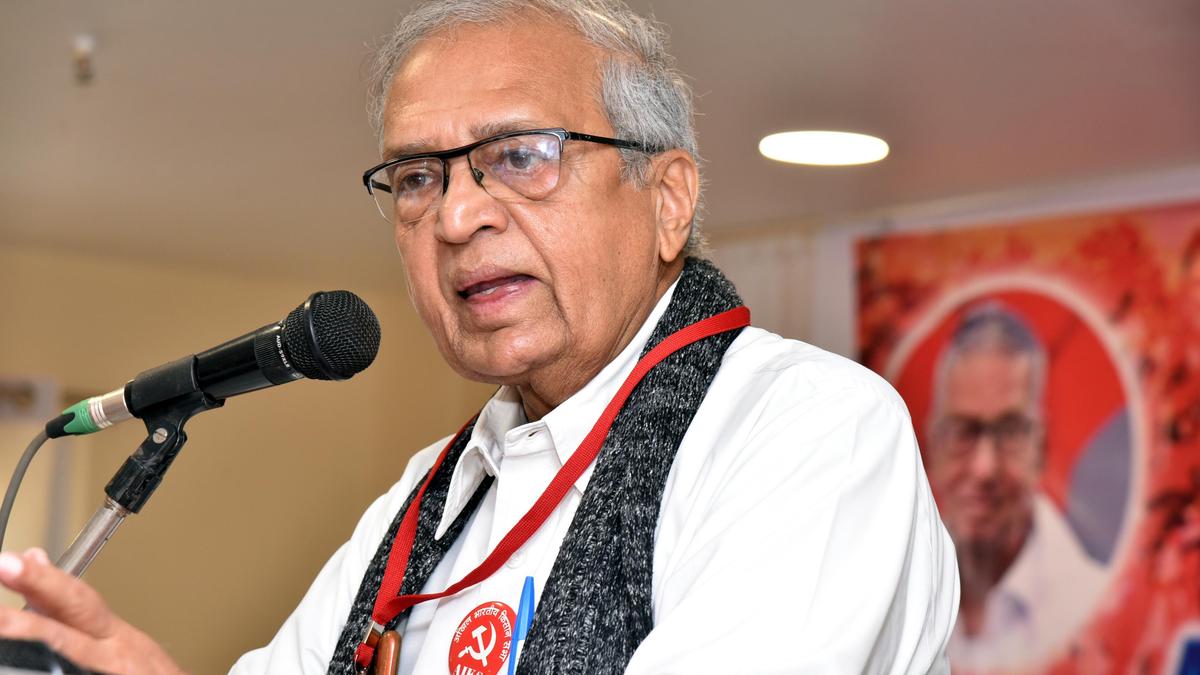
GK and monthly revision
Draft Seeds Bill promotes private monopoly: Kisan Sabha
The Draft Seeds Bill is currently under scrutiny, with the Kisan Sabha vocally opposing it. The farmers' organization contends that the proposed bill is designed to foster a private monopoly within the seed industry. Kisan Sabha advocates for a policy framework that prioritizes ensuring affordable, high-quality seeds and planting material for farmers, emphasizing the critical need for effective price control to prevent exploitation. This issue is significant for understanding agricultural policy and farmer welfare in India.
Revision structure
Monthly events and exam calendar context
Static GK and one-liner notes
Quiz and mock-test revision path
Key points
Exam-ready takeaways
The criticism against the bill has been voiced by the 'Kisan Sabha'.
Kisan Sabha alleges that the Draft Seeds Bill promotes 'private monopoly' in the seed sector.
A key demand from Kisan Sabha is to ensure 'affordable quality seeds' and planting material for farmers.
Kisan Sabha emphasizes the importance of 'price control' on seeds as a priority.
Detailed analysis
Full exam-oriented breakdown
The Draft Seeds Bill, a significant piece of proposed legislation for India's crucial agricultural sector, has stirred considerable debate, with the Kisan Sabha vocally opposing its provisions. At its core, this controversy highlights the delicate balance between promoting agricultural innovation, ensuring farmer welfare, and regulating the burgeoning private seed industry. Understanding this bill requires delving into India's agrarian past, its current challenges, and the potential future trajectory of its food security. Historically, the Indian seed sector has evolved from a predominantly public sector-driven model to one with substantial private participation. The **Seeds Act, 1966**, was the primary legal framework, focusing on regulating seed quality and ensuring availability. However, with advancements in agricultural biotechnology and the liberalization of the Indian economy in the 1990s, the need for a more comprehensive law became apparent. This led to the formulation of the **National Seed Policy in 2002**, which aimed to provide farmers with access to quality seeds, encourage private sector investment, and protect intellectual property rights. Subsequent attempts to replace the 1966 Act, including the Seeds Bill of 2004 and 2010, faced various criticisms, primarily regarding farmer rights and regulatory oversight. The current Draft Seeds Bill seeks to replace the outdated 1966 Act, aiming to regulate the production, quality, supply, and trade of seeds. While proponents argue it will streamline the seed industry, promote research, and ensure access to high-quality seeds, critics like the Kisan Sabha contend that its provisions disproportionately favor private seed companies. The core of Kisan Sabha's objection is the perceived promotion of a 'private monopoly' in the seed sector. They argue that the bill lacks adequate mechanisms for 'price control', potentially allowing private companies to dictate seed prices, thereby increasing input costs for farmers. This is a critical concern, as seeds constitute a fundamental input for agriculture, directly impacting farmers' profitability and livelihood. Key stakeholders in this debate include the **Government of India** (primarily the Ministry of Agriculture & Farmers' Welfare), which aims to modernize the agricultural sector and ensure food security; **private seed companies**, who are keen on protecting their intellectual property and expanding their market share; and most importantly, **farmers** and their representative bodies like the **Kisan Sabha**, who advocate for affordable, quality seeds and protection against exploitation. Farmers are often at the mercy of market forces and climate variability, making access to reliable and affordable inputs paramount for their survival. This issue holds immense significance for India, where agriculture employs a significant portion of the workforce and contributes substantially to the GDP. The bill's implications span economic, social, and political dimensions. Economically, unrestricted seed prices could exacerbate agrarian distress, already a pressing issue in many parts of the country. Socially, it could deepen inequalities, as marginal farmers might struggle to afford expensive hybrid or GM seeds. Politically, farmer protests against such policies have historically been powerful and can shape electoral outcomes. Ensuring affordable quality seeds is directly linked to food security, as it impacts agricultural productivity and the nation's ability to feed its vast population. Relevant constitutional provisions underscore the state's responsibility towards farmer welfare. The **Directive Principles of State Policy (DPSP)**, particularly **Article 38** (promoting welfare of the people), **Article 39** (securing adequate means of livelihood), and **Article 46** (promoting economic interests of weaker sections), provide a framework for policies that prioritize farmer well-being. While not directly enforceable, they guide the state in making laws. The **Protection of Plant Varieties and Farmers' Rights (PPV&FR) Act, 2001**, is another crucial legislation. This Act was a landmark in balancing breeders' rights with farmers' rights, including the right to save, use, sow, resow, exchange, share, or sell farm produce, including seed of a protected variety. Critics fear that the Draft Seeds Bill might dilute some of these farmer-friendly provisions, especially regarding seed saving and exchange, which are traditional practices vital for small and marginal farmers. Looking ahead, the future implications are substantial. If the bill passes in its current form without robust price control mechanisms and adequate farmer protections, it could lead to increased corporate control over the seed supply chain, potentially stifling indigenous seed varieties and traditional farming practices. This might lead to farmers becoming more dependent on a few large seed companies, potentially impacting seed diversity and resilience against climate change. Continued farmer protests and demands for amendments are likely. The government will need to carefully balance the interests of seed developers, who require incentives for innovation, with the fundamental right of farmers to affordable, quality seeds, which is crucial for India's long-term agricultural sustainability and food sovereignty. A balanced approach would involve robust regulatory oversight, clear price control mechanisms, and strong safeguards for farmers' traditional rights, perhaps by strengthening the synergy between the new bill and the PPV&FR Act, 2001.
How to study
Turn news into exam marks
Revise monthly events by exam family instead of reading random updates.
Pair one-liners with mock tests so mistakes become the next revision list.
Keep state job pages, calendar pages and GK packs connected in one path.