

Rahul Gandhi, the current Leader of Opposition (LoP), made accusations against the Modi government.
GK and monthly revision
Modi systematically strangling protections for poor, diverting resources: Rahul Gandhi
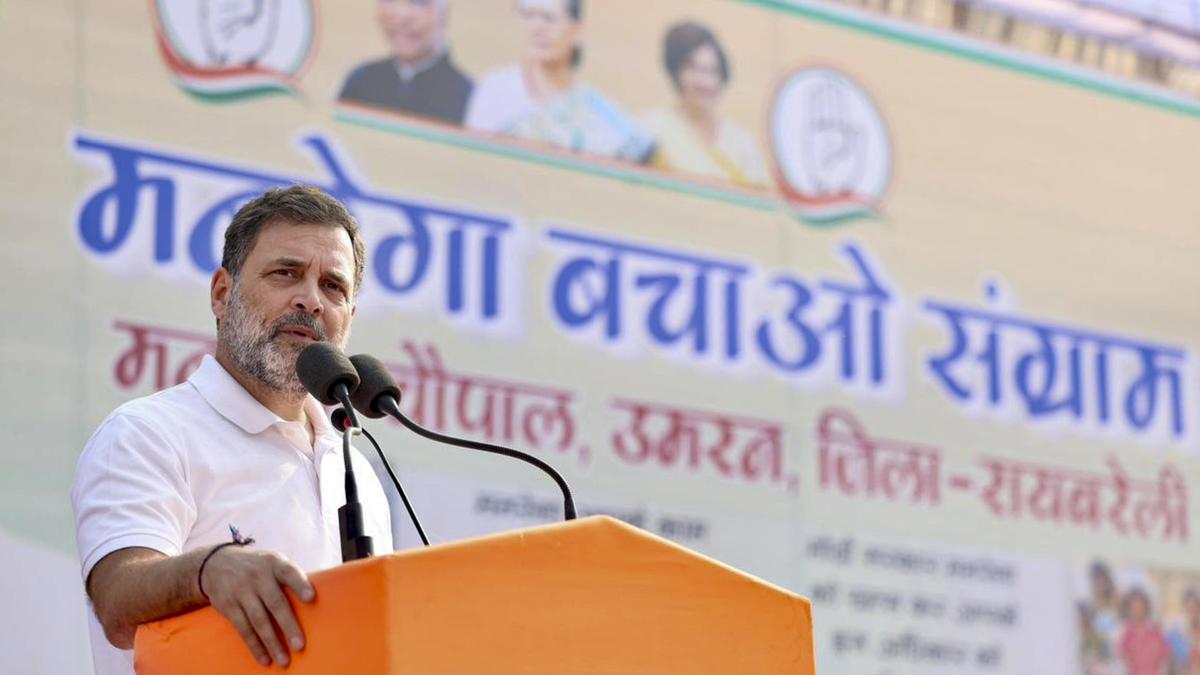
Rahul Gandhi, the Leader of Opposition, accused the Modi government of systematically undermining the MGNREGA scheme and diverting its funds. Speaking at an MGNREGA choupal in his constituency, he alleged that resources meant for workers, women, and the poor are being redirected to big industrialists like Adani and Ambani. This highlights a key political debate regarding social welfare schemes and resource allocation, crucial for understanding governance and economic policy in India for competitive exams.
Revision structure
Monthly events and exam calendar context
Static GK and one-liner notes
Quiz and mock-test revision path
Key points
Exam-ready takeaways
The allegations concerned the systematic undermining and fund diversion from the Mahatma Gandhi National Rural Employment Guarantee Act (MGNREGA).
The statement was made during an MGNREGA choupal event held in Rahul Gandhi's parliamentary constituency.
Gandhi alleged that funds meant for MGNREGA workers, women, and the poor were being diverted.
He specifically named industrialists like Adani and Ambani as beneficiaries of the alleged resource diversion.
Detailed analysis
Full exam-oriented breakdown
Rahul Gandhi's recent accusations against the Modi government, alleging systematic strangulation of protections for the poor and diversion of MGNREGA funds to big industrialists, bring to the forefront a critical debate on social welfare, economic policy, and governance in India. This statement, made at an MGNREGA choupal in his constituency, is not merely a political broadside but encapsulates fundamental questions about resource allocation, accountability, and the state's role in ensuring livelihood security for its most vulnerable citizens. To understand the gravity of these allegations, one must first grasp the background of the Mahatma Gandhi National Rural Employment Guarantee Act (MGNREGA). Enacted in 2005 under the UPA government, MGNREGA is a landmark social security scheme that guarantees 100 days of wage employment in a financial year to every rural household whose adult members volunteer to do unskilled manual work. Its primary objectives include enhancing livelihood security in rural areas, creating durable assets, strengthening Panchayati Raj Institutions, and reducing distress migration. It is a demand-driven scheme, legally backed, making the 'right to work' a statutory right for rural households. Over the years, MGNREGA has been instrumental in providing a safety net, especially during economic downturns and droughts, empowering women by ensuring equal wages, and boosting rural purchasing power. Rahul Gandhi's core accusation is that the Modi government is systematically undermining this crucial scheme and diverting its funds. He specifically alleged that resources earmarked for MGNREGA workers, women, and the poor are being redirected to large industrialists like Adani and Ambani. This accusation frames a larger political narrative often pushed by the opposition: that the government prioritizes corporate interests over the welfare of the common populace. The 'choupal' setting, a traditional village gathering, was strategically chosen to connect directly with the beneficiaries and amplify the message. Key stakeholders in this discourse include, primarily, the **Government of India (Modi administration)**, which is responsible for the implementation, funding, and oversight of MGNREGA. They are directly accused of malfeasance. **Rahul Gandhi**, as the Leader of Opposition, represents the voice of critique and accountability, articulating the concerns of his party and, ostensibly, the electorate. The millions of **MGNREGA workers** across rural India are the direct beneficiaries whose livelihoods are at stake. Their access to guaranteed employment and timely wages is central to the scheme's success. Finally, **industrialists** like Adani and Ambani, though not directly involved in the scheme's administration, are named as alleged beneficiaries of resource diversion, highlighting the broader economic policy debate on corporate welfare versus social spending. This debate matters immensely for India. Economically, any significant diversion or undermining of MGNREGA funds would severely impact rural demand, exacerbate poverty, and increase distress migration, especially in an economy still grappling with post-pandemic recovery. Socially, it could reverse gains made in women's empowerment and rural livelihood security, potentially increasing inequality. Politically, it intensifies the ongoing debate on governance, transparency, and accountability, forming a key narrative for the opposition ahead of future elections. It questions the government's commitment to social justice and inclusive growth. Historically, MGNREGA has faced challenges from all governments, including issues of wage payment delays, administrative inefficiencies, and corruption. However, the current allegations are about systematic undermining and diversion, which is a more severe charge. From a constitutional perspective, MGNREGA finds its roots in the **Directive Principles of State Policy (DPSP)**, particularly **Article 38**, which mandates the state to secure a social order for the promotion of the welfare of the people; **Article 39(a)**, which directs the state to secure the right to an adequate means of livelihood; and **Article 41**, which speaks of the right to work, to education, and to public assistance in certain cases. While not justiciable, these principles guide the state in policy-making. The **MGNREGA Act, 2005**, itself is a statutory embodiment of these principles, providing a legal guarantee for employment. The role of **Panchayati Raj Institutions**, strengthened by the **73rd Constitutional Amendment Act**, is crucial in planning, implementing, and monitoring MGNREGA works at the grassroots level, making local governance central to its success and accountability. The concept of social audit, embedded in the Act, is a powerful tool for transparency and public oversight. Looking ahead, these allegations will likely fuel further political contention, especially with upcoming elections. The government will need to defend its fiscal management and commitment to welfare schemes. There might be increased scrutiny on MGNREGA fund allocations, wage payment systems (often linked to the Public Financial Management System or PFMS), and the overall health of the rural economy. This debate also ties into the broader theme of India's development model: whether it should be primarily driven by large-scale industrial growth and infrastructure projects, or by strengthening social safety nets and empowering the rural poor through direct welfare measures. The future implications include potential policy adjustments to MGNREGA, increased focus on transparency mechanisms, and a continued political battle over the narrative of economic development and social justice.
How to study
Turn news into exam marks
Revise monthly events by exam family instead of reading random updates.
Pair one-liners with mock tests so mistakes become the next revision list.
Keep state job pages, calendar pages and GK packs connected in one path.