

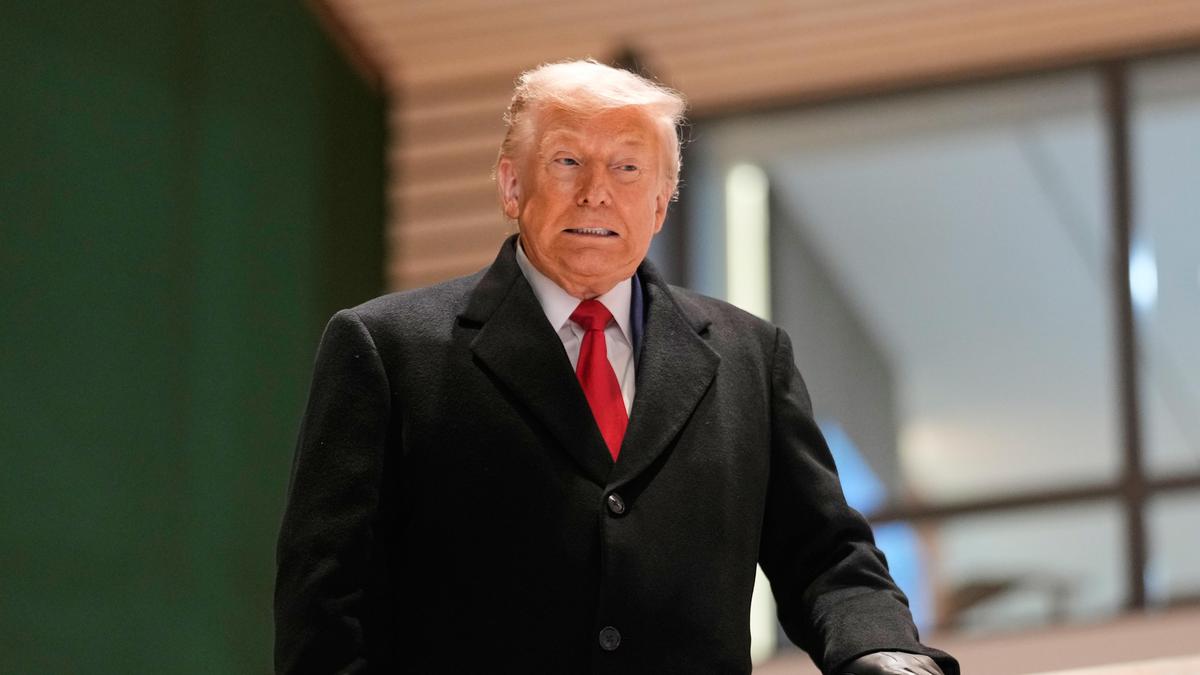
US President Donald Trump cancelled a tariff threat previously made regarding Greenland.
GK and monthly revision
Trump cancels tariff threat over Greenland, says NATO agreed to 'framework' of future Arctic deal
US President Trump cancelled a tariff threat concerning Greenland after NATO reportedly agreed to a framework for a future Arctic deal. This development is significant as it involves a major geopolitical region, the strategic importance of Greenland, and the role of NATO, an alliance crucial since the Cold War, highlighting evolving international relations and Arctic governance for competitive exams.
Revision structure
Monthly events and exam calendar context
Static GK and one-liner notes
Quiz and mock-test revision path
Key points
Exam-ready takeaways
The cancellation followed reports that NATO agreed to a 'framework' for a future Arctic deal.
Greenland, an autonomous territory of Denmark, had been a subject of US interest for potential acquisition.
NATO, an alliance formed post-Cold War, is central to security discussions, particularly in strategically important regions like the Arctic.
The Arctic region's increasing geopolitical significance and resource potential are key drivers for international agreements and discussions.
Detailed analysis
Full exam-oriented breakdown
The news regarding US President Donald Trump's cancellation of a tariff threat over Greenland, following NATO's reported agreement to an Arctic deal framework, unveils a complex tapestry of international relations, geopolitical strategy, and evolving security paradigms. This development, while seemingly minor in its immediate outcome, is profoundly significant, especially for competitive exam aspirants, as it touches upon critical themes like resource competition, climate change diplomacy, and the shifting balance of global power. **Background Context and What Happened:** Greenland, an autonomous territory within the Kingdom of Denmark, has a long history of strategic importance, particularly due to its geographical location. During World War II and the Cold War, its position between North America and Europe made it a crucial strategic outpost. The United States maintains the Thule Air Base in Greenland, a vital component of its missile defense and early warning systems. The idea of the U.S. acquiring Greenland is not new; President Harry S. Truman explored purchasing it from Denmark in 1946 for $100 million. Fast forward to 2019, President Trump revived this idea, expressing interest in buying the vast, resource-rich island. This proposal was met with a firm rejection from Denmark, with its Prime Minister Mette Frederiksen calling the idea "absurd." Following this diplomatic snub, President Trump abruptly cancelled a state visit to Denmark, and reports emerged of a potential tariff threat. However, the current development indicates a de-escalation, with Trump cancelling the tariff threat, reportedly because NATO agreed to a 'framework' for a future Arctic deal. This suggests a negotiation where the U.S. might have leveraged its interest in Greenland to push for broader Arctic security cooperation within the NATO framework. **Key Stakeholders Involved:** 1. **United States:** Views the Arctic as a region of increasing strategic importance for security, resource access (oil, gas, rare earth minerals), and new shipping routes (Northern Sea Route). Its interest in Greenland is part of a broader strategy to maintain influence and counter rival powers like Russia and China in the Arctic. 2. **Denmark and Greenland:** Denmark maintains sovereignty over Greenland but respects its autonomous status, which includes control over resource management and foreign policy (though Denmark handles defense and security). Greenland itself is seeking greater economic independence, often leading it to engage with foreign investors, including from China, for its nascent mining sector. They aim to balance economic development with environmental protection and sovereign control. 3. **NATO (North Atlantic Treaty Organization):** Formed in 1949, NATO is a collective security alliance primarily focused on the Euro-Atlantic area. The Arctic, with its melting ice caps, is becoming a new frontier for NATO's security concerns, especially given Russia's significant military buildup in the region. An 'Arctic deal framework' signifies NATO's evolving role and expansion of its strategic focus to this critical region. 4. **Russia:** Possesses the longest Arctic coastline and has heavily invested in military infrastructure, icebreakers, and resource extraction in its Arctic territories. Russia sees the Northern Sea Route as a crucial economic and strategic artery. 5. **China:** Declares itself a "near-Arctic state" and has been increasing its presence through scientific research, economic investments, and the 'Polar Silk Road' – an extension of its Belt and Road Initiative, aiming to develop shipping routes and infrastructure in the Arctic. **Why This Matters for India:** India, despite not being an Arctic state, has significant stakes in the region. In 2013, India gained observer status in the Arctic Council, the leading intergovernmental forum promoting cooperation in the Arctic. India's interest is multi-faceted: * **Geopolitical Significance:** As a rising global power, India seeks to participate in global governance and multilateral platforms. Its presence in the Arctic Council allows it to influence decisions in a strategically vital region. * **Economic Opportunities:** The melting Arctic ice opens up new shipping routes, such as the Northern Sea Route, which could significantly reduce transit times and costs for trade between Europe and Asia. This has implications for India's maritime trade and economic connectivity. Furthermore, the Arctic holds vast untapped reserves of hydrocarbons and minerals, which could be crucial for India's energy and resource security. * **Scientific Research:** India established its first Arctic research station, Himadri, in Ny-Ålesund, Svalbard, Norway, in 2008. Research here focuses on glaciology, atmospheric sciences, and marine biology, which are vital for understanding global climate patterns, including the Indian monsoon, and sea-level rise, which directly impacts India's vast coastline. * **Climate Change:** The Arctic is warming at twice the global average, leading to profound climate impacts globally, including altered weather patterns, extreme events, and sea-level rise, all of which directly affect India's climate and economy. **Historical Context and Broader Themes:** The Arctic has transitioned from being primarily a scientific frontier to a geopolitical hotspot, reminiscent of Cold War rivalries. The current situation reflects a broader theme of great power competition for resources, strategic advantage, and influence in a rapidly changing environment. The interplay between climate change, resource scarcity, and national security is a defining feature of 21st-century international relations. **Future Implications and Related Policies:** The agreement on an Arctic deal framework within NATO could signify increased militarization and security focus in the region. This might lead to more structured cooperation among NATO members in the Arctic, potentially challenging the traditionally peaceful and cooperative framework of the Arctic Council. It could also intensify the competition with Russia and China. For India, this necessitates a robust and proactive 'Arctic Policy.' India launched its dedicated 'Arctic Policy' in March 2022, titled 'India and the Arctic: Building a partnership for sustainable civilization.' This policy outlines six pillars: scientific research and cooperation, climate and environmental protection, economic and human development, transportation and connectivity, governance and international cooperation, and national capacity building. While no direct constitutional articles of India specifically address Arctic policy, the overarching principles of promoting international peace and security (Article 51 of the Directive Principles of State Policy) and the executive power of the Union in international affairs (Article 73) provide the framework for such engagements. Furthermore, India's commitment to environmental protection (Article 48A and Fundamental Duty Article 51A(g)) aligns with the need for sustainable practices in the Arctic.
How to study
Turn news into exam marks
Revise monthly events by exam family instead of reading random updates.
Pair one-liners with mock tests so mistakes become the next revision list.
Keep state job pages, calendar pages and GK packs connected in one path.