

Danish Prime Minister Ms. Frederiksen endorsed a 'permanent presence' of NATO forces.
GK and monthly revision
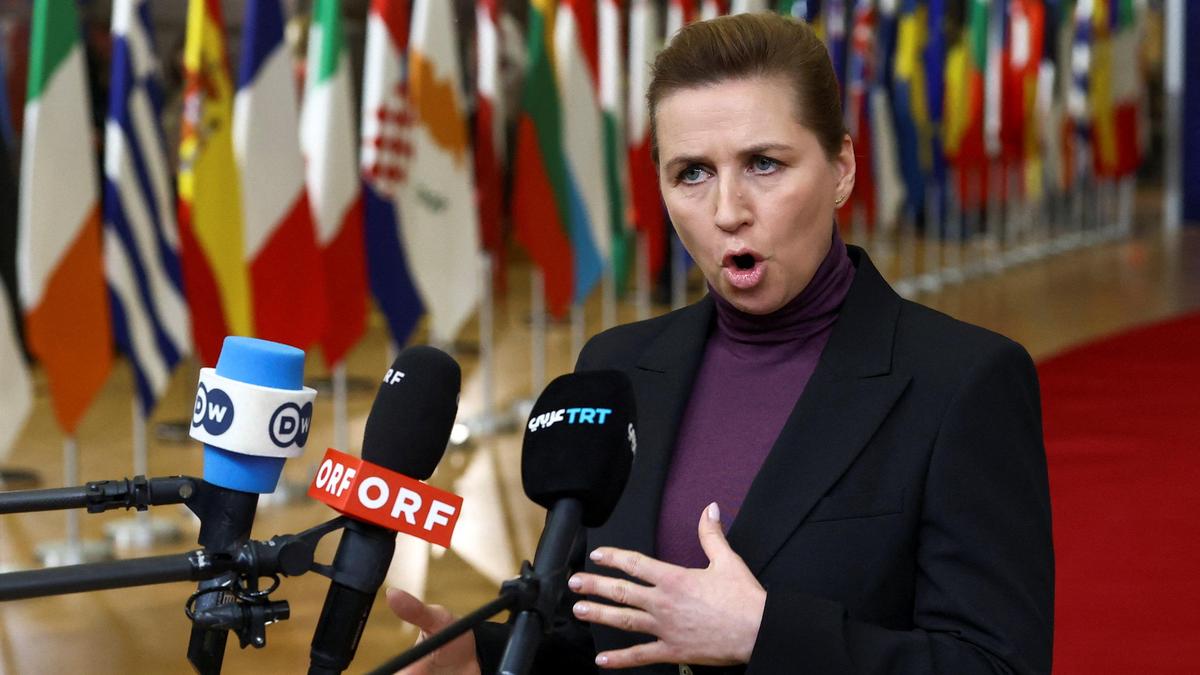
Danish PM backs NATO 'permanent presence' around Greenland
Danish Prime Minister Ms. Frederiksen has publicly supported a 'permanent presence' of NATO forces around Greenland, a crucial autonomous territory. She emphatically stated that discussions concerning Denmark's sovereignty over Greenland are 'off the table' and 'cannot be changed'. This declaration underscores the escalating geopolitical importance of the Arctic region and NATO's strategic interests, making it significant for understanding international relations and Arctic politics in competitive exams.
Revision structure
Monthly events and exam calendar context
Static GK and one-liner notes
Quiz and mock-test revision path
Key points
Exam-ready takeaways
The proposed NATO presence is specifically targeted 'around Greenland'.
Ms. Frederiksen firmly stated that discussions regarding 'Denmark's sovereignty' over Greenland are 'off the table'.
She reiterated that Denmark's sovereignty over Greenland 'cannot be changed'.
The statement highlights the increasing strategic significance of Greenland and the Arctic region in global geopolitics.
Detailed analysis
Full exam-oriented breakdown
The statement by Danish Prime Minister Mette Frederiksen, affirming NATO's 'permanent presence' around Greenland and unequivocally stating that Denmark's sovereignty over the autonomous territory is 'off the table,' highlights the rapidly escalating geopolitical significance of the Arctic region. This declaration is not merely a local Danish issue; it resonates across global strategic calculations, particularly in the context of great power competition and climate change. **Background Context and What Happened:** The Arctic, once a frozen frontier, is rapidly transforming due to global warming. Melting ice caps are opening up new shipping lanes, such as the Northern Sea Route, potentially cutting transit times between Asia and Europe. Simultaneously, vast untapped reserves of oil, gas, and rare earth minerals lie beneath its surface. This combination of strategic waterways and resource potential has ignited a new 'Great Game' in the Arctic. Greenland, the world's largest island, holds a pivotal position in this evolving landscape. Geographically located between North America and Europe, it offers strategic advantages for surveillance, defense, and resource exploitation. It is an autonomous territory within the Kingdom of Denmark, meaning it has significant self-governance but Denmark retains control over foreign policy, defense, and monetary policy. The Danish PM's statement explicitly supports NATO's enhanced presence, signaling a clear alignment with the Western alliance's efforts to secure its northern flank and counter perceived challenges from Russia. **Key Stakeholders Involved:** Several crucial actors are at play. **Denmark**, as the sovereign power, seeks to protect its territorial integrity and strategic interests while balancing Greenland's autonomy. **Greenland** itself, with its indigenous Inuit population, is a unique stakeholder. While it enjoys self-rule, its economic future is tied to its natural resources and potential foreign investment, making it susceptible to external influences. **NATO**, the North Atlantic Treaty Organization, is expanding its strategic focus to the Arctic, viewing it as a critical domain for collective defense, especially given Russia's increased military activity in its Arctic territories. The **United States**, a key NATO member, has a long-standing strategic interest in Greenland, exemplified by its Thule Air Base and even a past proposal by former President Trump to purchase the island. **Russia** is a major Arctic power, with a significant military presence and economic interests (hydrocarbons, Northern Sea Route). It views NATO expansion in the region as a direct threat. Finally, **China**, though not an Arctic nation, has declared itself a 'near-Arctic state' and pursues a 'Polar Silk Road' initiative, investing in research and infrastructure, primarily for economic and scientific reasons, but with clear strategic undertones. **Historical Context and Significance for India:** Historically, Greenland's strategic importance was recognized during World War II when the US established bases there. Post-Cold War, the Arctic remained relatively stable, but the last decade has seen a resurgence of interest. For India, this development in the Arctic carries significant implications. India, an observer state in the Arctic Council since 2013, launched its 'Arctic Policy 2022' titled 'India and the Arctic: Building a Partnership for a Sustainable Future.' This policy outlines India's interests in scientific research, climate and environmental protection, economic and human development, transportation and connectivity, and international cooperation. The militarization of the Arctic and the assertion of sovereignty by countries like Denmark impact India's long-term strategic and economic interests. Firstly, the opening of new Arctic shipping routes could reduce India's reliance on traditional routes, impacting trade and energy security. Secondly, Greenland is rich in critical minerals, including rare earth elements, which are vital for India's growing manufacturing and technology sectors. Thirdly, climate change in the Arctic directly influences global weather patterns, including the Indian monsoon, making Arctic research crucial for India's agricultural and water security. Geopolitically, India's engagement in the Arctic aligns with its broader ambition to be a responsible global player and its pursuit of a multi-aligned foreign policy. **Future Implications and Related Policies:** The Danish PM's statement signals a hardening stance among Arctic coastal states and NATO members regarding their sovereign rights and security interests. This could lead to increased military exercises, surveillance, and infrastructure development in the region, potentially escalating tensions. The delicate balance between resource exploitation, environmental protection, and indigenous rights will be a major challenge. Internationally, the **United Nations Convention on the Law of the Sea (UNCLOS)**, ratified by India, provides the framework for maritime claims and resource rights, but its application in the rapidly changing Arctic environment could face new interpretations and disputes. India's own **Arctic Policy 2022** emphasizes peaceful and sustainable engagement, aligning with international norms. While there aren't direct Indian constitutional articles on Arctic policy, **Article 51 of the Indian Constitution**, part of the Directive Principles of State Policy, implicitly guides India's foreign policy by advocating for the promotion of international peace and security, maintenance of just and honorable relations between nations, and respect for international law and treaty obligations. India's approach will likely involve balancing its strategic interests with its commitment to a rules-based international order and sustainable development in the Arctic. The future of the Arctic will be a critical test for international cooperation versus great power competition.
How to study
Turn news into exam marks
Revise monthly events by exam family instead of reading random updates.
Pair one-liners with mock tests so mistakes become the next revision list.
Keep state job pages, calendar pages and GK packs connected in one path.