

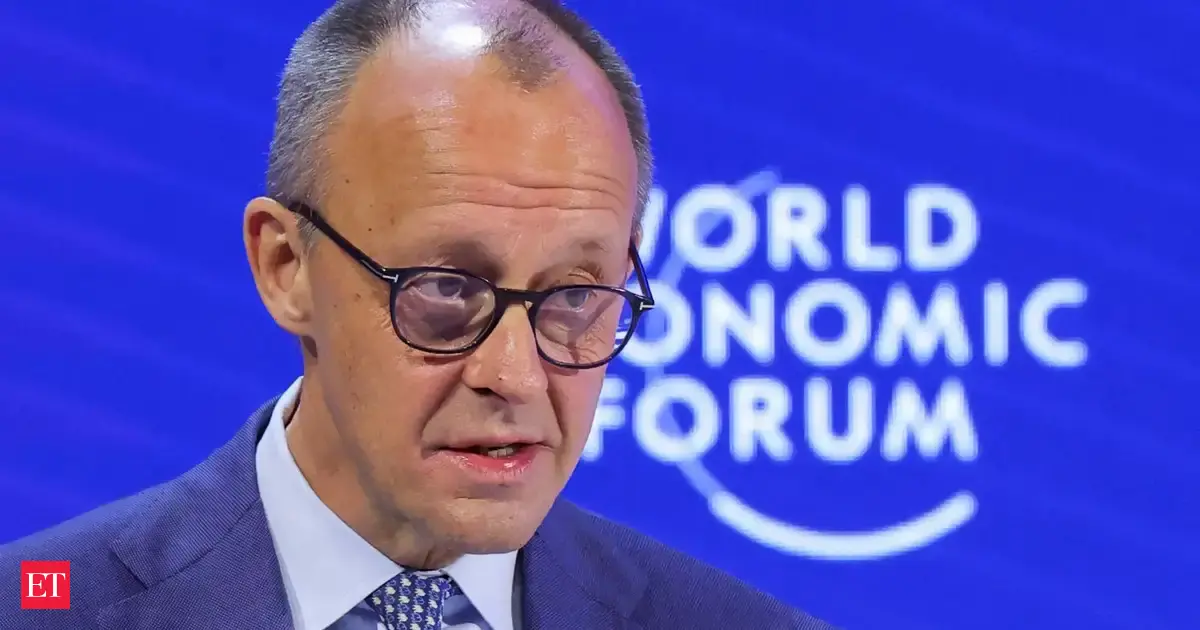
Germany's Chancellor Friedrich Merz sees the India-EU deal as a chance for nations favoring regulations to unite against protectionism.
GK and monthly revision
Germany sees India-EU deal as chance for 'great powers' to unite
Germany's Friedrich Merz views the impending India-EU Free Trade Agreement as an opportunity for regulatory nations to counter protectionism. This significant deal, dubbed 'the mother of all deals', aims to create a vast market for two billion people. European leaders' visit to India for Republic Day and summit talks underscores the strategic importance of this economic partnership for global trade dynamics, making it crucial for competitive exams.
Revision structure
Monthly events and exam calendar context
Static GK and one-liner notes
Quiz and mock-test revision path
Key points
Exam-ready takeaways
India and the European Union (EU) are preparing to sign a major Free Trade Agreement (FTA).
The proposed India-EU deal is referred to as 'the mother of all deals'.
The FTA is projected to create a market for two billion people.
European leaders are scheduled to visit India for Republic Day celebrations and summit talks regarding the deal.
Detailed analysis
Full exam-oriented breakdown
The impending Free Trade Agreement (FTA) between India and the European Union (EU) has been heralded by Germany's Chancellor Friedrich Merz as a pivotal moment for nations advocating for regulations to unite against the rising tide of protectionism. This ambitious agreement, often dubbed 'the mother of all deals', aims to forge a massive integrated market of two billion people, promising to redefine global trade dynamics and enhance strategic partnerships. The visit of European leaders to India for Republic Day celebrations and summit talks underscores the high strategic importance attached to this economic collaboration. **Background Context and History of Negotiations:** India and the EU, two of the world's largest economies and democratic entities, have a long-standing relationship. Formal negotiations for a Broad-based Trade and Investment Agreement (BTIA) between India and the EU first commenced in 2007. These talks progressed for several rounds but eventually stalled in 2013 due to significant divergences on various issues. Key sticking points included market access for automobiles and wines and spirits, data security provisions, intellectual property rights, and the extent of tariff reductions. After nearly a decade of hiatus, the geopolitical landscape shifted dramatically, prompting both sides to re-evaluate their trade strategies. The COVID-19 pandemic exposed vulnerabilities in global supply chains, while the Russia-Ukraine conflict and increasing geopolitical uncertainties highlighted the need for diversification and strengthening of partnerships. Consequently, India and the EU officially resumed negotiations for the FTA, along with a separate Investment Protection Agreement (IPA) and an Agreement on Geographical Indications (GIs), in June 2022. This resumption marked a renewed commitment to deepen economic ties and foster resilient supply chains. **Key Stakeholders Involved:** * **India:** The Government of India, primarily through the Ministry of Commerce and Industry, is the key negotiator. Indian businesses, encompassing a wide range of sectors from textiles and pharmaceuticals to IT and engineering, are significant stakeholders, anticipating greater market access and investment opportunities. Indian consumers stand to benefit from a wider array of goods and potentially lower prices. * **European Union:** The European Commission, as the executive arm, leads the negotiations on behalf of the 27 member states. Individual member states, such as Germany (represented by Chancellor Merz), France, and others, play crucial roles in shaping the EU's negotiating mandate and advocating for their national interests. European businesses seek access to India's vast and growing consumer market, while European consumers could gain from diverse Indian products. * **Germany (Friedrich Merz):** Merz's statement is particularly significant as Germany is the largest economy within the EU and a staunch advocate for rule-based multilateral trade. His emphasis on uniting against protectionism reflects a broader European desire to uphold the principles of free and fair trade in an increasingly fragmented global economy. **Significance for India:** This FTA holds immense significance for India across multiple dimensions. Economically, the EU is India's third-largest trading partner, and a comprehensive FTA would provide Indian goods and services preferential access to a highly lucrative market of over 450 million people, in addition to the two billion people mentioned in the article (which likely refers to the combined population of India and the EU). This would significantly boost India's exports, particularly in sectors like textiles, leather, pharmaceuticals, marine products, and engineering goods, supporting the 'Make in India' initiative. It is expected to attract greater Foreign Direct Investment (FDI) into India, fostering technology transfer, job creation, and economic growth. Politically and strategically, a robust partnership with the EU, a major global power bloc, strengthens India's geopolitical standing. It offers a crucial counterbalance in a multipolar world and enhances India's influence in global governance, aligning with India's vision of a rules-based international order. The agreement underscores India's commitment to global integration and its readiness to engage with major economic partners. **Constitutional Provisions and Broader Themes:** India's engagement in international agreements like the India-EU FTA is rooted in its constitutional framework. **Article 253** of the Indian Constitution empowers Parliament to make laws for implementing any international treaty, agreement, or convention. This provides the legal basis for India to ratify and operationalize such trade deals. Furthermore, **Article 51**, a Directive Principle of State Policy, encourages the State to promote international peace and security, foster respect for international law and treaty obligations, and encourage settlement of international disputes by arbitration. These articles underscore India's commitment to international cooperation and its adherence to global norms. The FTA also aligns with India's broader Foreign Trade Policy and the vision of 'Atmanirbhar Bharat', which, while emphasizing self-reliance, also advocates for global integration through strategic partnerships. **Future Implications:** The successful conclusion and implementation of the India-EU FTA could usher in a new era of economic cooperation. It is expected to substantially increase bilateral trade and investment flows, potentially adding billions to the economies of both regions. For India, it could solidify its position as a global manufacturing hub and a reliable partner in diversified supply chains. However, challenges remain, including addressing non-tariff barriers, ensuring equitable intellectual property protection, and harmonizing environmental and labor standards. The success of this 'mother of all deals' could also set a precedent for India's other ongoing FTA negotiations, such as with the UK and the Gulf Cooperation Council (GCC). Ultimately, this agreement represents a significant step towards reinforcing multilateralism and rule-based trade at a time when protectionist tendencies are gaining traction globally, shaping the future trajectory of global economic governance.
How to study
Turn news into exam marks
Revise monthly events by exam family instead of reading random updates.
Pair one-liners with mock tests so mistakes become the next revision list.
Keep state job pages, calendar pages and GK packs connected in one path.