

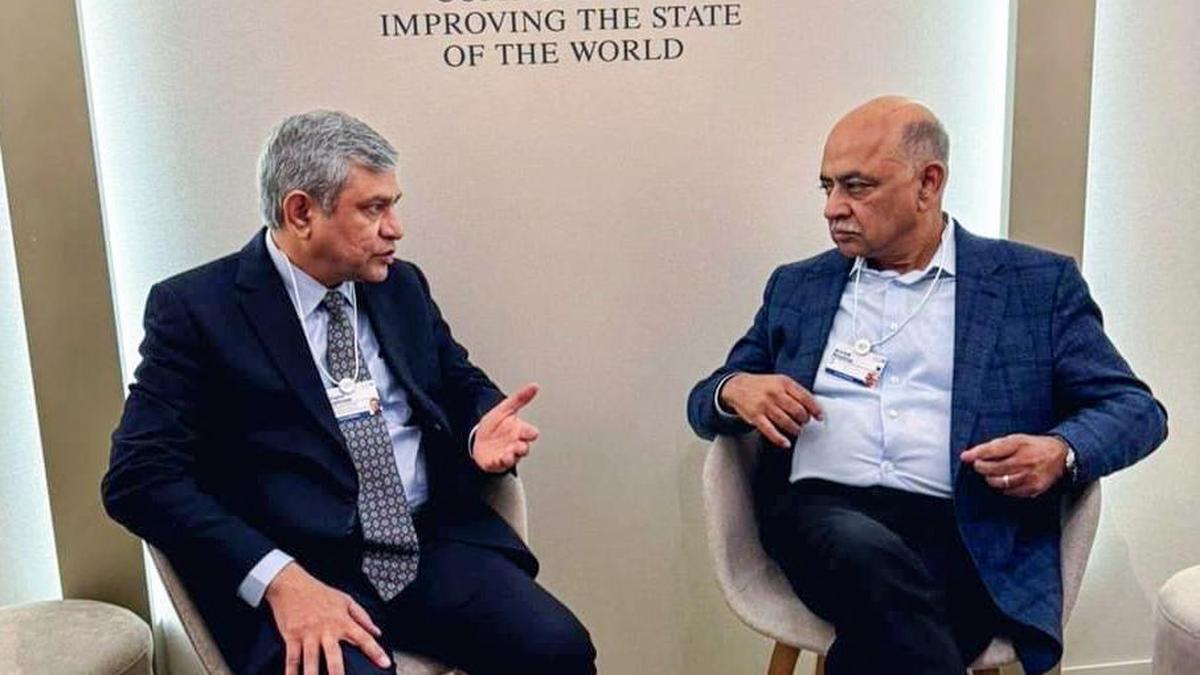
Union Minister Ashwini Vaishnaw affirmed India's reform momentum is on track.
GK and monthly revision
India’s reform momentum is firmly on track: Ashwini Vaishnaw
Union Minister Ashwini Vaishnaw stated that India's reform momentum is firmly on track, citing landmark reforms like labour code reforms and the simplification of the Goods and Services Tax (GST). These reforms are generating strong investor confidence across various sectors. This news is significant for competitive exams as it highlights key government economic policies and their perceived impact, relevant for questions on economic reforms and investor sentiment.
Revision structure
Monthly events and exam calendar context
Static GK and one-liner notes
Quiz and mock-test revision path
Key points
Exam-ready takeaways
Landmark reforms cited include the comprehensive Labour Code reforms.
Another key reform mentioned is the simplification of the Goods and Services Tax (GST).
These reforms are reported to be generating strong investor confidence.
The confidence is observed across various economic sectors in India.
Detailed analysis
Full exam-oriented breakdown
India's economic journey, particularly since the transformative reforms of 1991, has been characterized by a continuous pursuit of policies aimed at fostering growth, attracting investment, and enhancing global competitiveness. Union Minister Ashwini Vaishnaw's recent statement affirming that India's reform momentum is firmly on track, citing landmark reforms like labour code reforms and the simplification of the Goods and Services Tax (GST), underscores the government's commitment to this trajectory. **Background Context and What Happened:** India's pre-1991 economy was largely characterized by the 'License Raj,' a complex web of regulations that stifled private enterprise and foreign investment. The 1991 economic reforms ushered in an era of liberalization, privatization, and globalization. However, several sectors, particularly labour and indirect taxation, remained burdened by outdated and complex laws. The need for further 'second-generation' reforms became evident to sustain high growth rates, improve the ease of doing business, and integrate India more deeply into the global economy. One of the most significant initiatives mentioned is the **Labour Code Reforms**. For decades, India's labour laws were a labyrinth of over 200 state and 40 central laws, making compliance challenging for businesses and often failing to adequately protect workers in the informal sector. To address this, the government consolidated 29 central labour laws into four comprehensive codes: the Code on Wages, 2019; the Industrial Relations Code, 2020; the Code on Social Security, 2020; and the Occupational Safety, Health and Working Conditions Code, 2020. The primary objectives are to simplify the regulatory framework, promote formalization of the workforce, ensure minimum wages and social security for more workers, and create a conducive environment for industrial growth and job creation by balancing the interests of employers and employees. The second major reform highlighted is the **simplification of the Goods and Services Tax (GST)**. Introduced on July 1, 2017, through the 101st Constitutional Amendment Act, 2016, GST replaced a multitude of central and state indirect taxes (like excise duty, service tax, VAT, etc.) with a single, unified tax. While a landmark reform aimed at creating a common national market and reducing cascading effects of taxes, its initial implementation faced challenges related to complex compliance procedures, multiple tax slabs, and technological glitches. The 'simplification' refers to ongoing efforts by the GST Council to streamline processes, rationalize tax rates, improve the IT infrastructure (GSTN), and address industry concerns, thereby enhancing ease of compliance and reducing litigation. **Key Stakeholders Involved:** * **Government of India (Union Minister Ashwini Vaishnaw):** As the architect and proponent of these reforms, the government aims to drive economic growth, attract investment, and improve India's global standing. It leads the legislative process and policy implementation. * **Businesses and Industry:** They are direct beneficiaries of simplified regulations, reduced compliance burdens, and improved logistics, which enhance their operational efficiency and competitiveness. They are also the primary drivers of investment and job creation. * **Workers and Trade Unions:** While labour reforms aim for worker welfare, trade unions often voice concerns regarding potential impacts on worker rights, job security, and the balance of power in industrial relations. Their input is crucial for equitable implementation. * **Investors (Domestic and Foreign):** The ultimate target of these reforms. Simplified laws and a stable tax regime boost investor confidence, leading to increased Foreign Direct Investment (FDI) and domestic capital formation. * **State Governments:** Crucial partners in both reforms. State legislatures need to adopt the labour codes, and state representatives are integral to the GST Council, which makes decisions regarding GST rates and rules. **Significance for India and Historical Context:** These reforms are critical for India's economic future. They aim to boost the manufacturing sector, align India's labour laws with international best practices, and enhance its ranking in the World Bank's Ease of Doing Business index. A simplified GST regime not only makes tax compliance easier but also creates a seamless national market, improving logistics and reducing costs for businesses. This is vital for realizing the vision of 'Make in India' and 'Atmanirbhar Bharat'. Historically, India's economic reforms have been incremental, and these current initiatives represent a continuation of that journey, seeking to remove structural impediments to growth that were left untouched in earlier reform waves. **Future Implications:** If fully implemented and effectively managed, these reforms could lead to a significant surge in domestic and foreign investment, robust job creation, and sustained economic growth. Improved investor confidence translates into capital inflows, technological advancements, and expansion of industrial capacity. However, challenges remain, particularly in the effective implementation of the labour codes across all states and the continuous evolution and stabilization of the GST regime. The success hinges on consistent policy execution, stakeholder consensus, and adaptability to emerging economic realities. **Related Constitutional Articles, Acts, or Policies:** * **Goods and Services Tax (GST):** The **101st Constitutional Amendment Act, 2016**, inserted **Article 246A**, granting concurrent powers to both Parliament and State Legislatures to make laws with respect to GST. **Article 269A** deals with GST on inter-state trade and commerce, while **Article 279A** establishes the GST Council, a joint forum of the Centre and States. * **Labour Reforms:** Labour is a subject on the **Concurrent List** (Entry 22 of the Seventh Schedule) of the Constitution, allowing both the Centre and states to legislate. The Directive Principles of State Policy (DPSP) provide the foundational principles for labour welfare, including **Article 39** (equal pay for equal work), **Article 41** (right to work, education, public assistance), **Article 42** (just and humane conditions of work, maternity relief), and **Article 43** (living wage, etc.). The four new Labour Codes (Code on Wages, Industrial Relations Code, Code on Social Security, Occupational Safety, Health and Working Conditions Code) are the key legislative instruments. * **Broader Economic Governance:** These reforms are part of India's broader economic policy framework aimed at fiscal consolidation, industrial growth, and improving the investment climate, often guided by principles enshrined in the Preamble (socialist, democratic republic) and fundamental rights (e.g., freedom to practice any profession, Article 19(1)(g)).
How to study
Turn news into exam marks
Revise monthly events by exam family instead of reading random updates.
Pair one-liners with mock tests so mistakes become the next revision list.
Keep state job pages, calendar pages and GK packs connected in one path.