

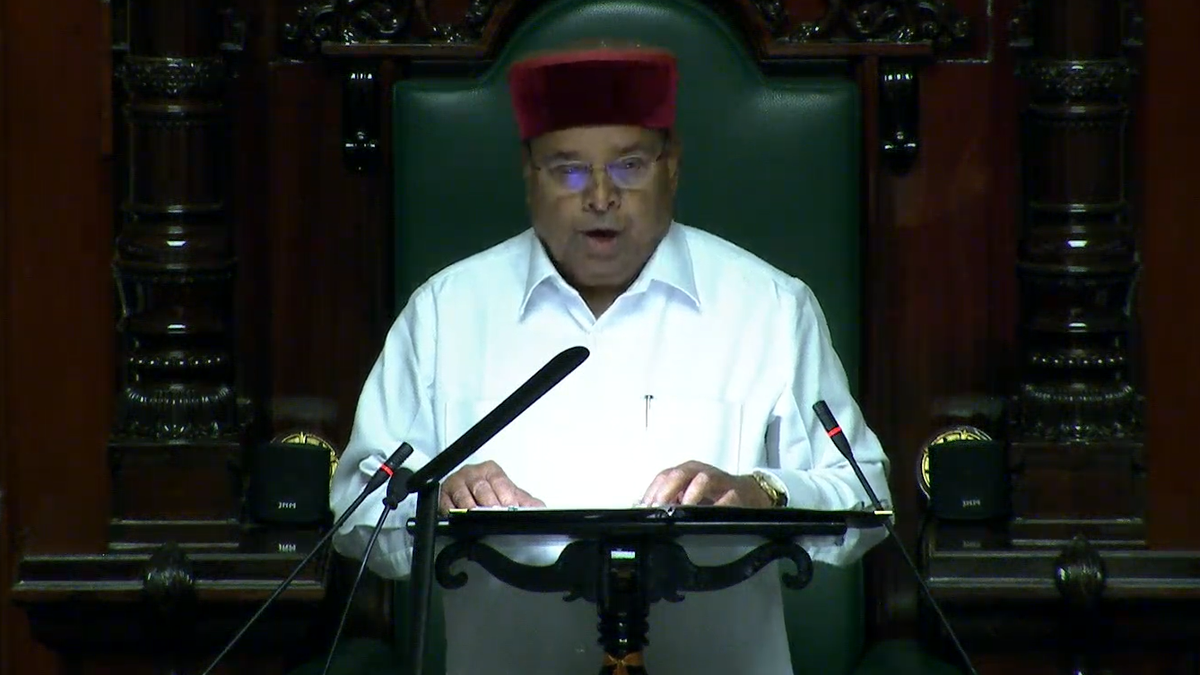
Karnataka Governor Thawar Chand Gehlot read only two lines of his address to the Legislature.
GK and monthly revision
Karnataka Governor Gehlot reads just two lines of his address in Legislature session, CM calls it ‘violation of Constitution’
Karnataka Governor Thawar Chand Gehlot read only two lines of his address during the Legislature session, prompting the Chief Minister to label it a "violation of Constitution." This incident highlights ongoing tensions between Governors and state governments, especially in non-BJP ruled states, making it crucial for understanding constitutional provisions related to Governor's powers and state-centre relations for competitive exams.
Revision structure
Monthly events and exam calendar context
Static GK and one-liner notes
Quiz and mock-test revision path
Key points
Exam-ready takeaways
The incident occurred during the Legislature session in Karnataka.
The Chief Minister of Karnataka called the Governor's act a "violation of Constitution."
This marks the third such face-off between a Governor and a state government in non-BJP ruled states within two days.
The Governor's address to the State Legislature is a constitutional mandate under Article 176, outlining the government's policies and programmes.
Detailed analysis
Full exam-oriented breakdown
The recent incident in Karnataka, where Governor Thawar Chand Gehlot chose to read only two lines of his constitutionally mandated address to the State Legislature, has ignited a fresh debate on the delicate balance of power between Governors and state governments, particularly in non-BJP ruled states. This event, termed a “violation of Constitution” by the Chief Minister, is not an isolated one but rather the latest in a series of confrontations underscoring persistent tensions in India's federal structure. **Background Context and What Happened:** The Governor's address to the State Legislature is a cornerstone of India's parliamentary democracy, mandated by **Article 176** of the Constitution. This article stipulates that the Governor shall address the Legislative Assembly at the commencement of the first session after each general election and at the commencement of the first session of each year, informing the Legislature of the causes of its summons. Conventionally, this address is a detailed speech prepared by the Council of Ministers, outlining the government's policies, programmes, and achievements. It reflects the agenda of the elected government and is read by the Governor as the constitutional head of the state, signifying the government's vision. By reading only two lines, Governor Gehlot effectively deviated from this established constitutional practice and convention, refusing to articulate the policies of the democratically elected government. This act immediately drew sharp criticism from the Chief Minister, who viewed it as a direct challenge to the state government's authority and a breach of constitutional propriety. **Key Stakeholders Involved:** At the heart of this controversy are three primary stakeholders: the **Governor**, the **State Government** (led by the Chief Minister and Council of Ministers), and the **State Legislature**. The Governor, appointed by the President under **Article 155**, acts as the constitutional head of the state and a crucial link between the Centre and the state. However, under **Article 163**, the Governor is generally bound to act on the 'aid and advice' of the Council of Ministers, except in matters where the Constitution explicitly grants them discretionary powers. The State Government, being the elected representative body, holds the executive power of the state. The State Legislature is the forum where the Governor's address is delivered, and it represents the will of the people. When a Governor deviates from reading the government's speech, it pits the constitutional head against the elected executive, disrupting the legislative process and raising questions about the Governor's impartiality and adherence to constitutional conventions. **Why This Matters for India and Historical Context:** This incident is deeply significant for India's federal polity and democratic principles. It highlights the ongoing strain in Centre-state relations, particularly when different political parties are in power at the Centre and in the states. The role of the Governor has historically been a contentious one, often perceived as an agent of the Centre rather than an impartial constitutional functionary. Instances of Governors withholding assent to bills (**Article 200**), delaying decision-making, or acting against the advice of the Council of Ministers have been observed in states like West Bengal, Kerala, Tamil Nadu, Telangana, and Maharashtra in recent years. This pattern raises concerns about the erosion of cooperative federalism and the potential for political interference in state governance. The **Sarkaria Commission (1988)** and the **Punchhi Commission (2010)**, established to review Centre-state relations, have both made significant recommendations regarding the Governor's role, emphasizing the need for impartiality and adherence to constitutional conventions. The Karnataka incident reinforces the urgency of addressing these recommendations. **Future Implications and Broader Themes:** The Karnataka incident carries significant future implications. It could further exacerbate Centre-state tensions, leading to increased political instability and hindering effective governance. Such actions by Governors can undermine public trust in constitutional institutions and democratic processes. It also reignites calls for fundamental reforms in the appointment, tenure (**Article 156** – 'pleasure of the President'), and powers of the Governor, possibly advocating for a more independent selection process or clearer guidelines for their conduct. The broader themes at play include the delicate balance of power, the spirit of federalism, the sanctity of constitutional conventions, and the need for institutional checks and balances to prevent political overreach. For India's robust democracy to thrive, all constitutional functionaries must uphold their oath and act in accordance with the letter and spirit of the Constitution, ensuring that the will of the elected representatives is respected within the constitutional framework. **Related Constitutional Articles, Acts, or Policies:** * **Article 153:** Governors of States * **Article 154:** Executive power of State vested in Governor * **Article 155:** Appointment of Governor by President * **Article 156:** Term of office of Governor (holds office during the pleasure of the President) * **Article 163:** Council of Ministers to aid and advise Governor * **Article 176:** Special address by the Governor * **Article 200:** Assent to Bills by the Governor * **Sarkaria Commission (1988)** recommendations on Centre-state relations, particularly regarding the Governor's role. * **Punchhi Commission (2010)** recommendations, further elaborating on the Governor's role and discretionary powers.
How to study
Turn news into exam marks
Revise monthly events by exam family instead of reading random updates.
Pair one-liners with mock tests so mistakes become the next revision list.
Keep state job pages, calendar pages and GK packs connected in one path.