

Mark Carney, former Governor of the Bank of Canada, made the statement regarding Canada's independence.
GK and monthly revision
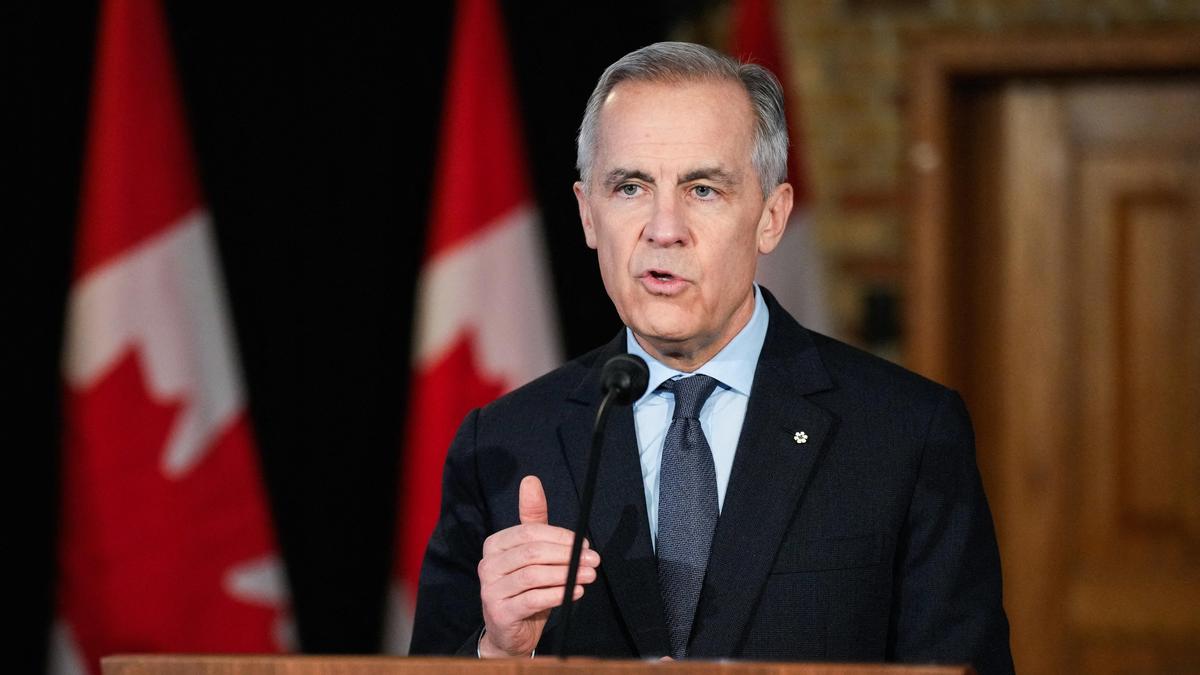
Carney answers Trump: ‘Canada doesn’t live because of U.S.’
Mark Carney, former Governor of the Bank of Canada, asserted Canada's independence from the U.S. in response to former President Trump's comments. His remarks, delivered following a speech at a forum in Switzerland, highlighted a perceived "rupture" in the U.S.-led, rules-based global order. This event is significant for understanding global geopolitical shifts and the ongoing debate on multilateralism, crucial for international relations topics in competitive exams.
Revision structure
Monthly events and exam calendar context
Static GK and one-liner notes
Quiz and mock-test revision path
Key points
Exam-ready takeaways
Carney's specific remark was: "Canada doesn't live because of U.S."
His comments were a direct response to statements made by former U.S. President Trump.
The remarks followed a speech delivered by Carney at a forum of political and financial elites in Switzerland.
Carney's speech at the Swiss forum emphasized a "rupture" in the U.S.-led, rules-based global order.
Detailed analysis
Full exam-oriented breakdown
Mark Carney's assertive statement, "Canada doesn't live because of U.S.," delivered in response to former U.S. President Donald Trump's comments and following a speech at a forum of political and financial elites in Switzerland, underscores a significant shift in global geopolitical dynamics. This declaration, coupled with Carney's observation of a "rupture" in the U.S.-led, rules-based global order, offers a crucial lens through which to understand contemporary international relations, particularly for competitive exam aspirants. **Background Context and What Happened:** To fully grasp the import of Carney's remarks, one must consider the historical relationship between Canada and the United States, characterized by deep economic integration and strategic alignment. The U.S. is Canada's largest trading partner, and their economies are intricately linked through supply chains and agreements like the North American Free Trade Agreement (NAFTA), now replaced by the United States-Mexico-Canada Agreement (USMCA). Former President Donald Trump's "America First" policy, however, challenged these established norms. His administration often adopted a confrontational stance with allies, imposing tariffs on Canadian steel and aluminum, and renegotiating NAFTA under duress. Trump's rhetoric frequently implied that allies benefited disproportionately from U.S. protection and economic largesse. It was likely against this backdrop of perceived U.S. condescension and unilateralism that Carney, a respected figure in international finance, chose to articulate Canada's independent standing. His speech in Switzerland, a hub for global governance discussions, provided the perfect platform to voice concerns about the stability of the post-World War II global order, which has largely been shaped and upheld by the U.S. **Key Stakeholders Involved:** **Mark Carney**, as the former Governor of the Bank of Canada and Bank of England, and currently the UN Special Envoy for Climate Action and Finance, is a highly influential voice in global economic and political discourse. His statements carry weight due to his expertise and experience at the highest levels of international finance. **Donald Trump**, as a former U.S. President, represents a strain of nationalist and protectionist thought that challenged multilateralism and traditional alliances. His policies and rhetoric initiated a period of uncertainty for many U.S. allies. **Canada** is a G7 nation and a significant player in the global economy, traditionally advocating for multilateralism and a rules-based international system. Its assertion of independence reflects a broader sentiment among some U.S. allies seeking to diversify their foreign policy and economic engagements. The **United States**, as the traditional hegemon of the post-WWII order, is central to this discussion, with its actions directly impacting global stability and the future of international institutions. **Significance for India:** Carney's statement and the broader theme of a 'rupture' in the global order hold profound significance for India. India has historically championed multilateralism and a rules-based international order, albeit through its own lens of strategic autonomy and non-alignment. A weakening of this order, or a shift towards protectionism and bilateralism, could impact India's economic growth, which relies heavily on global trade and investment. India's foreign policy, articulated through principles like 'Vasudhaiva Kutumbakam' (the world is one family), aligns with the spirit of international cooperation. Economically, India benefits from a stable, predictable global trade regime. Any disruption could lead to trade wars, supply chain issues, and increased volatility in global markets, directly affecting India's exports and imports. Politically, as a rising power, India aims to play a greater role in global governance. A fragmented global order could make it harder for India to assert its influence and achieve its foreign policy objectives, such as securing a permanent seat in the UN Security Council or advancing its interests in climate change negotiations. **Historical Context and Broader Themes:** The "rules-based global order" emerged after World War II, built on institutions like the United Nations, the International Monetary Fund (IMF), and the World Bank. These institutions facilitated international cooperation, trade, and peace, largely under U.S. leadership. This order championed free trade, democratic values, and collective security. However, in recent decades, this order has faced challenges from various quarters: the rise of China, the 2008 financial crisis, the Syrian refugee crisis, and increasingly, the resurgence of nationalist and protectionist sentiments in many countries, including the U.S. Carney's remarks highlight this ongoing tension between global cooperation and national self-interest, between multilateralism and unilateralism. It connects to broader themes of global governance, economic interdependence, and the evolving nature of power dynamics in the 21st century. **Future Implications and Related Constitutional Provisions:** The future implications are multifold. We could see a more multipolar world, where countries like Canada, and indeed India, seek to diversify their alliances and economic partnerships, reducing over-reliance on any single power. This might lead to increased regional cooperation and the strengthening of alternative multilateral forums. The debate between protectionism and free trade will continue to shape global economic policies. For India, this reinforces the importance of its 'Act East' and 'Connect Central Asia' policies, as well as strengthening ties with European and African nations, to build resilience against global uncertainties. India's Constitution, particularly the Directive Principles of State Policy (Part IV), outlines the state's responsibility in international relations. **Article 51** explicitly directs the state to "promote international peace and security," "maintain just and honourable relations between nations," "foster respect for international law and treaty obligations," and "encourage settlement of international disputes by arbitration." This constitutional mandate underpins India's commitment to a rules-based global order and multilateralism, making it imperative for India to navigate these geopolitical shifts carefully while upholding its principles. The Executive's power to enter into international treaties and agreements, though not explicitly detailed in a single article, is derived from **Article 73** (Extent of executive power of the Union) read with **Article 253** (Legislation for giving effect to international agreements), allowing India to engage robustly in global diplomacy and economic relations, even as the global order faces transformation.
How to study
Turn news into exam marks
Revise monthly events by exam family instead of reading random updates.
Pair one-liners with mock tests so mistakes become the next revision list.
Keep state job pages, calendar pages and GK packs connected in one path.