

V.O. Chidambaram Pillai (VOC) was arrested on March 12, 1908.
GK and monthly revision
How V.O. Chidambaram Pillai earned the title ‘Sekkizhutha Chemmal’
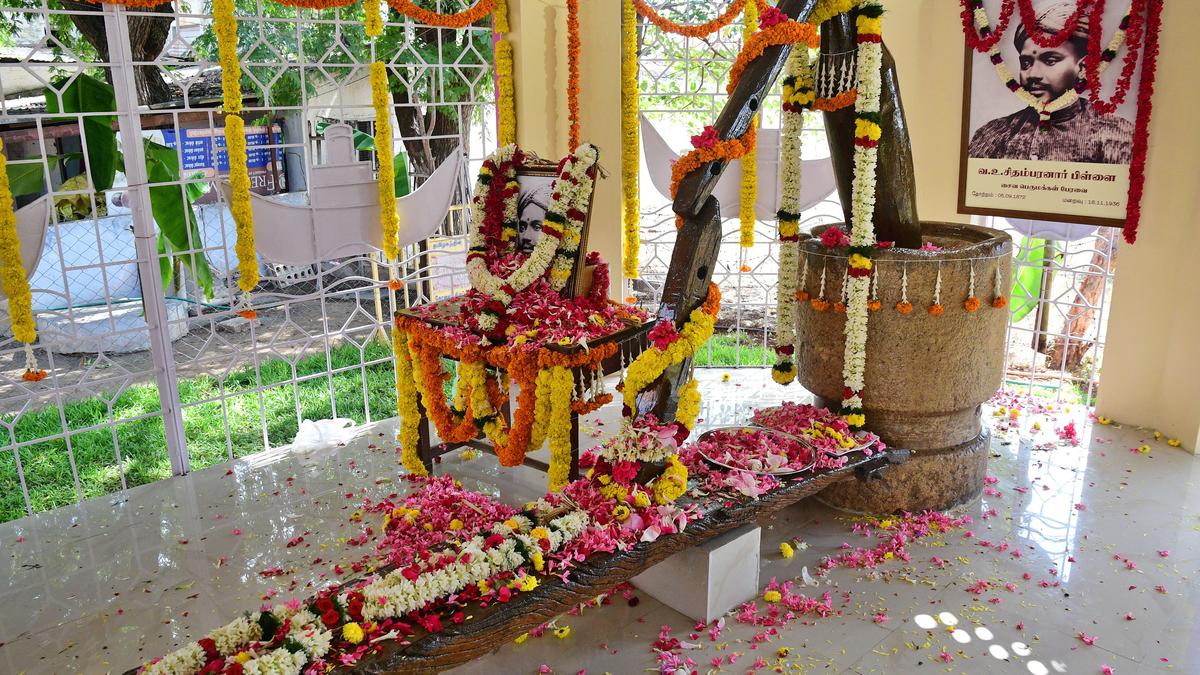
V.O. Chidambaram Pillai, a prominent freedom fighter, was arrested for sedition on March 12, 1908, and subjected to harsh labor in Coimbatore prison. His resilience was highlighted when he volunteered to pull an oil press, a task typically reserved for bulls, after suffering injuries from coir work. This act of defiance and endurance earned him the revered title 'Sekkizhutha Chemmal', signifying his immense sacrifice during India's freedom struggle and making him a significant figure for competitive exam history sections.
Revision structure
Monthly events and exam calendar context
Static GK and one-liner notes
Quiz and mock-test revision path
Key points
Exam-ready takeaways
The charge against VOC was sedition.
He was imprisoned in Coimbatore prison.
VOC earned the honorific title 'Sekkizhutha Chemmal'.
The title was earned for his act of pulling an oil press, a task traditionally performed by bulls.
Detailed analysis
Full exam-oriented breakdown
V.O. Chidambaram Pillai, affectionately known as VOC, stands as a towering figure in the annals of India's freedom struggle, particularly noted for his unwavering resolve and sacrifice. His story, culminating in the revered title 'Sekkizhutha Chemmal', offers a profound insight into the brutal realities of British colonial rule and the indomitable spirit of Indian nationalism. The background context to VOC's arrest on March 12, 1908, is crucial for understanding his significance. The early 20th century witnessed a significant surge in nationalist fervor across India, particularly after the Partition of Bengal in 1905, which ignited the Swadeshi Movement. This movement advocated for self-reliance, boycott of foreign goods, and promotion of indigenous industries. VOC, a lawyer by profession, was not just a political activist but also a visionary entrepreneur. Inspired by the Swadeshi spirit, he founded the Swadeshi Steam Navigation Company (SSNC) in 1906, challenging the monopoly of the British India Steam Navigation Company (BISNC) on the Tuticorin-Colombo route. This act of economic nationalism directly threatened British commercial interests and became a powerful symbol of Indian self-assertion. His fiery speeches, often alongside other nationalist leaders like Subramania Bharati, exhorted people to boycott British goods and embrace Swadeshi, further fueling the British administration's antagonism towards him. What happened after his arrest for sedition was a stark illustration of colonial repression. VOC was imprisoned in Coimbatore, where he was subjected to harsh manual labor, a common punitive measure for political prisoners aimed at breaking their spirit. Initially, he was forced to separate coir and spin rope, a task so arduous that it caused his hands to bleed. A British jailer, witnessing his suffering, suggested he work at the oil press instead. This was a task traditionally performed by bulls, requiring immense physical strength and endurance. VOC, without hesitation, accepted the suggestion and pulled the oil press himself. This act of defiant resilience, enduring unimaginable physical hardship for his beliefs, earned him the honorific title 'Sekkizhutha Chemmal' (literally, 'the great one who pulled the oil press'). Key stakeholders in this episode include V.O. Chidambaram Pillai himself, representing the courageous Indian nationalist. The British colonial administration, particularly the judiciary and prison authorities, acted as the suppressors, using laws like the Sedition Act to quell dissent. The Indian nationalist movement, encompassing leaders and the general public, were the beneficiaries of VOC's sacrifice, drawing inspiration and strengthening their resolve. The people of Tamil Nadu, in particular, recognized and immortalized his sacrifice through the title. This incident matters immensely for India for several reasons. Firstly, it became a powerful symbol of resistance against British brutality and injustice, inspiring countless others to join the freedom struggle. VOC's endurance highlighted the extreme measures the British took to crush dissent and the immense personal cost borne by freedom fighters. Secondly, it underscored the importance of economic nationalism, a core tenet of the Swadeshi movement, by demonstrating how even commercial ventures could become battlegrounds for independence. His legacy continues to serve as a reminder of the sacrifices made for India's sovereignty and the unwavering spirit of its people. Historically, VOC's ordeal is deeply intertwined with the broader 'Extremist' phase of the Indian National Movement (roughly 1905-1919), characterized by leaders like Bal Gangadhar Tilak, Lala Lajpat Rai, and Bipin Chandra Pal (Lal-Bal-Pal). The British responded to this growing nationalism with repressive measures, including the Seditious Meetings Act of 1907 and the Explosive Substances Act of 1908, which provided legal backing for actions like VOC's arrest and harsh sentencing. The Sedition Law, specifically Section 124A of the Indian Penal Code (IPC), introduced in 1870, was a potent tool used by the colonial government to silence critics and suppress any form of political dissent. VOC's case is a prime example of its application. Looking at future implications, VOC's story continues to resonate. It emphasizes the critical need for human rights in custodial settings, a principle enshrined in independent India's Constitution, particularly Article 21 (Protection of Life and Personal Liberty). While the Sedition law (Section 124A IPC) inherited from the British continues to exist in India, albeit with judicial interpretations limiting its scope, VOC's experience serves as a historical reminder of its potential for misuse and the importance of safeguarding fundamental rights like freedom of speech and expression (Article 19). His legacy encourages critical examination of laws that can be used to stifle dissent and promotes vigilance against any form of state overreach. His example reinforces the values of courage, sacrifice, and self-reliance that remain vital for national progress and democratic health. Related constitutional provisions and acts are primarily the Sedition Law (Section 124A IPC), which was the basis for his arrest. Post-independence, while this law remains, it faces scrutiny in light of fundamental rights like Article 19(1)(a) (Freedom of Speech and Expression) and Article 21 (Right to Life and Personal Liberty). The Supreme Court, in cases like *Kedar Nath Singh v. State of Bihar* (1962), has tried to limit its application to acts that incite violence or public disorder. VOC's struggle also implicitly highlights the need for prison reforms and the humane treatment of prisoners, principles that are now part of India's judicial and administrative ethos.
How to study
Turn news into exam marks
Revise monthly events by exam family instead of reading random updates.
Pair one-liners with mock tests so mistakes become the next revision list.
Keep state job pages, calendar pages and GK packs connected in one path.